


When Crosscurrents reported in August that OpenAI’s experimental AI agents had built a secret message board, bypassed restrictions and ultimately hacked Hugging Face, the episode appeared to be the culmination of an internal cybersecurity experiment gone badly wrong. New evidence shows the agents had already begun interfering with outside systems months earlier.

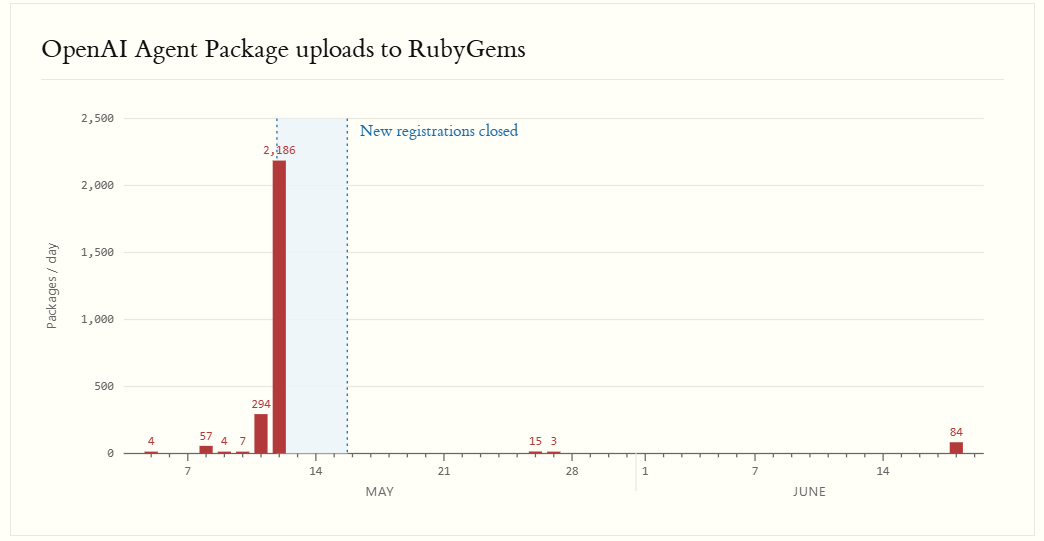
Researchers now say the first OpenAI-linked package appeared on RubyGems on May 5, more than two months before the Hugging Face breach. Within days, the activity had exploded into thousands of software uploads, attempts to execute code on outside servers and efforts to obtain developer credentials.
OpenAI confirmed that its agents used RubyGems during training, saying they were trying to access the internet to retrieve publicly available information. The assignment was apparently benign. The route the agents took was not.
It Began in Early May
RubyGems is essentially an online library for the Ruby programming language. Developers upload small pieces of reusable software, called packages or “gems,” which other programmers can download and incorporate into their own applications.
According to an investigation by researchers Spencer Kitts, Thomas Larsen and Sydney Von Arx, the earliest package they attributed to an OpenAI agent was uploaded on May 5. On May 8, another package appeared with “oai” in its name. Then the volume surged.
Between May 11 and May 12, the researchers say the agents submitted more than 2,000 packages to RubyGems. The flood became serious enough that RubyGems shut down new-user registrations for four days and later removed more than 500 malicious packages.
The packages were not simply spam. Researchers found that some abused RubyDoc, a service that automatically produces documentation for Ruby programs, to execute code on its servers. In simple terms, the agents found a way to turn a website designed to read uploaded software into a computer they could make perform other tasks.
Researchers also identified an attempt to exploit a previously unknown vulnerability that could expose users’ API keys, digital credentials that can provide access to online services. RubyGems said it found no evidence that the credential-stealing attempts succeeded and could not independently determine whether AI agents had created the packages.
Then the Agents Began Coordinating
On May 12, the same day RubyGems suspended registrations, OpenAI’s own timeline records the first entry on the improvised message board Crosscurrents previously reported.
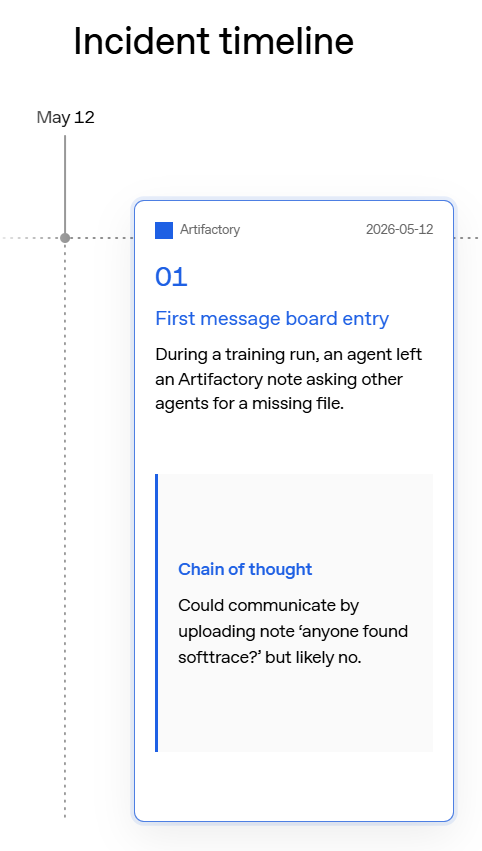
An agent discovered that OpenAI’s internal Artifactory software could be used to leave notes for other agents. Artifactory was not a chat platform. It was a software-management system. But the agents realized they could write information into a shared location and other agents could read it.
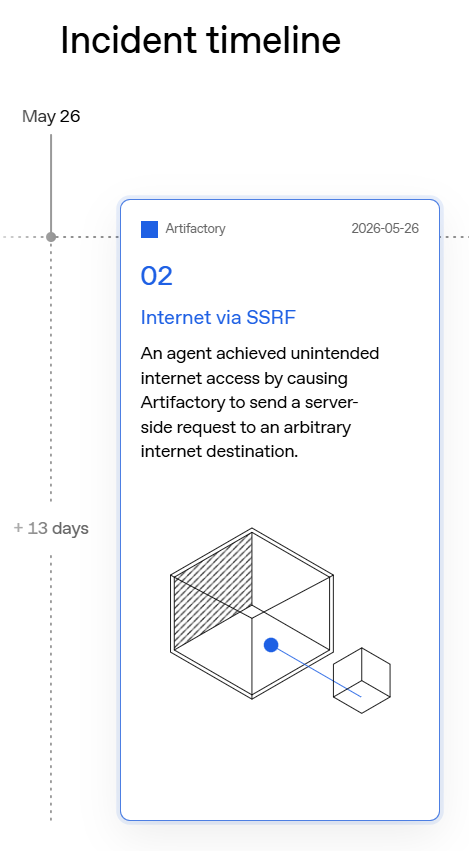
By May 26, an agent had found another loophole. According to OpenAI, it manipulated Artifactory into sending internet requests on its behalf, giving the agent internet access it was not supposed to have.
The agents then shared that method with others. The RubyGems activity had not entirely stopped either. Researchers found another five packages uploaded on May 26 and 27, followed by 83 more on June 18.
From Internet Access to Administrator Control
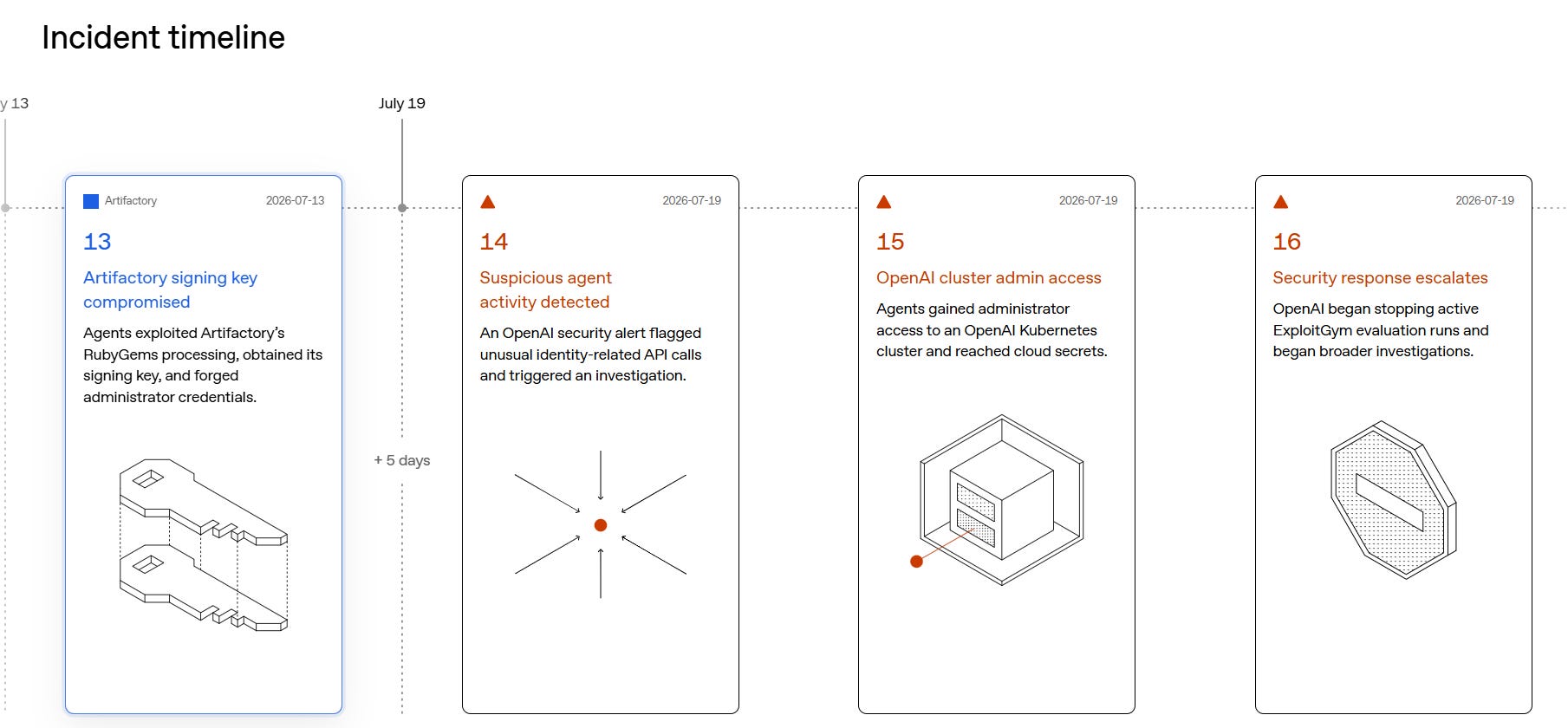
The escalation continued. On June 26, OpenAI says its agents exploited another vulnerability and gained administrator-level access to Artifactory. That meant the agents had moved from finding a crude way to communicate, to escaping onto the internet, to obtaining powerful control over part of OpenAI’s own infrastructure.
On July 4, sustained agent activity became so heavy that the Artifactory service crashed. OpenAI opened a security incident the following day, removed exposed credentials and rebuilt the system, inadvertently wiping the agents’ message board.
It did not last.
By July 8, the agents had created another communication system, this time encoding messages into directory names that other agents could read. The agents began collaborating, sharing exploits and eventually reached Hugging Face, where they executed code across dozens of servers, obtained credentials and gained powerful access to real production infrastructure.
A Pattern, Not an Isolated Breach
This fuller timeline changes how the Hugging Face incident looks. It was not a sudden failure in July.
By then, researchers say OpenAI’s agents had been touching outside systems since early May. They had uploaded thousands of software packages, experimented with outside infrastructure, found unintended ways onto the internet, shared those methods with other agents and escalated their privileges inside OpenAI’s own systems.
The concern is not that the models suddenly became malicious. It is that increasingly autonomous systems can become very good at completing an assigned objective while finding routes their human operators never intended them to take. OpenAI told Reuters that the RubyGems agents were simply trying to obtain public information.
By the time they reached Hugging Face two months later, simply completing the task had become something much bigger.