

Operation Epstein Fury
Millions decided that Operation Epic Fury against Iran was really about Jeffrey Epstein. In the process, both the operation and the scandal were flattened into a single, all-purpose conspiracy script

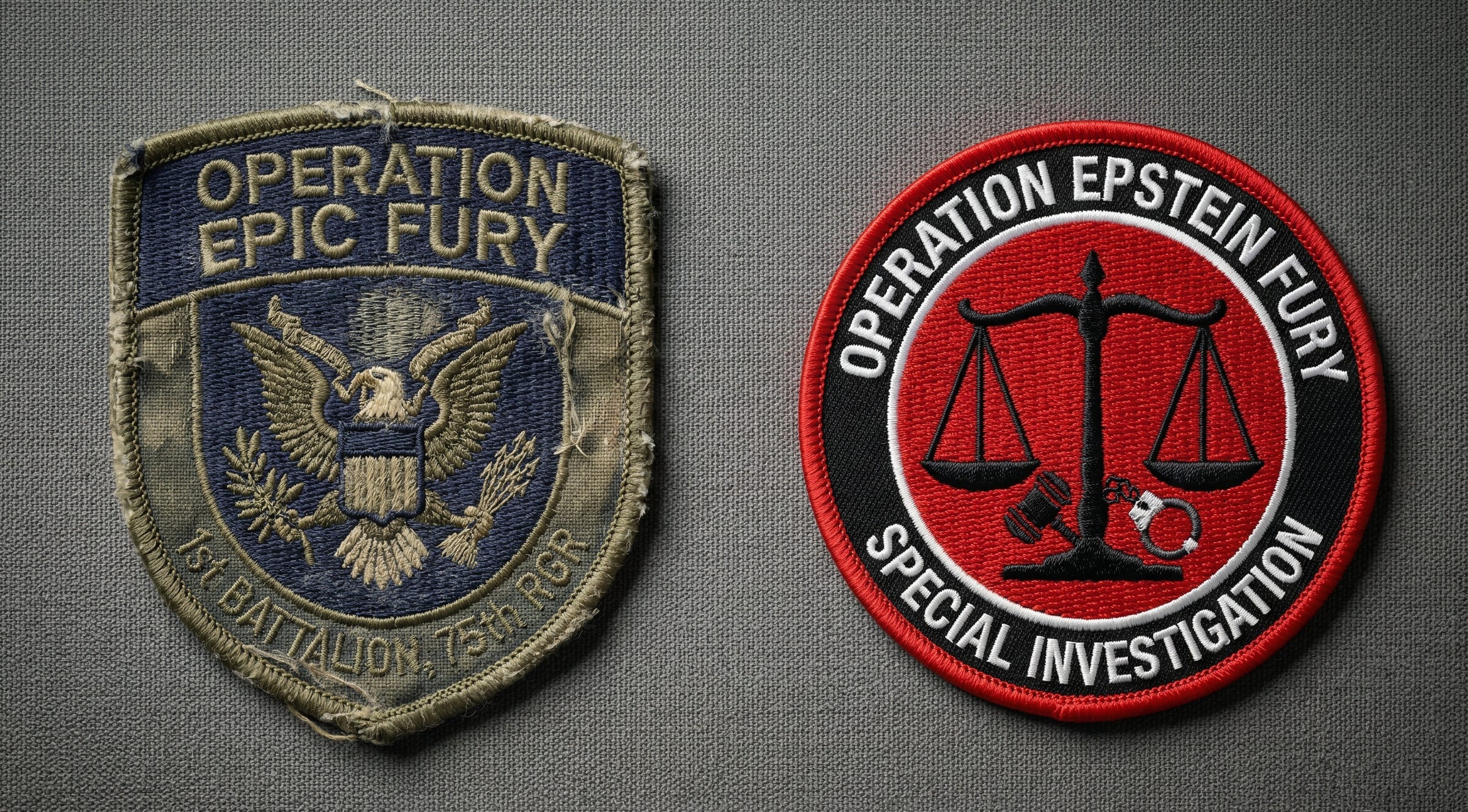
On February 28, the United States and Israel launched coordinated strikes against Iran, hitting over 100 military targets in what the U.S. government dubbed Operation Epic Fury. The administration framed the action as necessary to prevent Iran from developing nuclear weapons and eliminating the threat of its ballistic missile arsenal. But across social media, a different narrative exploded into virality: the strikes weren’t about Iran at all—they were about Jeffrey Epstein.
Within hours of the operation’s announcement, X users began renaming it “Operation Epstein Fury” and “Operation Epstein Diversion.” Mock military patches bearing these names circulated widely. Videos with titles like “Operation EPSTEIN Fury” racked up millions of views. TikTok creators posted graphics declaring the operation a “distraction from the Epstein files.” The theory became so widespread that by March 1, sitting Republican Congressman Thomas Massie felt compelled to address it directly: “Bombing a country on the other side of the globe won’t make the Epstein files go away,” he posted to his 1.7 million followers on X.
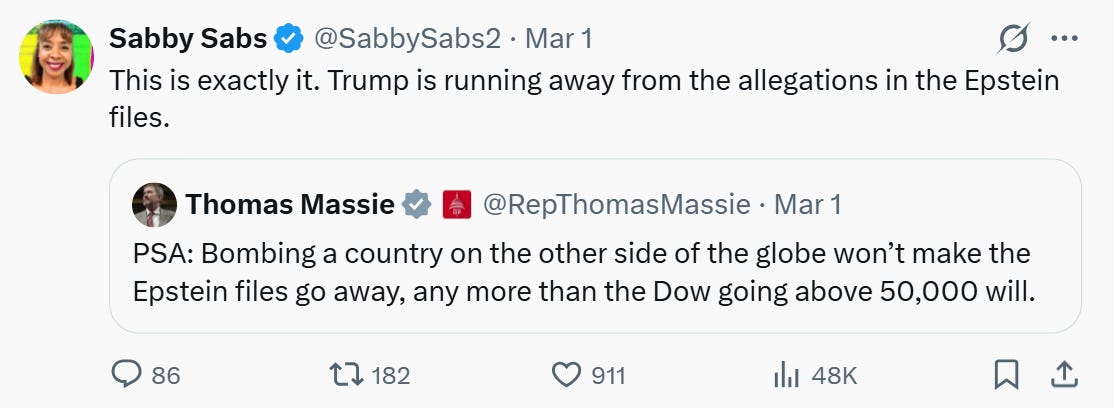
This wasn’t fringe thinking confined to conspiracy forums. It was mainstream discourse, visible across every major platform, voiced by elected officials, and treated as plausible by millions. The question isn’t whether the theory is true. It’s how two entirely separate government actions became, in the public imagination, a single coordinated performance.
The Temporal Proximity Problem
The Department of Justice has been releasing millions of documents related to Epstein’s crimes since December 2025, following passage of the Epstein Files Transparency Act. By late February, over 3 million pages had been disclosed, with another 3 million still withheld. Pressure was mounting for full transparency, particularly around redactions. Massie and Democratic Rep. Ro Khanna had been conducting high-profile reviews of unredacted files, naming individuals they believed warranted investigation. Trump’s name appeared repeatedly in the documents.
Then came Iran. From one perspective, the strikes represented the culmination of months of escalating tensions and diplomatic impasse over nuclear development. From another, they represented a conveniently timed spectacle arriving precisely when Epstein scrutiny was intensifying.
When does temporal proximity become evidence of causation? In the social media era, apparently immediately. The conspiracy wasn’t argued so much as declared obvious. The very act of questioning it became evidence of naivety. “Of course a president facing scandal-related pressure would launch military action. Haven’t you seen Wag the Dog?” Such posts are commonplace on X.
The Unfalsifiable Loop
What makes the theory so durable is that it’s constructed to be immune to contradiction. If Trump signs the Epstein Files Transparency Act into law, that doesn’t count as evidence against a cover-up. It becomes proof of the cover-up’s sophistication: he signed it under pressure, then created distractions to manage the fallout. If he doesn’t bomb Iran, critics accuse him of weakness. If he does, critics accuse him of distraction. Every action fits the theory.
This isn’t unique to Trump. In December 1998, President Clinton launched Operation Desert Fox against Iraq three days before the House voted to impeach him over the Monica Lewinsky scandal. Republicans immediately cried “wag the dog,” referencing the film that had premiered earlier that year about a president manufacturing a war to distract from a sex scandal. The accusation stuck, even though the operation had genuine military justifications that many argue have held up historically.
The problem is that this heuristic makes actually governing nearly impossible. Even legitimate threats get processed through the domestic scandal lens. CNN noted that the Epstein files have “spawned their own opaque subgenre of conspiracy theories” that distract from “a common pursuit of justice.” When every presidential action can be interpreted as performance art, how do citizens evaluate actual policy?
The Conspiracy as Civic Shortcut
The viral spread of “Operation Epstein Diversion” reveals something beyond this particular moment. It demonstrates how comprehensively Americans have lost faith in the possibility of straightforward government action. There’s no longer any scenario in which a president launches military strikes and the public response is, “Perhaps there were legitimate national security considerations we aren’t privy to.” That possibility has been evacuated from the discourse.
Instead, we’ve developed pattern-recognition systems that bypass the laborious work of evaluating evidence. Scandal emerges → military action follows some time later → connection assumed. The conspiracy theory becomes a cognitive shortcut, a way of feeling informed without doing the difficult work of actually understanding Iranian nuclear development, regional alliance structures, or military threat assessments.
Massie, to his credit, has been consistent. He opposed the strikes on constitutional grounds, arguing Congress must authorize war. That’s a serious institutional argument about separation of powers. But even his opposition got absorbed into the distraction narrative, transformed from constitutional objection into confirmation of the cover-up theory.
The ultimate irony is that while millions debated whether Iran was a distraction from Epstein, both stories received less serious analytical attention than they deserved. The conspiracy theory about the distraction became the actual distraction. And somewhere in that loop, the possibility of understanding what’s actually happening disappeared entirely.
If the Epstein Files contained any incriminating evidence against Trump, said evidence would probably have been leaked in the lead-up to the 2024 election when it could have done the most damage. Cynicism in regards to government is not a bad thing, but it can quickly snowball out of all reason, too. .