


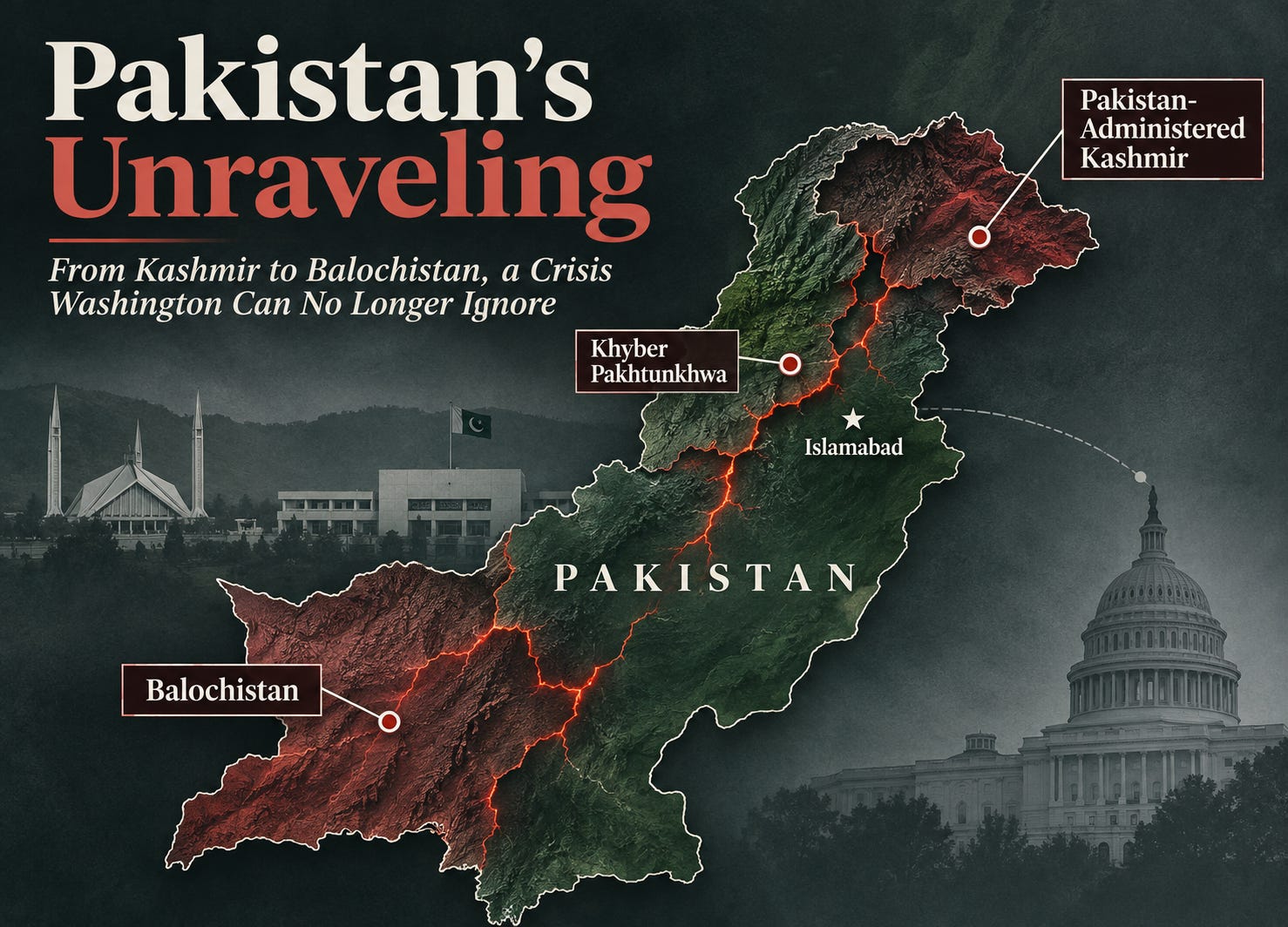
Pakistan has spent decades presenting itself as an indispensable partner in South Asian security. Yet across its own territories, growing unrest is exposing a troubling contradiction: a state increasingly willing to confront its citizens rather than address their grievances.
For the United States, which has invested billions of dollars in Pakistan’s stability since 2001, the implications extend well beyond South Asia. Pakistan is a nuclear-armed country of approximately 255 million people. Its internal instability cannot be treated as a distant domestic dispute. Its economy remains dependent on international financial support, including a $7 billion IMF program approved in 2024. Washington also has legitimate interests in counterterrorism, Afghanistan, nuclear security and China’s expanding regional influence.
For decades, Pakistan has told Washington that Kashmir is the unfinished business of the Indian subcontinent. Today, an altogether different story is unfolding in the part of Kashmir administered by Pakistan. People are taking to the streets not against India, but against the authorities governing them.
And Kashmir is hardly the only trouble spot. Across Balochistan, a decades-old separatist insurgency has intensified alongside protests over enforced disappearances. In Khyber Pakhtunkhwa, the province bordering Afghanistan, demonstrations and an extraordinary federal takeover have deepened a political confrontation. Meanwhile, former Prime Minister Imran Khan, imprisoned since August 2023, is warning that his deteriorating health could cost him his life.
These crises have different histories and different demands. But together they expose a fundamental weakness in Pakistan’s political system: its persistent inability to accommodate dissent without treating it as a security threat.
Kashmir: The revolt Islamabad never anticipated
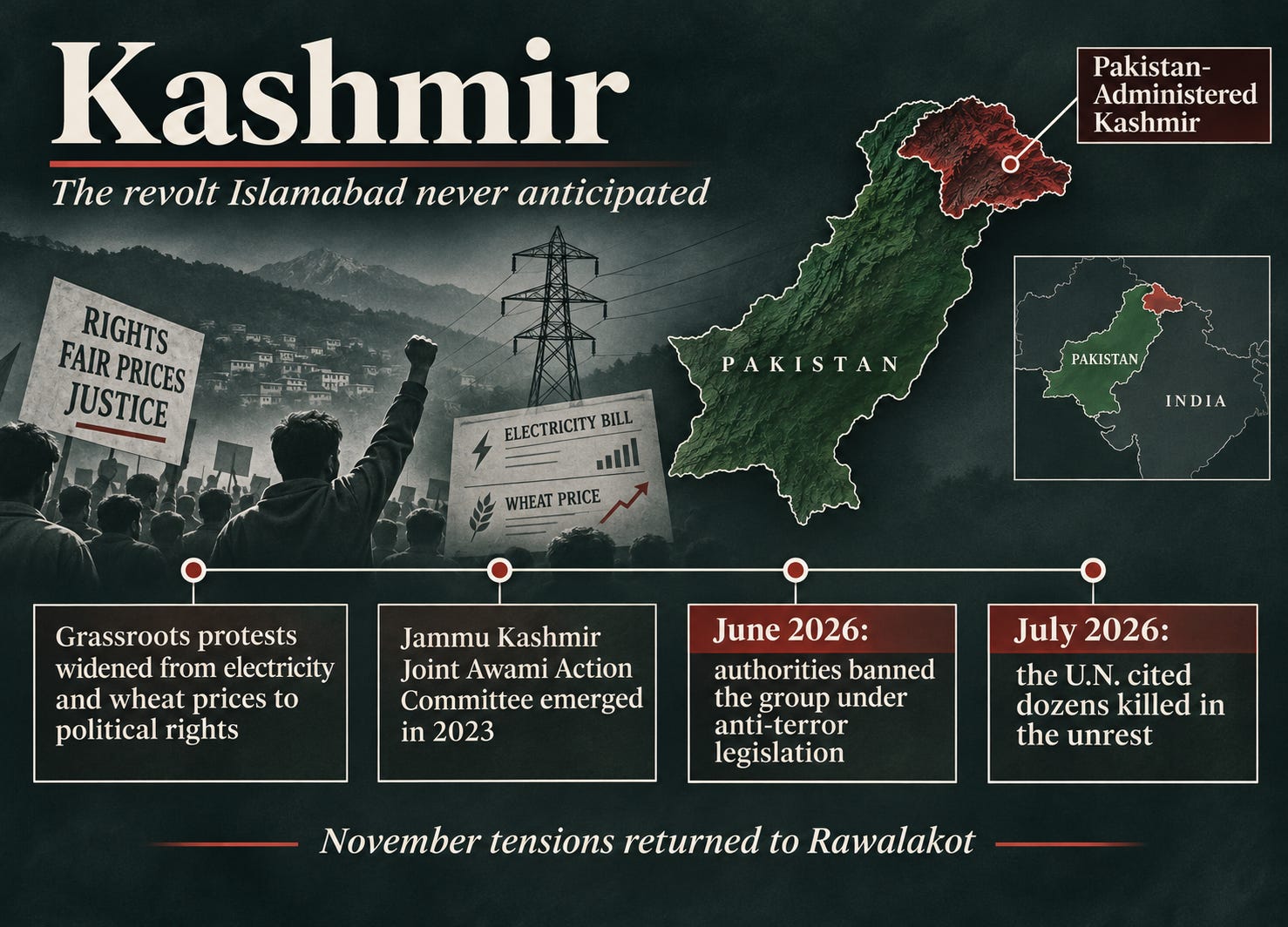
The unrest in Pakistan-occupied Jammu and Kashmir did not begin with demands for independence. It began with electricity bills, flour prices and an increasingly familiar complaint: ordinary people were paying for the privileges of a political elite.
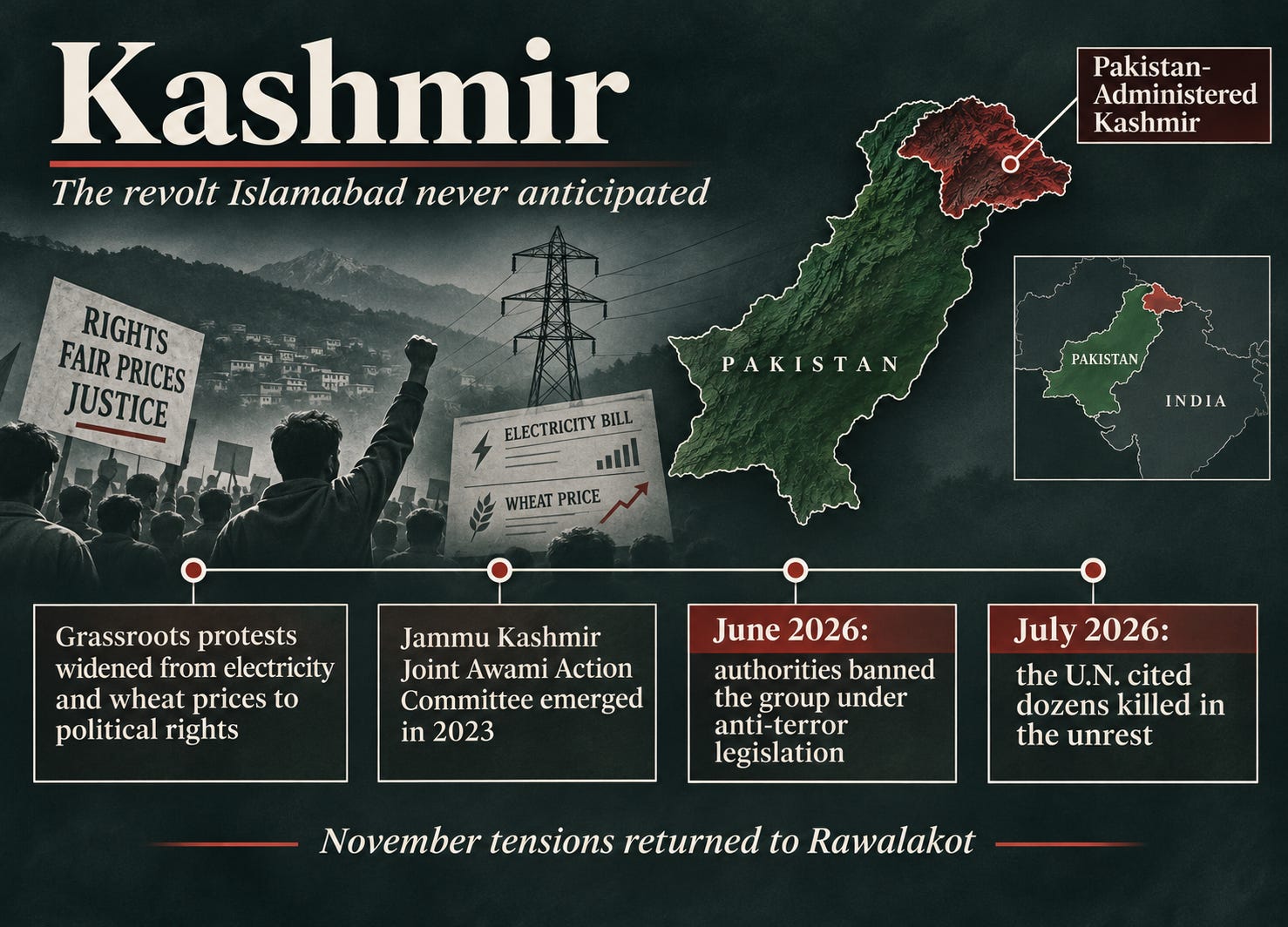
The Jammu Kashmir Joint Awami Action Committee, a grassroots coalition of traders, lawyers, students and civil society activists formed in 2023, emerged as the principal vehicle for public anger. Its demands expanded from affordable electricity and subsidized wheat to electoral representation, accountability and political rights.
In June 2026, authorities banned the organization under anti-terrorism legislation. Protests continued, followed by deadly confrontations, arrests and communications blackouts.
The United Nations human rights chief reported in July that dozens of people, including protesters and security personnel, had been killed in the violence. By November, the confrontation had returned to Rawalakot, where three deaths were independently corroborated by the Jammu Kashmir Human Rights Observatory following a November 5 security operation. Other casualty claims remain disputed.
The political contradiction is difficult to ignore. Islamabad regularly raises the issue of Kashmiri rights internationally, yet struggles to address demands for democratic accountability in territory under its own control.
These protesters are not all advocating the same political future. Many simply want affordable necessities, functioning institutions and an end to intimidation. Their grievances cannot credibly be dismissed as foreign interference.
Balochistan: A rebellion that refuses to disappear
Balochistan presents an even more serious challenge. Pakistan’s largest province by area, rich in minerals and strategically located along the Arabian Sea, has endured successive insurgencies since the country’s early years.
The underlying grievances are hardly mysterious. Baloch nationalists argue that their land supplies resources to the Pakistani state while local communities receive too little of the resulting wealth. Allegations of enforced disappearances, extrajudicial killings and political exclusion have compounded the anger.
The Human Rights Council of Balochistan documented 54 cases of alleged enforced disappearance and 66 killings in its September 2026 report. These figures come from a regional rights organization, rather than an independently verified government census, but they illustrate the scale of the accusations.
The armed insurgency has also become more sophisticated. On January 31, coordinated attacks by the Baloch Liberation Army brought parts of the province to a standstill. Pakistan’s military subsequently reported killing 216 militants during its counteroffensive.
The violence is real, and civilians have suffered from insurgent attacks as well as alleged state abuses. The BLA, which Washington designated a foreign terrorist organization in 2025, must not be confused with peaceful Baloch rights campaigners.
Yet the political crisis continues to widen. On November 19, a province-wide shutdown was observed following a call by political parties and traders protesting deteriorating security, economic hardship and government failures.
For Washington, Balochistan also matters because it contains Gwadar, a major component of China’s Belt and Road infrastructure ambitions. Instability here threatens investments, critical mineral interests and an increasingly contested strategic coastline.
Khyber Pakhtunkhwa: Democracy under emergency rule
Pakistan’s northwest presents another uncomfortable picture.
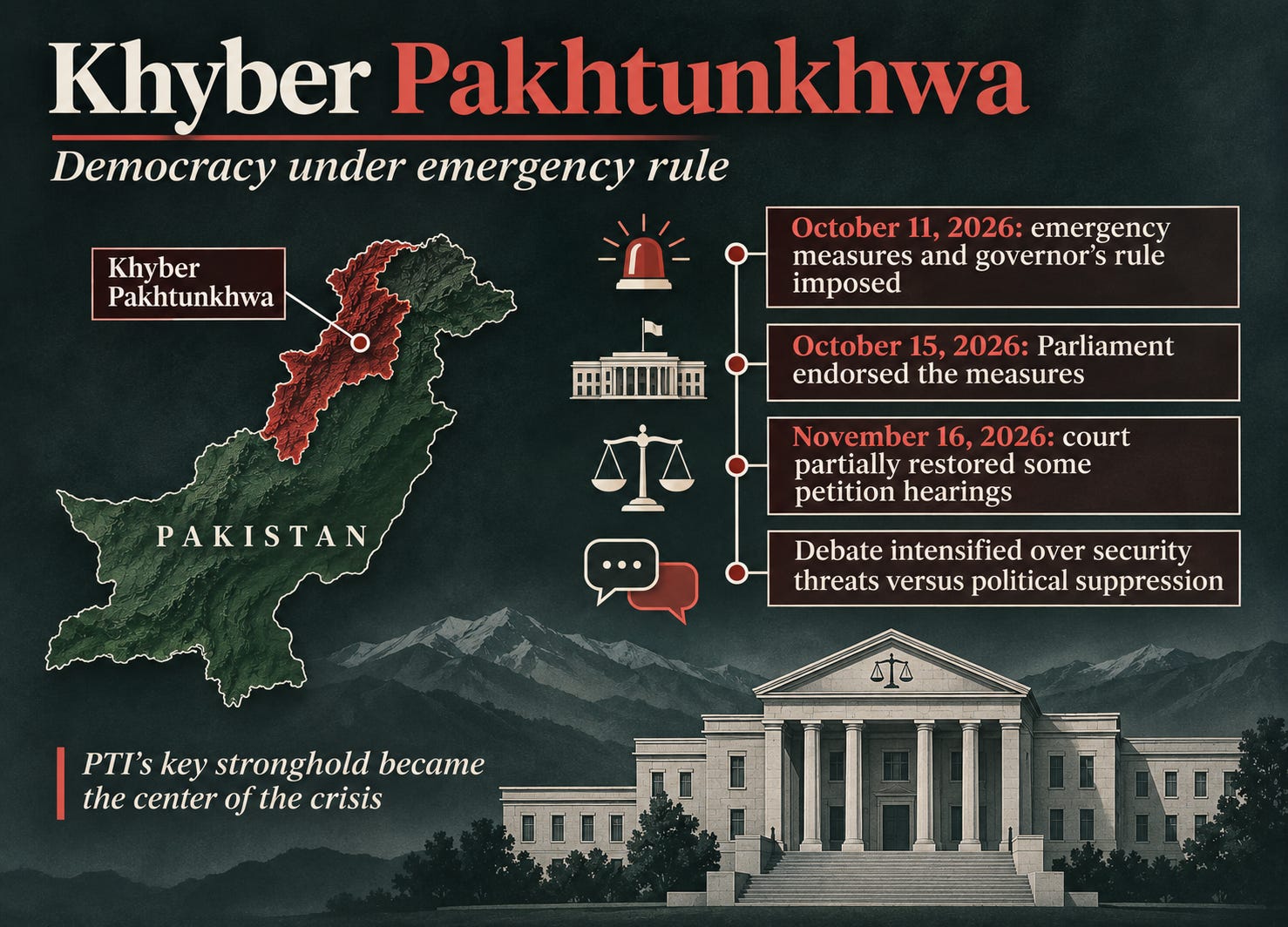
Khyber Pakhtunkhwa, home to a large Pashtun population, has suffered enormously from terrorism and military operations since the American intervention in Afghanistan in 2001. Its residents know the human cost of militancy better than most.
But their latest confrontation with Islamabad is political as well as security-related.
On October 11, President Asif Ali Zardari approved emergency measures and governor’s rule, removing the elected provincial administration controlled by Imran Khan’s Pakistan Tehreek-e-Insaf party.
The federal government cited escalating militant violence and a breakdown in governance. Its opponents saw something else: the elimination of Khan’s most important remaining political stronghold, just as his supporters were mobilizing for his release.
The Pakistani Taliban remains a genuine security threat. But suppressing political opposition is no substitute for confronting militancy. The protests and disputes over governor’s rule have exposed how easily security arguments can become entangled with political survival.
Imran Khan: A prisoner who still dominates politics
Then there is Imran Khan himself.
The former cricket star became prime minister in 2018, only to be removed through a parliamentary no-confidence vote in April 2022. He has been imprisoned since August 2023 and remains one of Pakistan’s most influential political figures.
On November 16, the 74-year-old made an extraordinary appeal to Pakistan’s senior judges.
In a letter delivered through his lawyer, Khan claimed that his blood pressure had reached dangerously high levels and warned that he faced the risk of a brain hemorrhage or cardiac arrest. He also alleged serious damage to his eyesight and said his wife, Bushra Bibi, required urgent eye treatment.
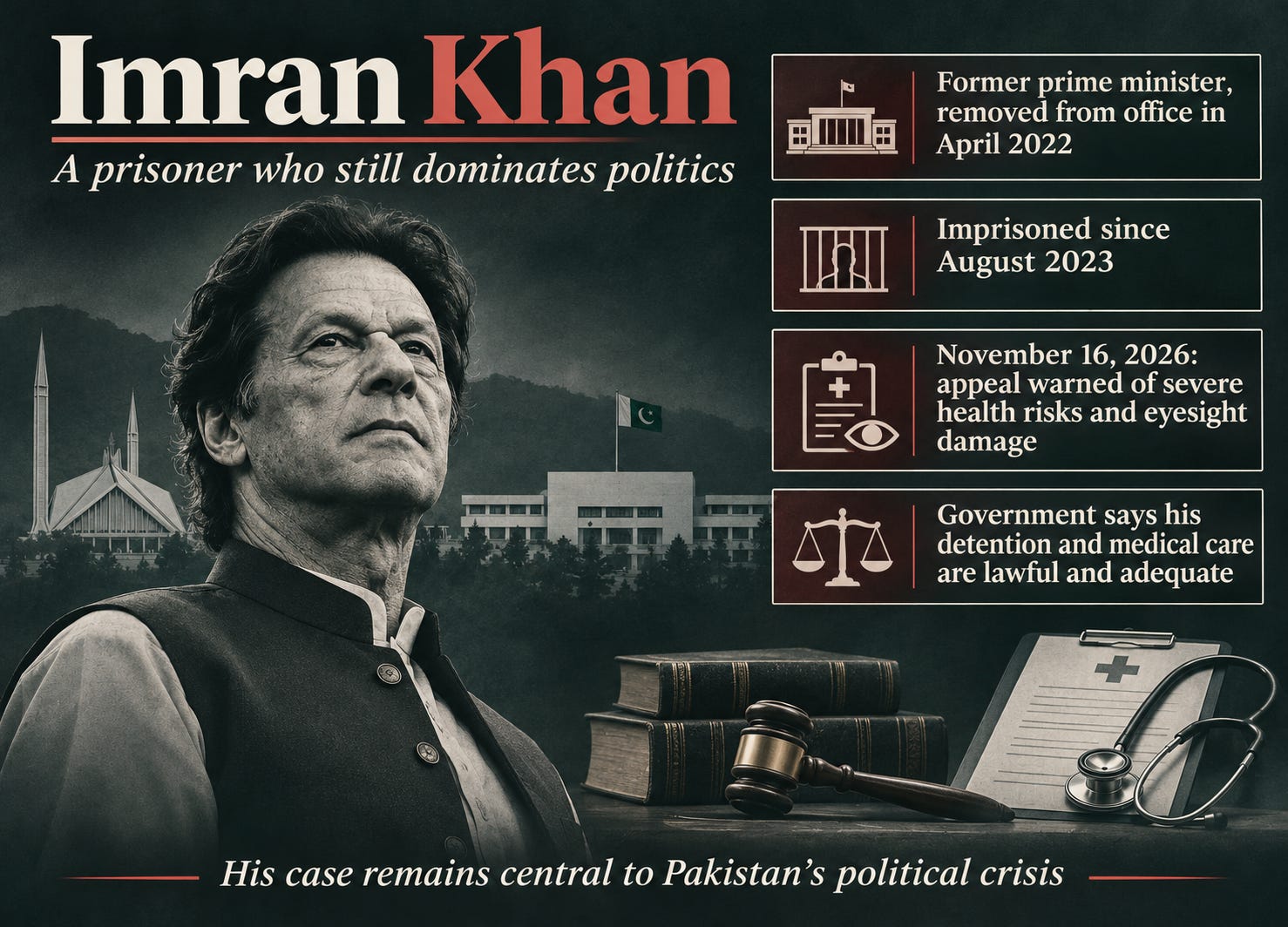
The government disputes his account, insisting that he receives appropriate medical attention and that his detention follows lawful convictions.
Whatever one’s opinion of Khan, a former prime minister pleading publicly for medical treatment is hardly evidence of a confident democracy.
Why Washington should pay attention
None of this means America should encourage separatism or overlook attacks on civilians by armed groups. But neither should strategic cooperation require silence about political repression.
For too long, outsiders have viewed Pakistan primarily through the prism of its military leadership. That approach misses the mounting frustration of ordinary Pakistanis who want representation, accountability and basic dignity.
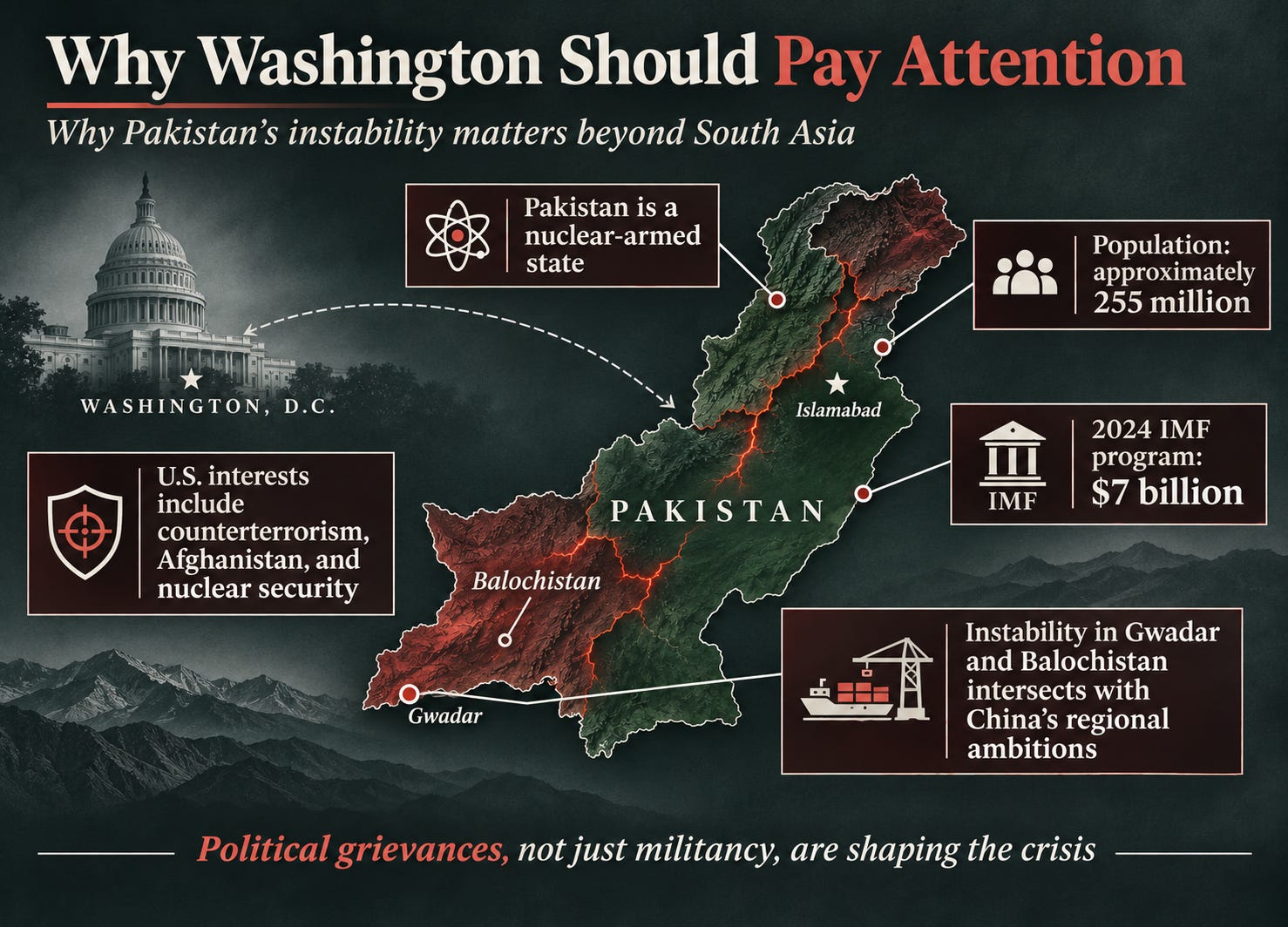
The striking feature of today’s unrest is not that Kashmiris, Baloch nationalists, Pashtun communities and Khan’s supporters share one political agenda. They do not.
It is that so many different constituencies increasingly see the same problem in Islamabad.
Pakistan’s gravest challenge may no longer be an external adversary. It may be the growing distance between those who govern the country and those expected to accept their authority.
And that is a crisis no amount of military power can resolve.
Rishi Suri is the editor and director at The Daily Milap, India’s oldest Urdu newspaper. He has previously served as a Media Advisor to the Chief Minister of Jammu and Kashmir.
The views expressed in this guest op-ed are solely those of the author and do not necessarily reflect the views or editorial positions of Crosscurrents.