


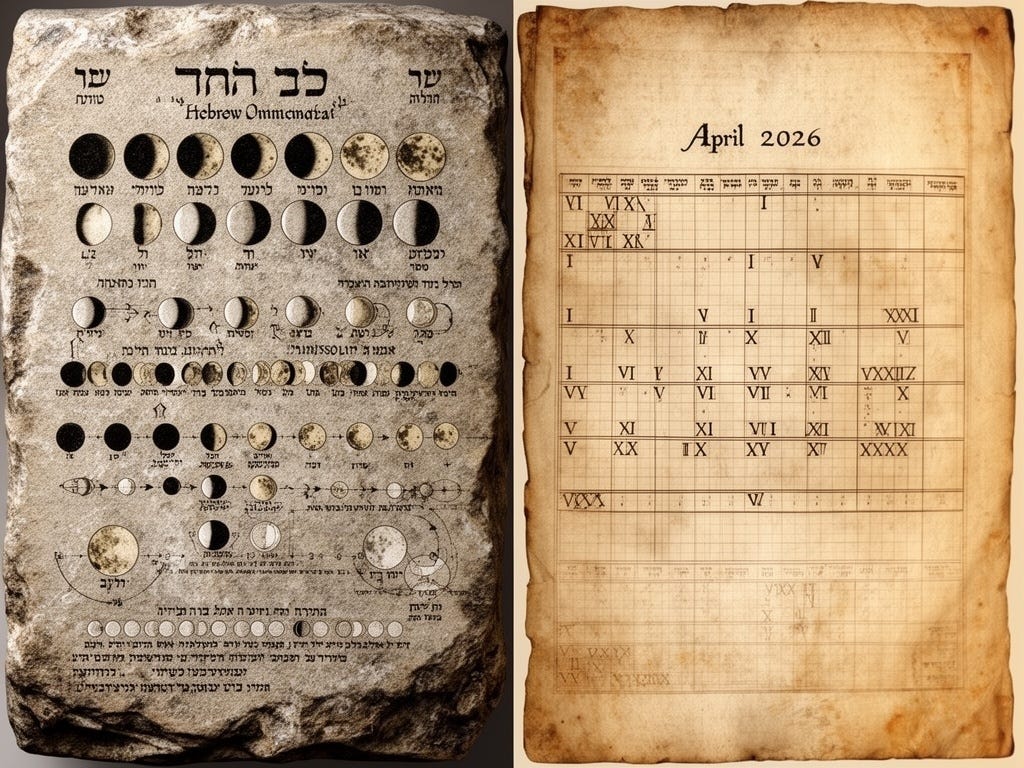
The Passover seder begins tonight at sundown on April 1st. Easter Sunday follows four days later. It’s also April Fools’ Day.
Look back far enough and you’ll find the last time these three converged: 1912, three weeks before the Titanic sailed, when the Ottoman Empire still controlled Jerusalem and the 20th century was young enough to seem promising. Look forward and the next convergence appears in 2103, long after everyone reading this has become a footnote in someone else’s calendar calculations.
What this rare alignment actually reveals is the architecture of separation: one of history’s most consequential engineering projects, designed to pull apart what celestial mechanics keeps trying to reunite. Passover and Easter.
And this year carries an additional weight. Good Friday falls on April 3rd, 2026- the same date scholars believe Jesus was crucified in 33 CE, making this not just a calendrical curiosity but a moment when commemoration and history run in precise parallel, separated by nearly two millennia but aligned in time.
When the Past Arrives on Schedule
Biblical scholars working backward from Roman records and astronomical data have narrowed the crucifixion to either April 3, AD 33 or April 7, AD 30. The stronger case points to April 3- a conclusion built from the documented beginning of Tiberius Caesar’s reign in AD 14, the “fifteenth year” Luke’s Gospel mentions when John the Baptist’s ministry began, and the three Passovers recorded in John that suggest Jesus’s ministry lasted at least three years.
This year, the Gregorian calendar brings that date back around. Good Friday 2026 falls on April 3rd—1,993 years later, potentially the exact anniversary. Palm Sunday through Easter Sunday track the same sequence: Sunday’s triumphal entry, Thursday’s last meal, Friday’s execution, Sunday’s empty tomb. The days of the week align with the events they commemorate, transforming Holy Week from ritual reenactment into something stranger- a moment when the memorial and the memory briefly occupy the same temporal coordinates.
The alignment depends on that AD 33 dating, which remains debated among scholars. But for those who mark these days, the convergence creates an odd resonance: celebrating the crucifixion not just in the season it occurred, but on the date itself, as if history’s echo arrived perfectly on schedule.
Two Systems Chasing the Same Moon And a Forced Separation
Both calendars are hunting the same celestial phenomenon, that first full moon of spring when lambs were traditionally sacrificed and winter finally broke, but they approach it from different directions, using different mathematics, arriving at different conclusions about when the commemoration should occur.
The Jewish calendar runs on lunar months that never quite sync with solar years. Twelve lunar cycles complete in roughly 354 days, leaving the calendar 11 days short of a full trip around the sun. Without correction, Passover would drift backward through the seasons. The solution is intercalation: every few years, an entire extra month appears (Adar II), keeping Passover anchored to spring, always falling on the 15th of Nisan, always beginning at that first full moon after the equinox.
The Christian calendar follows the sun’s annual rhythm but borrows the moon for calculation. Easter comes on the first Sunday after the first full moon on or after March 21st—a formula that sounds straightforward until you realize it’s using a mathematical approximation of the full moon rather than the astronomical one. It’s calendar astronomy, a parallel universe of computation designed to reach roughly the same point in roughly the same season without consulting either Jewish authorities or the night sky.
That separation was deliberate. When Constantine’s Council of Nicaea convened in 325 CE, early Christians were still celebrating the resurrection in direct connection to Passover because that’s when it happened. But as Christianity became the Roman state religion, having Christians appear to follow Jewish timing suggested dependence and meant different Christian communities were celebrating Easter on different dates depending on which Jewish community’s calculations they followed.
Constantine’s letter after Nicaea doesn’t hide the intent: “It seemed most unworthy that in celebrating this most holy festival we should follow the practice of the Jews, who have impiously defiled their hands with enormous sin.” The language is harsh enough that modern readers flinch, but the structural problem was real—how do you maintain connection to the historical moment while severing connection to the people who still marked that moment’s original context?
The solution was computational independence. Christians would track the equinox and full moon themselves, using their own tables, arriving at their own conclusions. Both systems had to honor the historical reality that the resurrection occurred during Passover season, but the Christian calculation would proceed as if the Jewish one didn’t exist. Parallel tracks running through the same stretch of days, occasionally intersecting but never merging, each declaring independence while remaining bound to the same astronomical constraints.
It worked, mostly. Easter drifted away from Passover in timing even as it remained connected in meaning. The separation was complete, or appeared to be, for centuries at a time.
When Engineering Fails
Between 358 CE, when the fixed Jewish calendar achieved its final form, and 783 CE, the two dates coincided 24 times despite all that careful engineering. Then, nothing. For more than 1,200 years the calendars maintained distance, Easter and Passover circling each other at safe remove.
The drift wasn’t intentional—it was a side effect of the Julian calendar’s slight inaccuracy accumulating over centuries, compounded by the eventual Gregorian reform that widened the gap further. Some historians theorized that the Dionysian Easter tables (the refinement of Nicaea’s formula that the Western church still uses) were deliberately constructed to prevent convergence, building in mechanisms to keep the dates apart. The evidence suggests otherwise. The separation was accident, not design, a fortunate side effect of calendrical imprecision.
But imperfection cuts both ways. As the great cycles complete their rotations—the 19-year Metonic cycle governing lunar phases, the solar year’s steady rhythm, the periodic adjustments both systems make to stay aligned with seasons—windows open where convergence becomes possible again. The mathematics that created separation can’t fully prevent reunion. The same astronomical realities govern both calendars, and you can only manipulate the formulas so much before celestial mechanics override human intent.
The convergences are returning. 1981 saw Easter and Passover align. Now 2026. The intervals remain irregular, but the pattern is clear—the walls Constantine built are permeable, and what was separated keeps finding ways to coincide.
What Remains Visible
There’s something archaeological about these moments when the calendars converge. The separation becomes transparent and you can see through to the original structure underneath—that Passover week in Jerusalem when one religious tradition split into two, when a particular seder became the last supper, when the feast of liberation became the context for a crucifixion that would reshape Western civilization.
Constantine complained in his letter that Jews “will celebrate the Feast of Passover a second time in the same year,” referencing that intercalated month that appears periodically to keep the calendar aligned with seasons. He read it as error, evidence of confusion. But it’s actually elegant engineering, the mechanism that keeps Passover anchored to spring rather than drifting through seasons like Islamic holidays do on their purely lunar calendar. It’s sophisticated timekeeping disguised as repetition.
The Christian solution was different but equally sophisticated: anchor to a solar calendar, borrow the moon for calculation, mandate Sunday to ensure the resurrection is always celebrated on the day it reportedly occurred. It works mathematically. It achieves independence. But it can’t escape its origins.
Every time these calendars converge, the relationship becomes visible again—not the theological disputes or historical wounds, but the simple structural fact that Easter exists because Passover existed first. The commemoration of resurrection is permanently embedded in the architecture of liberation, even when calendar engineers try to separate them. They’re marking different moments in the same week of the same year, observing them through different lenses, but the connection persists underneath the computational independence.
This year, that connection is unusually obvious. Families gather for seders on April 1st while Christians enter Holy Week. Good Friday falls on April 3rd- perhaps the exact date Jesus died nearly two millennia ago. The same spring moon governs both observances. And for the first time in 114 years, it all unfolds on a day that history designated, entirely by accident, for foolishness and deception.
The next collision arrives in 2103. By then, perhaps the discomfort will have transformed into something else, or intensified, or faded into the background noise of a world that has moved on to different concerns. But the calendars will keep cycling, separation will keep failing, and the convergences will keep revealing what Constantine tried to obscure: these traditions remain cosmically entangled, tracking the same celestial events from different angles, unable to fully escape their shared origins no matter how carefully the mathematics are engineered to keep them apart.