


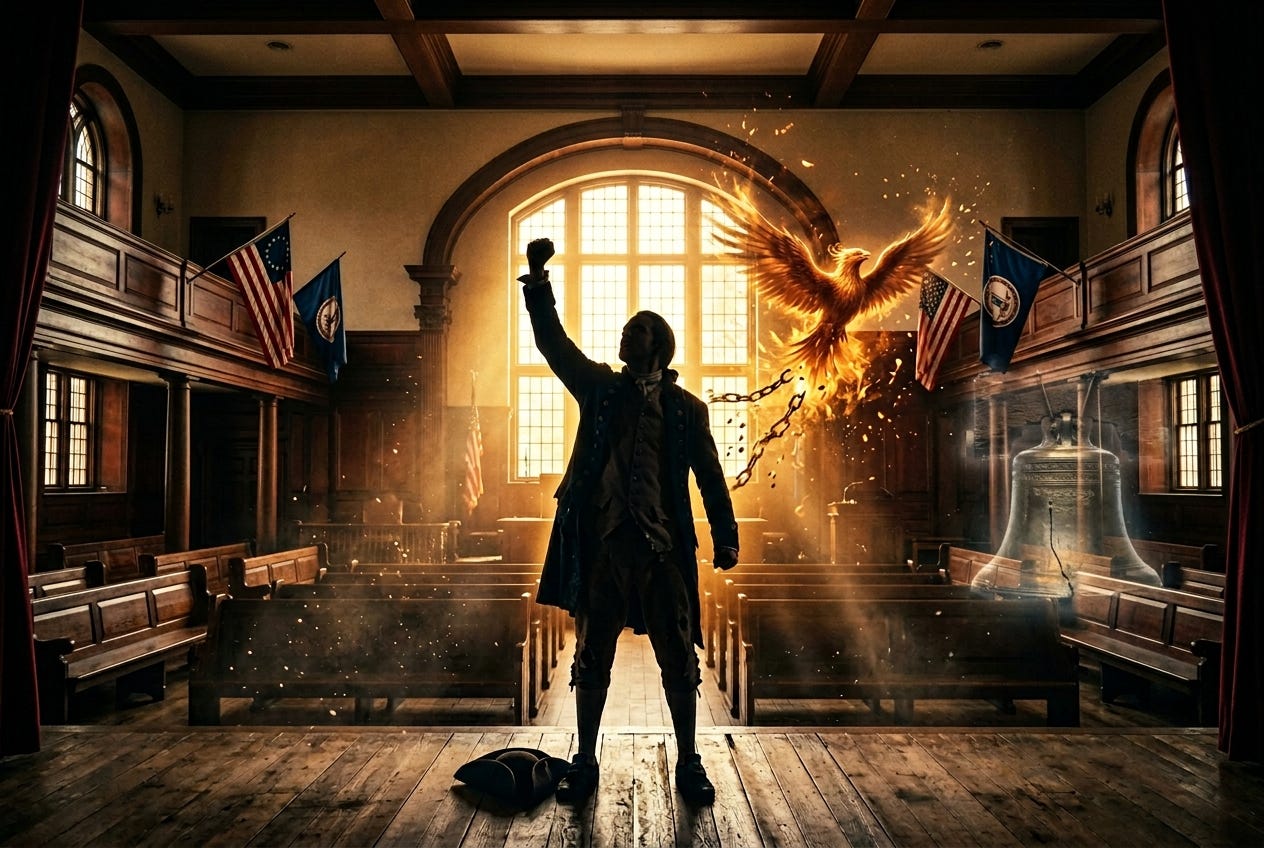
On this day in 1775, Patrick Henry stood in St. John’s Church in Richmond and delivered the most famous ultimatum in American history. While the phrase “Give me liberty, or give me death” is remembered for its passion, its true function was to collapse a political middle ground that had become logistically and institutionally untenable.
At the second Virginia Convention, the delegates were paralyzed by a fundamental disagreement over the nature of reality. One faction sought to continue diplomatic reconciliation, viewing the rising tensions as a series of misunderstandings that could be managed through further petition. Henry’s oratory sought to galvanize the delegates by arguing that the oppressive actions of the British government—specifically the physical arrival of fleets and armies—left no room for hope in reconciliation.
Henry wasn’t just making a moral argument; he was pointing to a physical shift in incentives. He argued that when an adversary has already transitioned to a posture of force, “hope” is no longer a policy; it is a delay that grants the opponent a tactical advantage. The undercovered detail here is the Virginia Militia. Henry’s resolution was a formal proposal to arm the colony, forcing the convention to stop debating abstract rights and start managing the concrete logistical constraints of a closing window for action.
This highlights a recurring mechanism in institutional realism: the moment when the pursuit of peace transitions from a virtuous goal into a failure to recognize that an adversary has already changed the rules of the game. Henry understood that if one side is preparing for conflict while the other is committed to diplomacy at any cost, the latter is not “keeping the peace.” Instead, they are witnessing the erosion of foundational assumptions—the very norms and minority protections that constitute a civilizational achievement—in favor of managed subjugation.
When the meaning vacuum of a decaying status quo is filled by an adversary’s mobilization, the survival of a self-governing society depends on its ability to see the map as it is, not as they wish it to be. His speech served as the catalyst that shifted Virginia from a state of deliberation to a state of mobilization just four weeks before the “shot heard ‘round the world” at Lexington and Concord.
You point out something that many ivory tower intellectuals often fail to realize: our perceptions of the other side are irrelevant when compared to their intentions. Even if we don't see the other side as an enemy ('we need to just understand them better') that doesn't change their intent to destroy us if they so desire one bit. At a much more benign level, we may think we're qualified for a job, but the hiring manager's opinion is the only one that matters.