


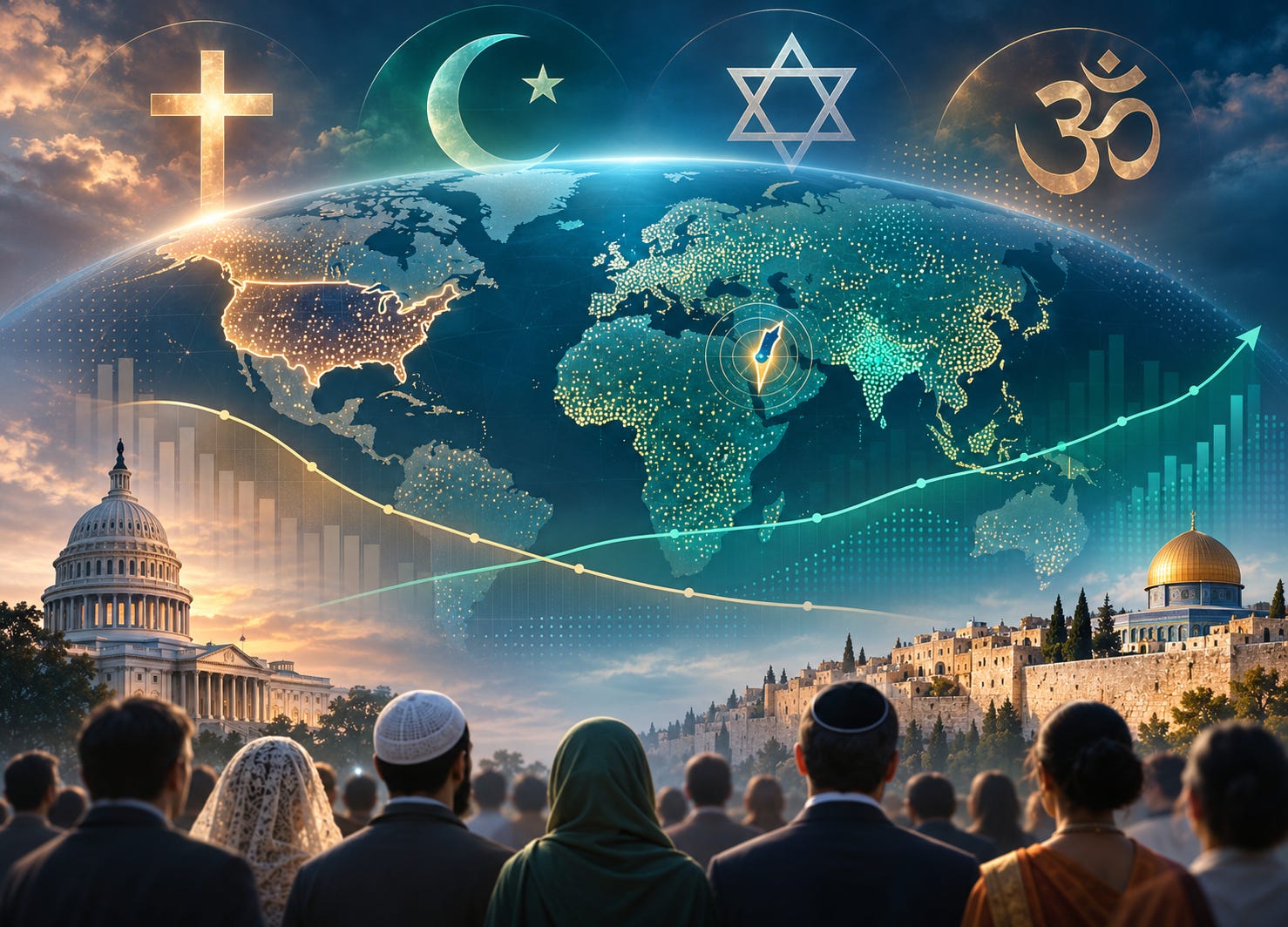
The United States is projected to lose its Christian majority by 2065, while Islam is expected to overtake Christianity as the world’s largest religion by 2035, according to a sweeping new demographic study published Wednesday by the Pew Research Center.
The report, The Future of World Religions: Population Growth Projections, 2020–2070, examines the expected religious composition of 201 countries and territories over the next five decades. Its findings suggest major changes in the distribution of Christianity, Islam, Judaism and other religions, driven by differences in fertility rates, aging populations, migration and religious affiliation.
Among the most striking findings is a divergence between the United States and the world as a whole. While America is projected to become substantially less Christian and more religiously unaffiliated, the global proportion of people identifying with a religion is expected to increase.
The study also forecasts a decline in the number of Americans identifying with Judaism as their religion, the growth of Muslim and Hindu populations in the United States, and an unprecedented concentration of the world’s Christians in sub-Saharan Africa.
America’s Christian Majority Is Projected to End by 2065
Christianity has historically been the dominant religion in the United States, but Pew’s projections suggest that its majority status will disappear within four decades. Christians represented approximately 64% of the American population in 2020, totaling around 217 million people. By 2070, Pew projects that their share will fall to 48%, or approximately 174 million people.
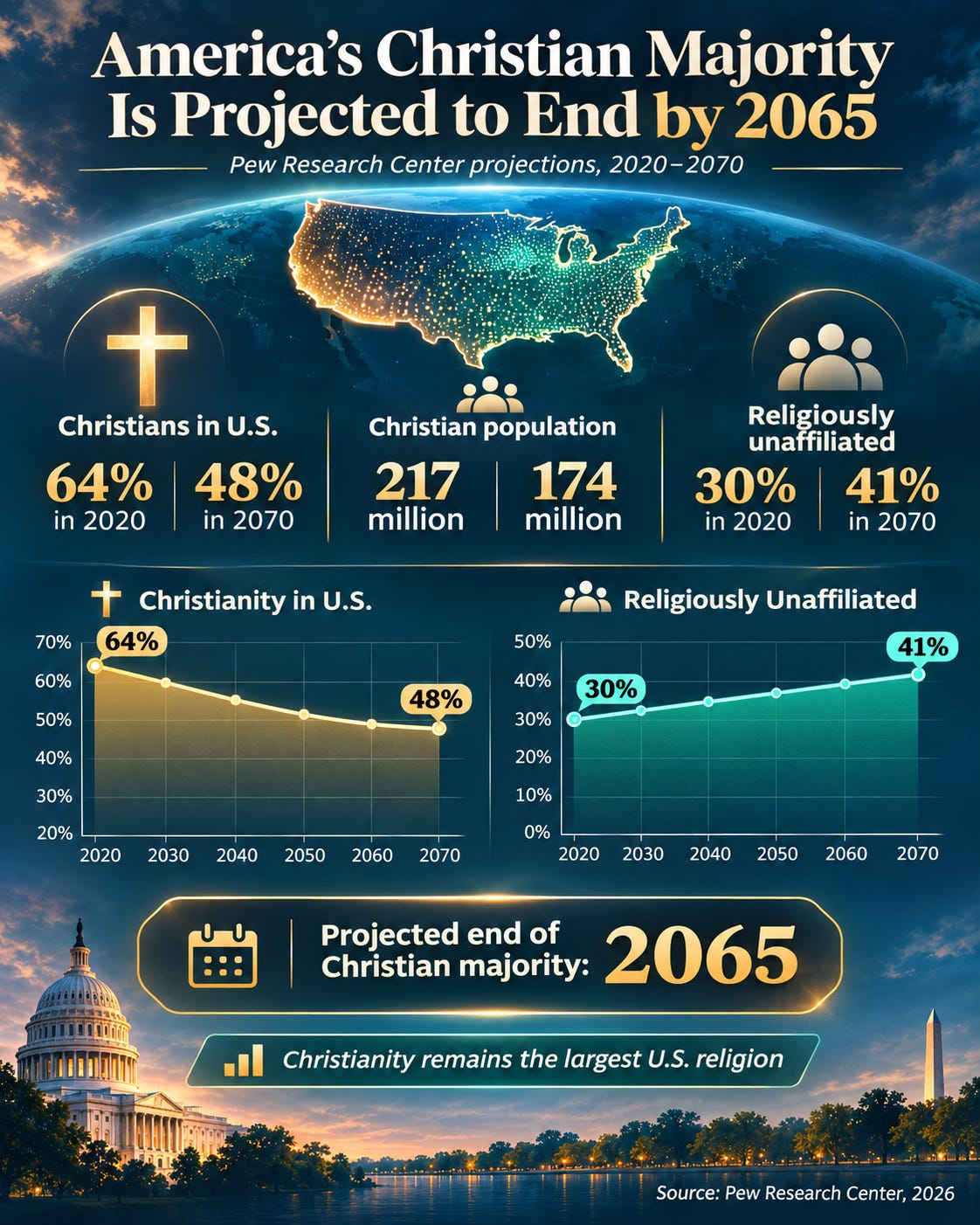
That represents a decline of 43 million Christians, the largest projected numerical loss of any country studied. Meanwhile, Americans identifying with no religion are expected to increase from approximately 30% of the population in 2020 to 41% in 2070. This category includes atheists, agnostics and people who identify with no particular religion.
Christianity would remain the country’s largest religious group, but it would no longer command a majority. According to Pew’s North American projections, the transition is expected to occur around 2065. Canada is projected to lose its Christian majority considerably earlier, by 2030.
One of the principal drivers is religious switching, particularly Americans who were raised Christian but no longer identify with the faith as adults.
However, the decline is not entirely attributable to people abandoning Christianity. Even under a hypothetical scenario in which all religious switching stopped, Pew estimates that Christians would fall to 58% of the U.S. population by 2070, six percentage points below their 2020 share.
The remaining decline reflects demographic factors, including Christians’ relatively older age profile and low fertility rates. The projections come despite evidence that the long-running decline in Christian identification among American adults has recently stabilized. Pew’s 2025 Religious Landscape Study found that 62% of U.S. adults identified as Christian in 2023–2024, with the figure remaining between 60% and 64% in surveys conducted since 2019.
That stabilization contrasts with the longer-term decline from 78% in 2007. It also highlights the uncertainty surrounding projections extending half a century into the future. Pew’s latest model assumes that recently observed patterns of religious switching will continue, even though the rate of change in American religious identification has slowed.
America’s Jewish Population Is Projected to Shrink
The study also forecasts significant changes in the relative sizes of America’s minority religious communities. According to Pew’s Jewish projections, the number of Americans identifying with Judaism as their religion is expected to decline from approximately 5.7 million in 2020 to 4.5 million in 2070.
Their share of the American population would fall from 1.7% to approximately 1.2%. The decline is attributed primarily to demographic characteristics. Jewish Americans have a relatively high median age and an estimated fertility rate of 1.5 children per woman during 2020–2025, below the replacement level generally associated with stable populations.
Pew projects that deaths will exceed births among American Jews over the coming decades, producing a natural population decrease that migration and religious switching will not fully offset. At the same time, other minority religions are expected to expand.
America’s Muslim population is projected to grow by approximately 9 million people, increasing from 1.2% of the population in 2020 to 3.7% in 2070. The Hindu population is expected to more than double, rising from approximately 3 million to 7.4 million. By 2070, the United States is projected to have the world’s fifth-largest Hindu population.
As a result, Pew forecasts that both Muslims and Hindus will outnumber Americans identifying with Judaism by 2070. Jews ranked as the country’s third-largest religious group in 2020.
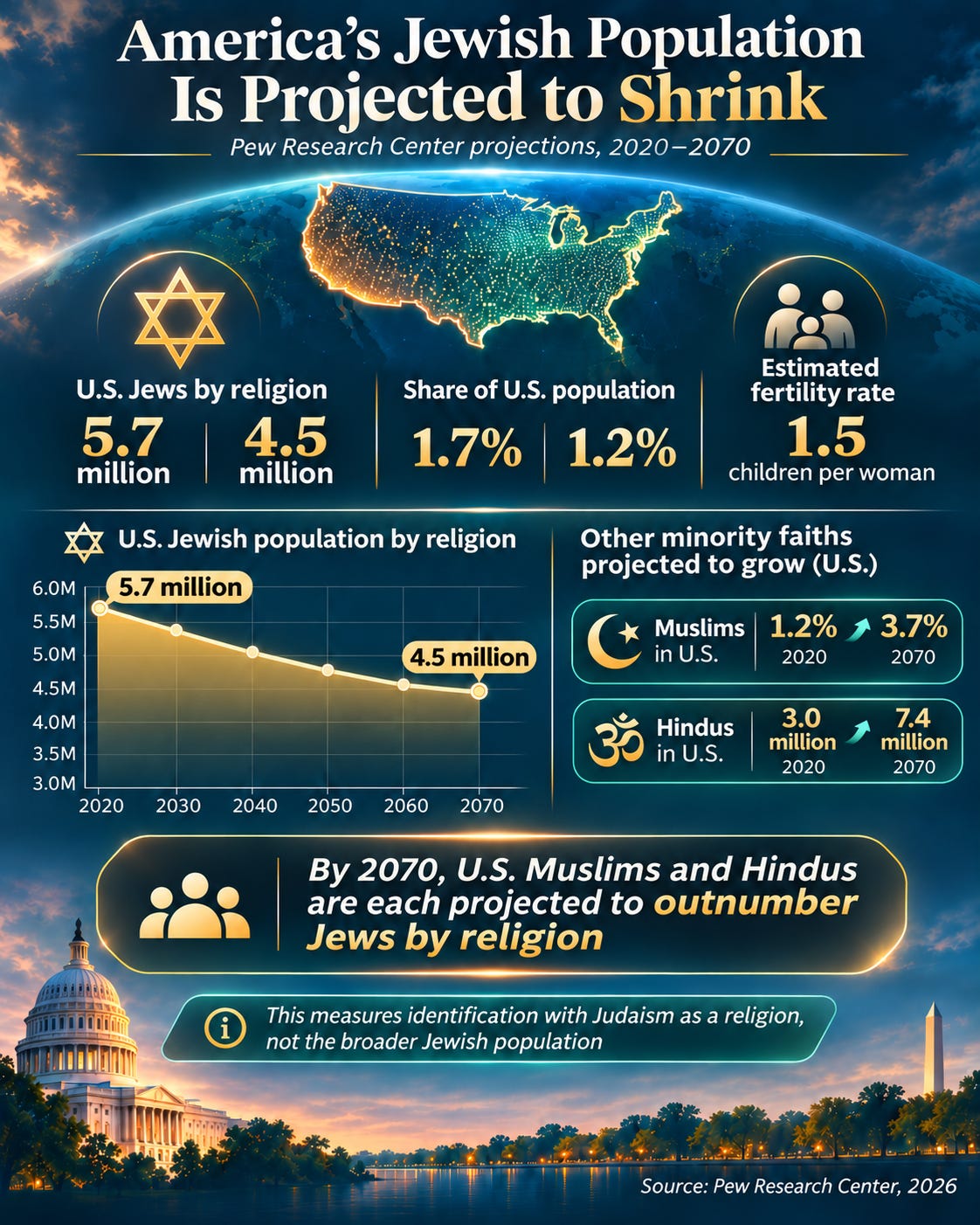
An important distinction concerns how the study defines Jewish identity. Its American figures measure identification with Judaism as a religion, excluding people who identify as Jewish ethnically, culturally or through family background but not religiously. Those identifying as Jewish without a religion are counted among the religiously unaffiliated.
Islam Is Projected to Become the World’s Largest Religion
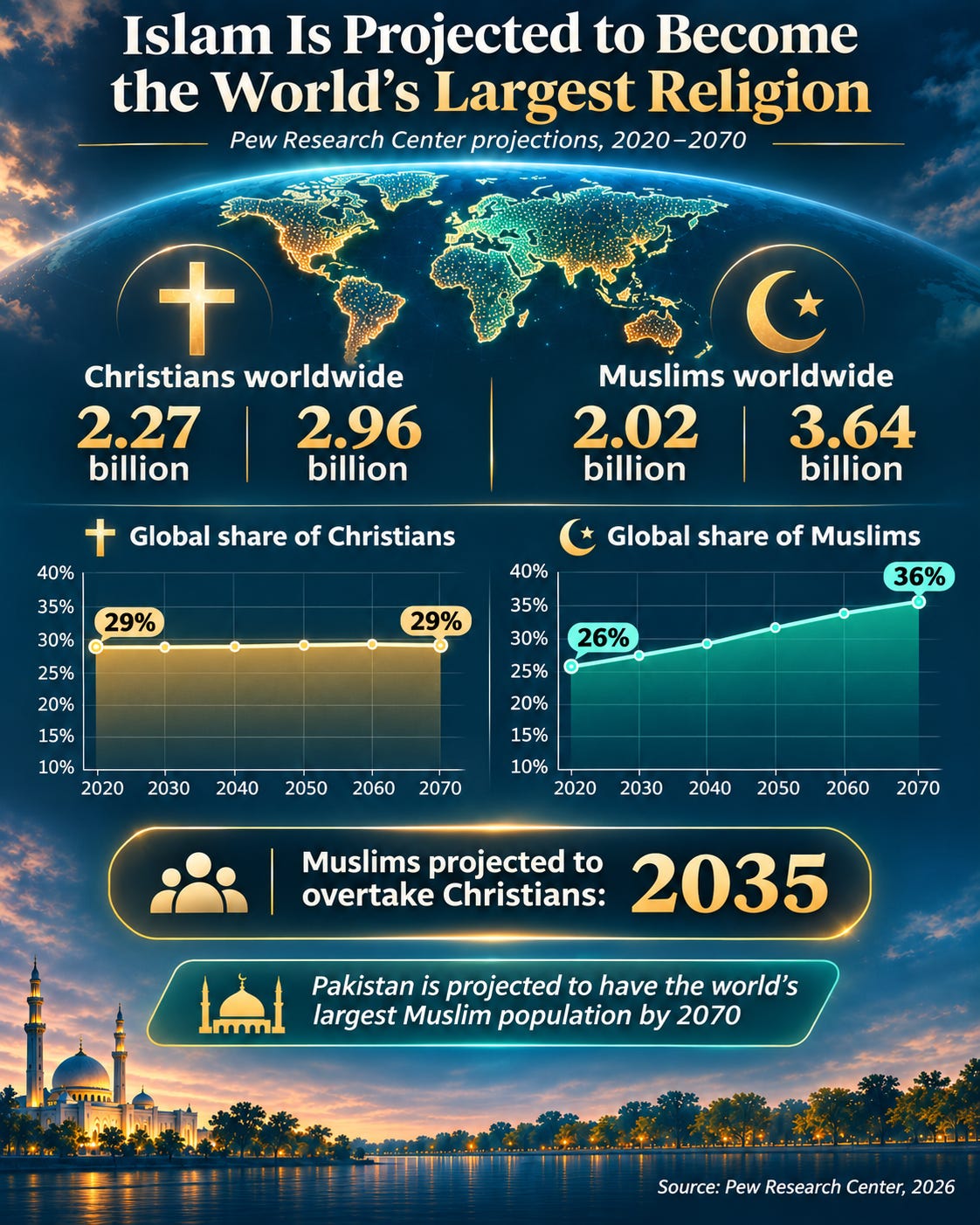
Beyond the United States, Pew’s most consequential finding concerns the changing balance between Christianity and Islam. In 2020, Christians numbered approximately 2.27 billion worldwide, compared with 2.02 billion Muslims.
By 2035, Muslims are projected to overtake Christians as the world’s largest religious group. By 2070, the Muslim population is expected to reach 3.64 billion, compared with approximately 2.96 billion Christians.
Muslims would account for nearly 36% of the global population, up from approximately 26% in 2020. Christianity’s share would remain relatively stable at around 29%, even as its absolute population increases.
The shift reflects faster Muslim population growth rather than a worldwide decline in Christian numbers. Pakistan is projected to replace Indonesia as the country with the largest Muslim population, reaching approximately 461 million by 2070.
Christianity, meanwhile, is expected to undergo a dramatic geographic transformation. In 2020, approximately 31% of the world’s Christians lived in sub-Saharan Africa. By 2070, that share is projected to reach 54%.
The Democratic Republic of the Congo is expected to surpass the United States as the country with the largest Christian population, growing from approximately 92 million Christians in 2020 to 299 million in 2070.
Europe is expected to move in the opposite direction. Its Christian share is projected to decline from 67% to 52%, while its Muslim share increases from 6% to approximately 13%.
Other major religions will follow different trajectories. Hindus are expected to grow from approximately 1.18 billion to 1.38 billion worldwide, although their percentage of the global population will decline slightly. Buddhists are projected to decrease from approximately 324 million to 250 million.
A Growing Global Jewish Population, Increasingly Concentrated in Israel
While the number of American Jews identifying with Judaism is projected to decline, the global Jewish population is expected to increase from approximately 15 million in 2020 to 18 million in 2070. That growth will be concentrated overwhelmingly in Israel.
Pew projects that Israel’s Jewish population will rise from approximately 6.8 million to 11.1 million over the period, reflecting a younger population and higher fertility rates. The proportion of the world’s Jews living in Israel is expected to climb from 46% to approximately 62%.
By contrast, America’s share of the global Jewish population is projected to fall from 39% to 26%. The figures suggest a major redistribution of world Jewry, with Israel becoming increasingly dominant demographically even as Jewish communities in North America and Europe experience stagnation or decline.
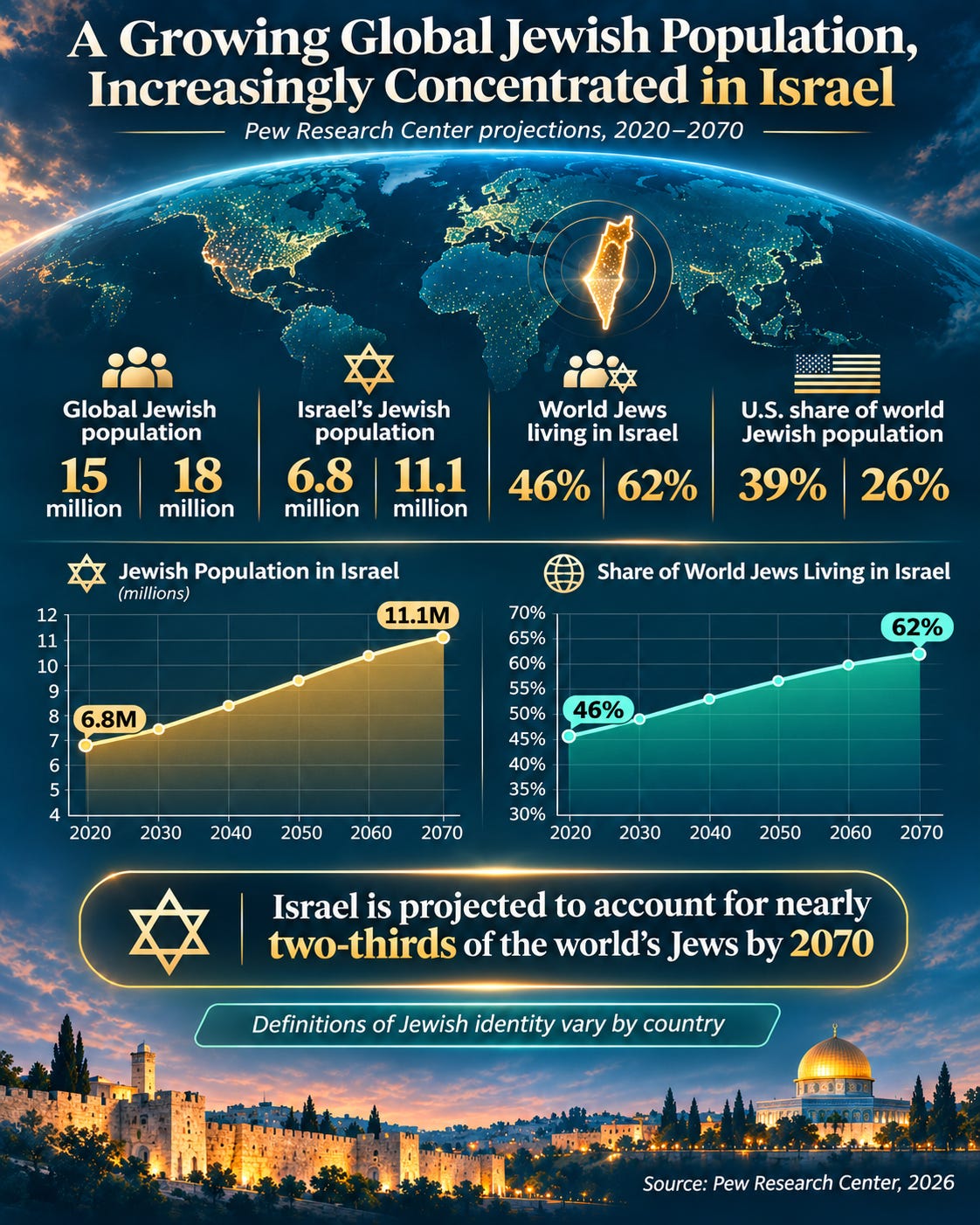
However, the study uses different underlying measures of Jewish identity across countries. In the United States, its figures count people who identify with Judaism as their religion. In Israel, Pew relies on the Interior Ministry’s population register, which classifies Jews according to religious legal criteria based on descent or recognized conversion. For many other countries, the researchers use estimates of the core Jewish population that can also include people who identify as Jewish culturally or ethnically without professing a religion.
These differences mean the international totals are not based on a perfectly uniform definition of Jewish identity, an important qualification when comparing the projected populations of Israel, the United States and other countries.
Religious Affiliation Is Projected to Rise Worldwide, Even as America Secularizes
Perhaps the most counterintuitive finding is that religious non-affiliation is projected to decline globally despite its expansion across much of the developed world. In 2020, approximately 24% of the world’s population identified with no religion. By 2070, Pew expects that proportion to fall to 17%.
The number of religiously unaffiliated people is projected to decrease by approximately 181 million worldwide, even though their populations are expected to grow in 141 countries and territories. The explanation lies largely in China.
China is home to approximately 1.3 billion religiously unaffiliated people, the world’s largest such population. Its broader demographic contraction is expected to reduce that figure to approximately 917 million by 2070.
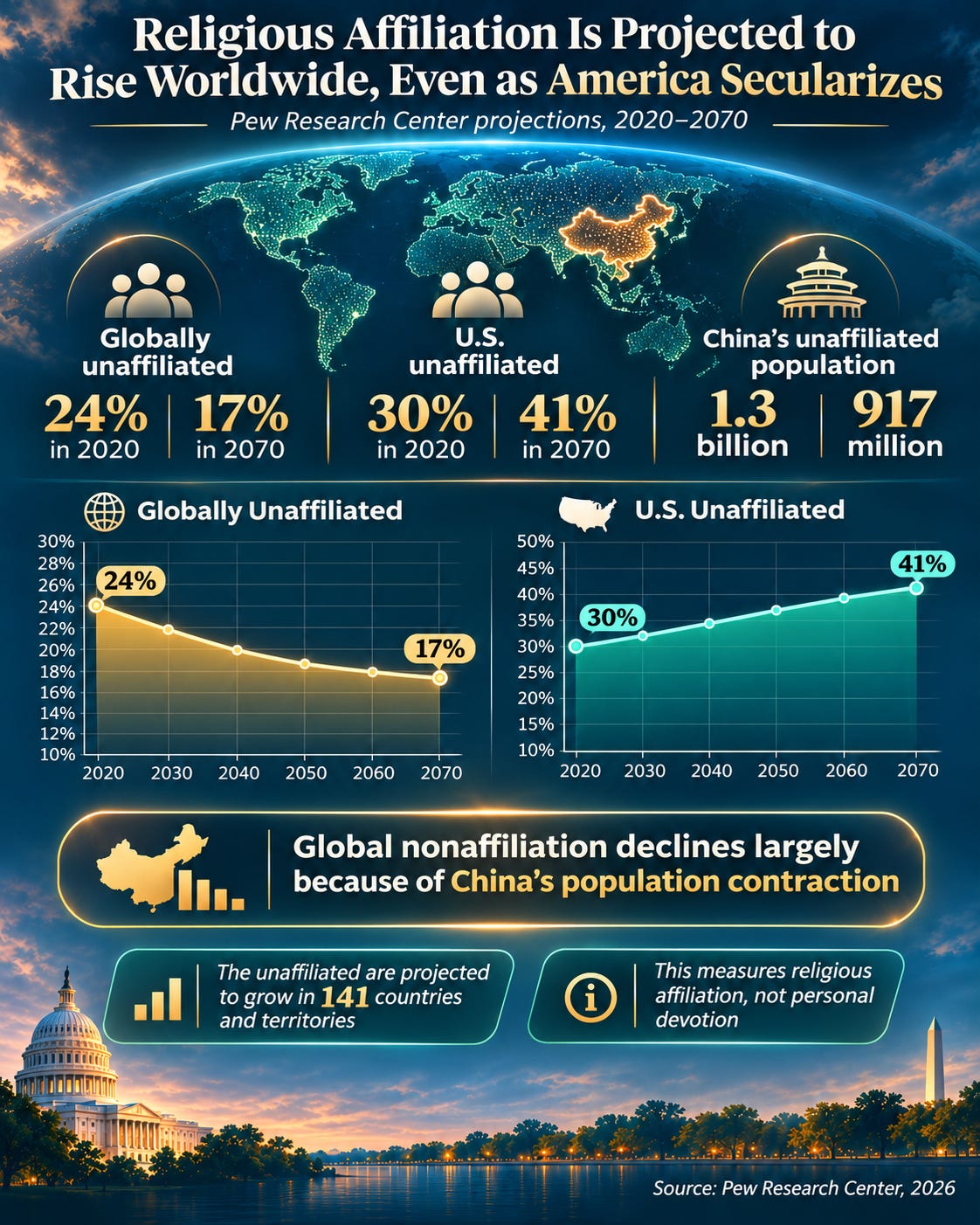
That decline is large enough to offset projected increases in religious non-affiliation across the rest of the world. The result is a projected increase in the proportion of humanity identifying with a religion, even as religious identification declines in countries such as the United States.
Importantly, this does not necessarily indicate a worldwide religious revival or an increase in religious observance. Pew’s projections measure religious affiliation rather than personal devotion, and the global shift is driven substantially by population growth and decline in different parts of the world.
Why the Religious Balance Is Changing
Pew identifies fertility, age structure, migration and religious switching as the principal forces behind the projected transformation.
Globally, Muslim women had an estimated fertility rate of 3.1 children per woman during 2020–2025, compared with 2.5 among Christian women and 1.6 among women belonging to all other religious categories combined.
Muslims also had the youngest median age of any major religious group in 2020, at 24, compared with 33 among non-Muslims. These demographic differences help explain why Islam is expected to grow substantially faster than Christianity, even without large-scale religious conversion.
In the United States, however, changing religious identity plays a much larger role. Continued disaffiliation from Christianity, alongside an older Christian population, is expected to narrow the gap between Christians and Americans who identify with no religion.
Pew’s methodology incorporates population estimates, fertility and mortality rates, migration patterns and observed religious switching. The researchers assume that recent patterns of migration and switching will continue, while future fertility and mortality follow modeled demographic trends.
The results are projections rather than predictions of inevitable outcomes. Major changes in immigration policy, fertility, religious identification, conflict or other circumstances could substantially alter the figures. The study also measures religious affiliation, not the intensity of religious belief or practice.
Nevertheless, the findings point toward a world in which America’s historically dominant religious identity loses ground at home, while Christianity’s population center shifts toward Africa and Islam becomes the world’s largest faith.
The projected transformation is not simply a story of religion declining or expanding. It is a fundamental change in where the world’s religious populations live, how quickly they grow, and the place the United States occupies within that shifting landscape.