


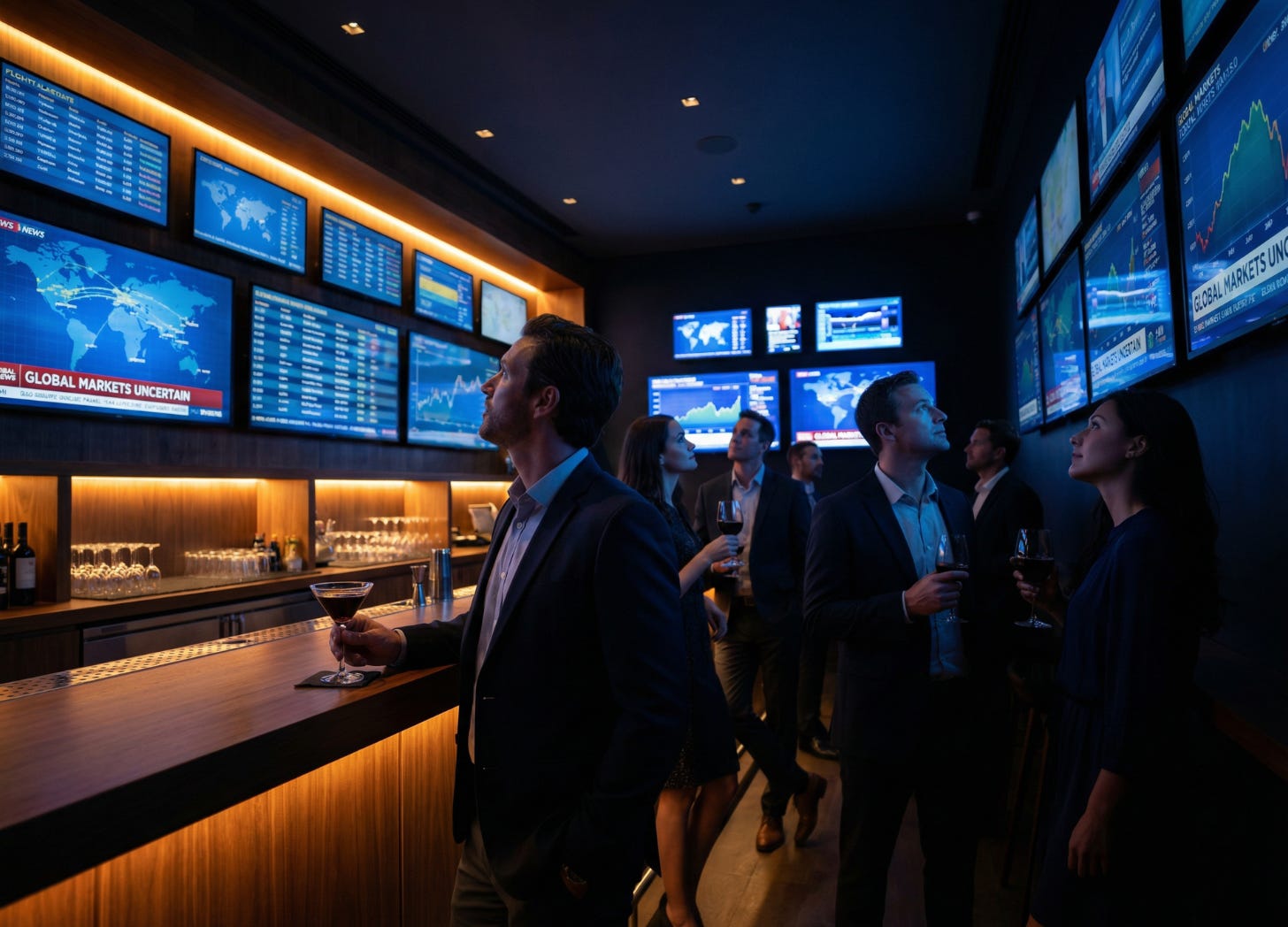
Polymarket—a crypto-based platform where users bet real money on everything from election outcomes to whether wars will escalate—is opening a bar in Washington, D.C. this Friday where patrons can drink while watching Bloomberg terminals, flight radar feeds, and prediction market odds flicker across wall-mounted screens. The venue—dubbed “The Situation Room”—promises the ambiance of a sports bar, except instead of March Madness brackets, you’ll be tracking missile strikes in real time over your IPA.
The announcement landed with perfect timing. For months, an increasingly popular internet meme has celebrated the art of “monitoring the situation”—the practice of obsessively tracking global events through a patchwork of feeds, maps, and data streams. World Monitor, a website that transforms any browser into a makeshift CIA command center, drew 2 million users in its first three weeks. The masculine urge to monitor the situation, as the original viral post put it, has found its physical embassy.


At first glance, this looks like internet culture turned into performance art, complete with craft cocktails. But the meme’s resonance reveals something substantial about how people engage with information in the current moment.
The Free Press identified something crucial beneath the joke: “a deep and unchangeable male instinct—the instinct for heroic action.” When institutions struggle to provide coherent narratives quickly enough, people build their own intelligence apparatuses. World Monitor’s creator, Elie Habib, told The Atlantic that users “feel in control” when they see “everything happening in front of them.”
This represents something more than information consumption—it’s a hunger for agency in an increasingly complex world. The monitoring impulse taps into the desire to serve, to make a difference, to be ready when called upon. It’s also evidence of people breaking out of their immediate bubbles, engaging with global events beyond their own neighborhoods and industries.
The meme works precisely because it acknowledges its own nature with humor. Most “monitoring the situation” posts are ironic, gently mocking the gap between the impulse toward engagement and the reality of refreshing Twitter feeds. “He’s not unemployed, he’s monitoring the situation” became a viral format. That self-awareness creates its peculiar appeal—the instinct is genuine even when its expression invites gentle mockery.
The practice fills a vacuum that previous generations handled differently. When information moved slowly through curated channels, citizens relied on institutions to filter signal from noise. Today’s environment offers direct access to raw data streams with more individual responsibility for interpretation. Monitoring becomes a way to stay oriented in fast-moving events.
Polymarket’s situation room makes this dynamic literal and social. Prediction markets already turned current events into trackable data; now you can discuss unfolding situations while drinking with others who share the interest. The venue transforms what’s often a solitary activity into communal engagement.


The question is what monitoring actually produces. You can watch oil prices and missile trajectories in real time, though that provides information rather than necessarily understanding. Habib himself admitted that what he built is fundamentally “a noise machine.” The challenge is converting access to information into genuine comprehension—and converting the desire to serve into meaningful action beyond observation.
What’s clear is that monitoring reflects genuine engagement with consequential events. People are paying attention to global developments, trying to make sense of complexity, looking beyond their immediate concerns. The instinct driving this—to understand, to be prepared, to potentially contribute—is fundamentally sound even when its expression involves refreshing feeds and watching flight trackers.
The phenomenon reveals something worth noting: the instinct for heroic action doesn’t disappear just because clear outlets for it become scarce. Previous generations channeled similar impulses through volunteer fire departments, local civic organizations, and community service groups that turned awareness into participation. The monitoring meme captures what happens when the instinct remains but the pathways from observation to action have atrophied. People stay perpetually ready, scanning for the moment when their preparation might matter.
Polymarket’s situation room will likely succeed because it addresses a real appetite: the desire to engage with the world alongside others doing the same. Whether it becomes merely another form of entertainment consumption or something that reconnects people to meaningful civic participation remains to be seen. The instinct is admirable. The question is whether we can rebuild the structures that historically gave it somewhere worthwhile to go.
I can see it now: people across the country screaming at their TVs as the nightly news reports the number of missile strikes that day in the Iran War because they lost money on the over/under for the day. Being able to bet on missile strikes (and a lot of other things) is making me feel like I'm living in an episode of 'South Park' from 20 years ago. Am I alone here?