


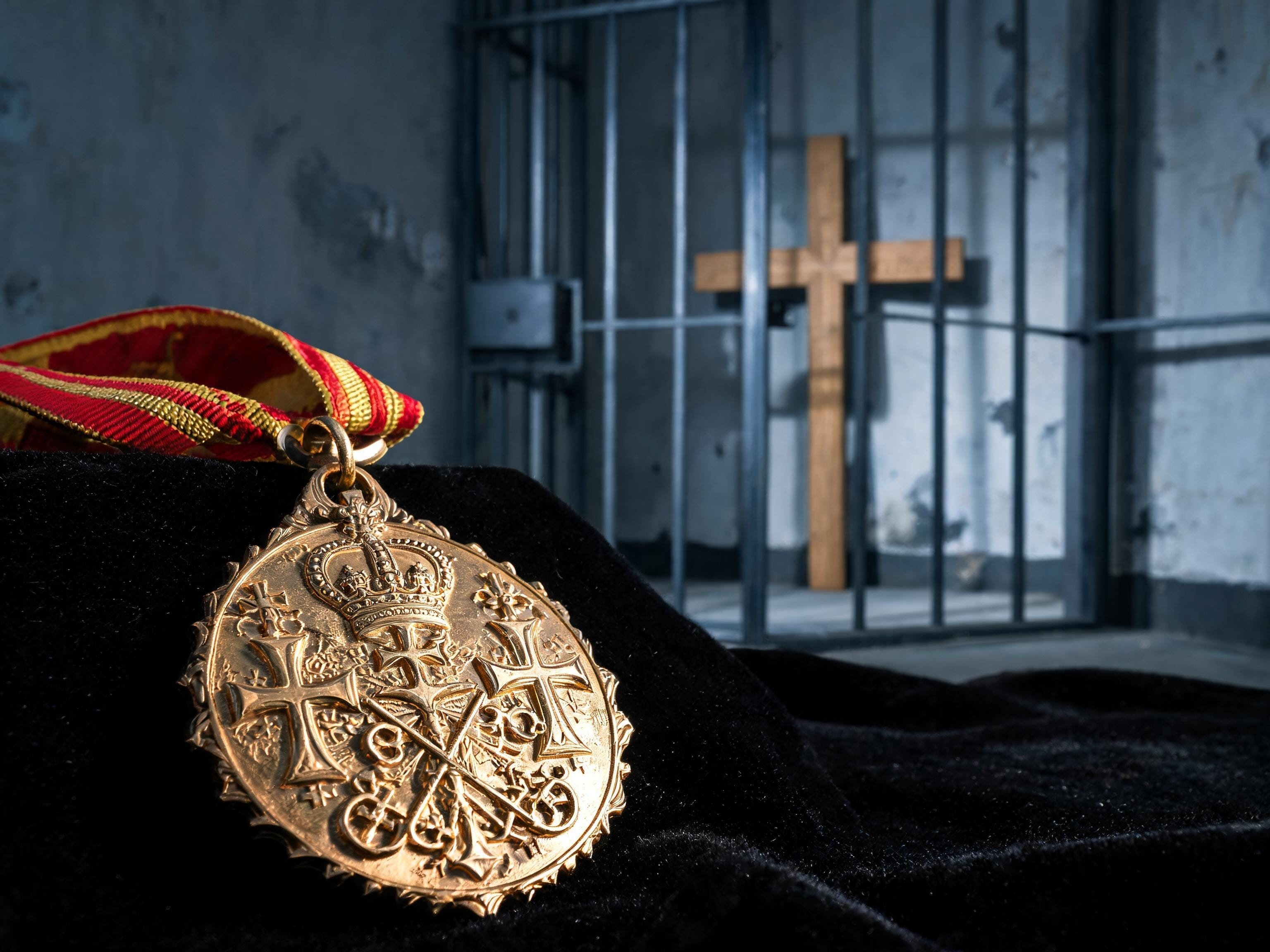
Pope Leo XIV awarded the Vatican’s highest diplomatic honor to Iran’s ambassador to the Holy See earlier this week — the same year Iranian courts sentenced 73 Christians to a combined 280 years in prison for owning Bibles, attending house churches, and celebrating Christmas. The honor, bestowed the same week President Donald Trump declared the U.S.-Iran ceasefire “on life support,” has drawn sharp criticism from religious freedom advocates and exposed a widening rift between the Vatican’s diplomatic posture and the persecution unfolding inside Iran.
A Regime Ideologue at the Vatican
Mohammad Hossein Mokhtari, Iran’s envoy to the Vatican since December 2023, received the Knight of the Grand Cross of the Pontifical Order of Pius IX on May 8, according to a certificate signed by Cardinal Pietro Parolin, the Vatican’s Secretary of State. The Order of Pius IX, established in 1847, is the Holy See’s most senior active papal order, typically conferred on resident ambassadors for “strengthening diplomatic ties and serving the cause of peace and dialogue,” according to Iranian state media’s characterization of the award.


But Mokhtari’s record undermines that framing. The Hojjatoleslam — a mid-ranking Shi’a cleric — spent his career embedded in Iran’s religious and ideological apparatus. He served on the scientific committee of the Imam Khomeini Education and Research Institute, an institution led by by hardline cleric Ayatollah Mohammad-Taqi Mesbah Yazdi, and led the University for Islamic Denominations, a regime-backed institution that signed cooperation agreements with universities in Assad-era Syria.
Demanding the Pope Defend Khamenei
In his role as ambassador, Mokhtari urged the Pope publicly defend Supreme Leader Ali Khamenei against “insults and assassination threats” from the United States, describing Khamenei as not merely a political figure but “a sacred religious authority for Shi’a Muslims” whose dignity was being violated. He authored an op-ed accusing American policymakers of “cloaking inhumane and irrational decisions in religious rhetoric” and personally delivered a plaque of Khamenei’s speeches about Jesus to Pope Francis in 2024.
Following the launch of Operation Epic Fury, Mokhtari condemned the strikes as “aggression” and a “blatant violation of territorial integrity,” invoking Iran’s “legal and legitimate right to respond.” He told the Pope it was his “moral duty” to condemn the strikes — a request the Vatican did not answer.
Awarded Mid-War, as Ceasefire Collapsed
The timing of the Vatican honor was particularly striking. The certificate awarding Mokhtari the Grand Cross was dated May 8, 2026 — just three days before Trump called Iran’s latest peace proposal “garbage” and declared the ceasefire “on life support.”


The U.S.-Israeli military campaign against Iran, dubbed Operation Epic Fury, had begun February 28, 2026, with nearly 900 strikes in the first 12 hours targeting Iranian missiles, air defenses, and military infrastructure. After more than five weeks of fighting that left thousands dead in Iran and Lebanon, a ceasefire was brokered April 7–8 by Pakistan. But by May, negotiations had stalled over Iranian demands for compensation, an end to the U.S. naval blockade, and sovereignty over the Strait of Hormuz, where Iran had shut down shipping traffic carrying one-fifth of the world’s oil and gas supply.
Iranian state media framed the Vatican honor as closely linked to Pope Leo XIV’s condemnation of U.S.-Israeli actions and to the Iranian embassy’s efforts to “promote messages of peace, justice, and opposition to warmongering.” Yet the regime Mokhtari represents was simultaneously overseeing a dramatic escalation in the persecution of Christians.


280 Years in Prison, One Year
In 2025, Iranian courts sentenced 73 Christians to more than 280 cumulative years in prison, according to a joint report by Middle East Concern, Open Doors, Article 18, and Christian Solidarity Worldwide. That figure represents a six-fold increase in imprisonment compared to 2023, when 22 Christians received a combined 43.5 years. At least 254 Christians were arrested in 2025 on charges related to their faith — nearly double the prior year’s total.
The charges used against Christians include “propaganda activity contrary to Islamic law,” “acting against national security,” and violations of Article 500 of Iran’s Islamic Penal Code, which criminalizes “any deviant educational or proselytizing activity that contradicts or interferes with the sacred law of Islam.” Iranian authorities increasingly characterize Christian converts as promoting “Zionist Christianity” — a deliberate effort to link evangelicals with foreign adversaries.
Pregnant Women, Spinal Fractures, and Spies
Among those sentenced in 2025: Narges Nasri, a Christian convert who was pregnant when she received a 16-year prison term for “propaganda activity contrary to Islamic law” and “membership in opposition groups.” Aida Najaflou, sentenced to 17 years for evangelism, prayer, and celebrating Christmas, suffered a spinal fracture in prison; authorities initially denied her surgery and returned her to her cell on a stretcher. At least 11 Christians received sentences of 10 years or more in 2025.


The U.S. Commission on International Religious Freedom documented denial of medical treatment for detained Christians, psychological torture, threats against families, and charges of espionage. In the aftermath of the Iran-Israel war, at least 54 Christians were arrested in a coordinated sweep across 21 cities, with state media publicly branding them as spies linked to “foreign intelligence services.”
Death Penalty for Leaving Islam
Iran’s Constitution recognizes only ethnic Armenian and Assyrian Christians as protected minorities — excluding Persian-speaking converts, who face the death penalty for apostasy under Shari’a-based rulings. Although apostasy is not codified in the Islamic Penal Code, judges apply religious law to impose capital sentences.
Pastor Hossein Soodmand, a convert from Islam, is an Iranian Christian officially executed for apostasy since the 1979 revolution — hanged in December 1990 and buried in an unmarked grave that the regime demolished in 2019. Three senior Protestant pastors were murdered in 1994, with a TIME magazine investigation concluding that “decisions to assassinate opponents at home or abroad are made at the highest level of the Iranian government,” including Supreme Leader Ali Khamenei.


The Unanswered Christmas Plea
On Christmas Eve 2025, Iran’s exiled Crown Prince Reza Pahlavi wrote to Pope Leo XIV, urging him to use diplomatic channels to speak publicly for Christians imprisoned, flogged, and threatened with execution by the Iranian regime. Pahlavi noted that in 2024 alone, Christian converts in Iran received 263 combined years in prison and 37 years in internal exile — a six-fold increase in sentencing compared to 2023.
The Vatican did not respond. Two months later, the Pope awarded the regime’s envoy the Holy See’s highest diplomatic decoration.
Playing gentle with people who play rough has never worked well. Undeniable historical fact.