


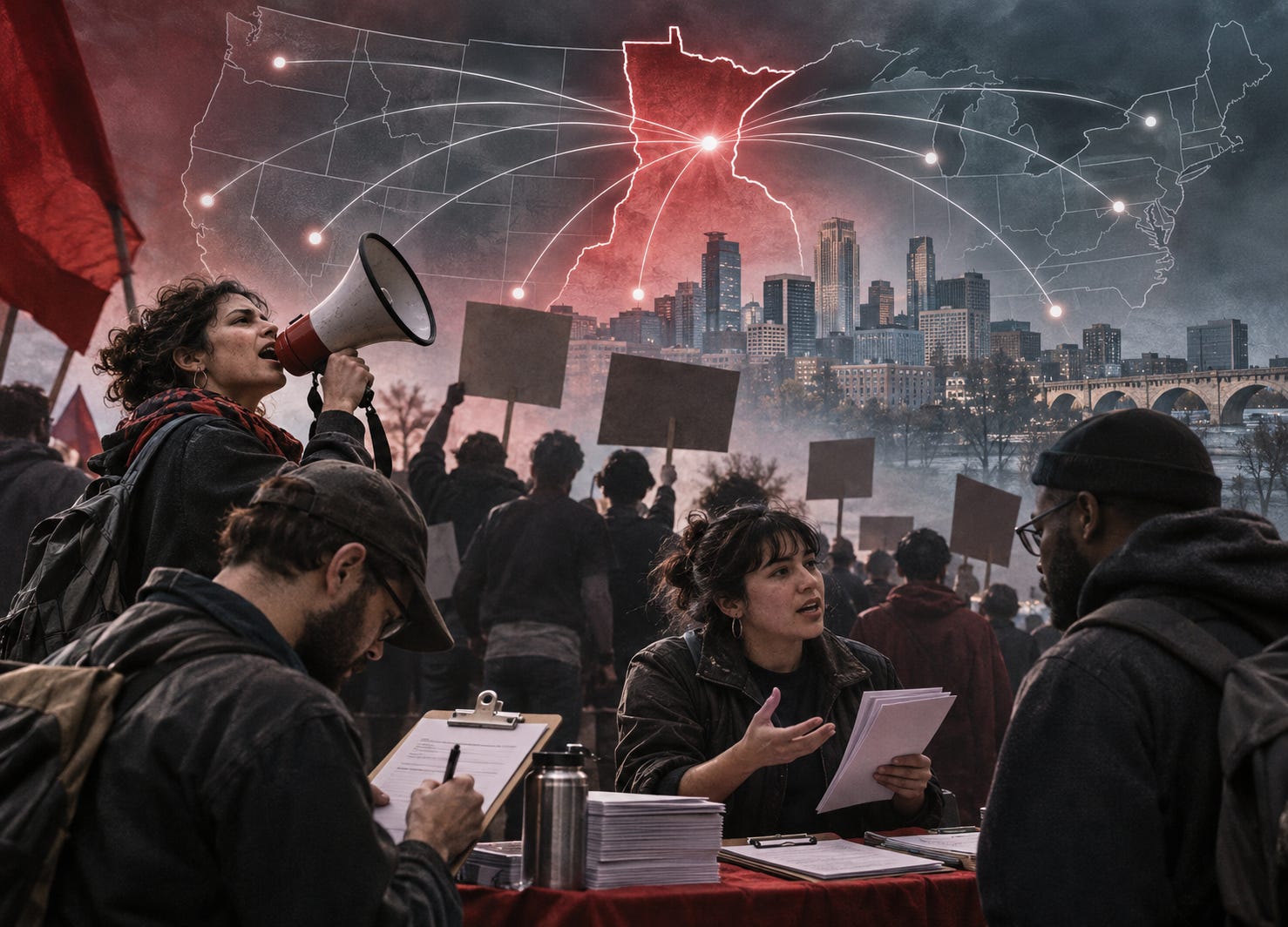
The Party for Socialism and Liberation is attempting to convert the mass protest infrastructure built during Minnesota’s confrontation with federal immigration authorities into a durable socialist movement extending across state lines.
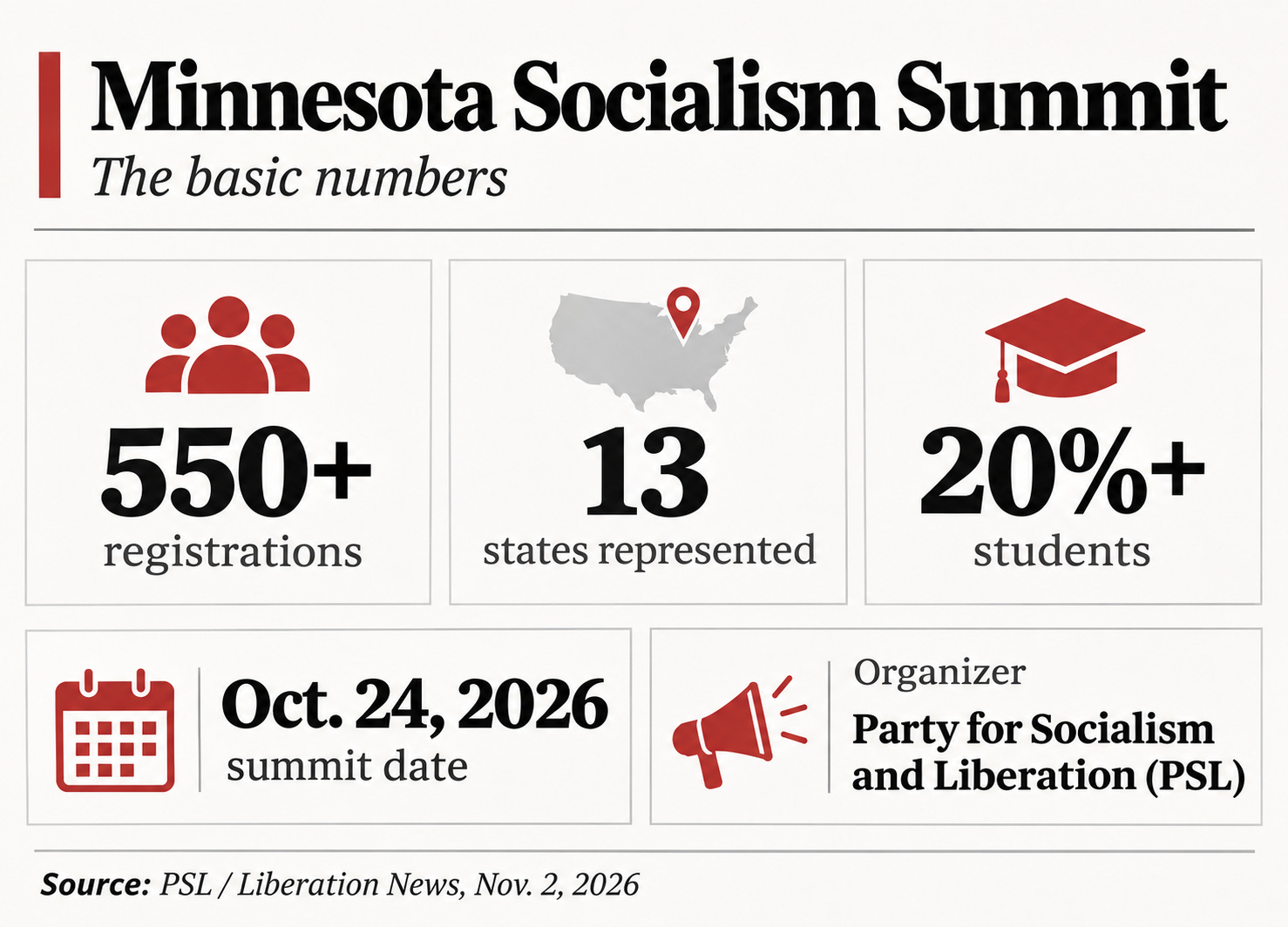
More than 550 people registered for the Oct. 24 Minnesota Socialism Summit, with participants coming from 13 states and more than 20 percent of registrants identified as high school or college students, according to a Nov. 2 account published by PSL’s Liberation News.
PSL presented the gathering not simply as a conference, but as an effort to preserve the momentum generated by Minnesota’s January shutdowns and move participants into permanent political organization.
The party’s own account makes clear that the goal extends beyond elections.
PSL said it organized the summit in part because political attention following the protests had begun shifting toward the 2026 midterms and toward what it described as getting people “to the polls and out of the streets.”
Rather than allowing the movement to dissolve into the electoral cycle, organizers said they wanted to build toward what they called “real political power.”
Minnesota as a Model
The summit grew out of two major January protest actions held during the Trump administration’s immigration enforcement campaign in Minnesota.
PSL has repeatedly described the Jan. 23 and Jan. 30 shutdowns as evidence that coordinated strikes, demonstrations and mass disruption can exert political pressure outside conventional electoral politics.
In a later assessment of the Minnesota mobilization, PSL argued that the lessons of January should not be forgotten and praised strikes, shutdowns and “militant mass mobilization” as mechanisms for building political power.
The party also treated the January actions as a national organizing opportunity.
Its branches around the country mobilized behind the Jan. 30 shutdown, while PSL organizers in Minnesota expanded volunteer operations and helped coordinate outreach.
By October, that protest infrastructure had become the basis for a much broader ideological gathering.
From Protest to Recruitment
The Minnesota Socialism Summit brought together hundreds of attendees for an all-day program of panels, workshops and political education.
An Augsburg University student newspaper preview identified Claudia De La Cruz and Karina Garcia, PSL’s 2024 presidential and vice-presidential nominees, among the featured speakers.
The program was framed around studying earlier mass movements and discussing how workers could acquire political power.
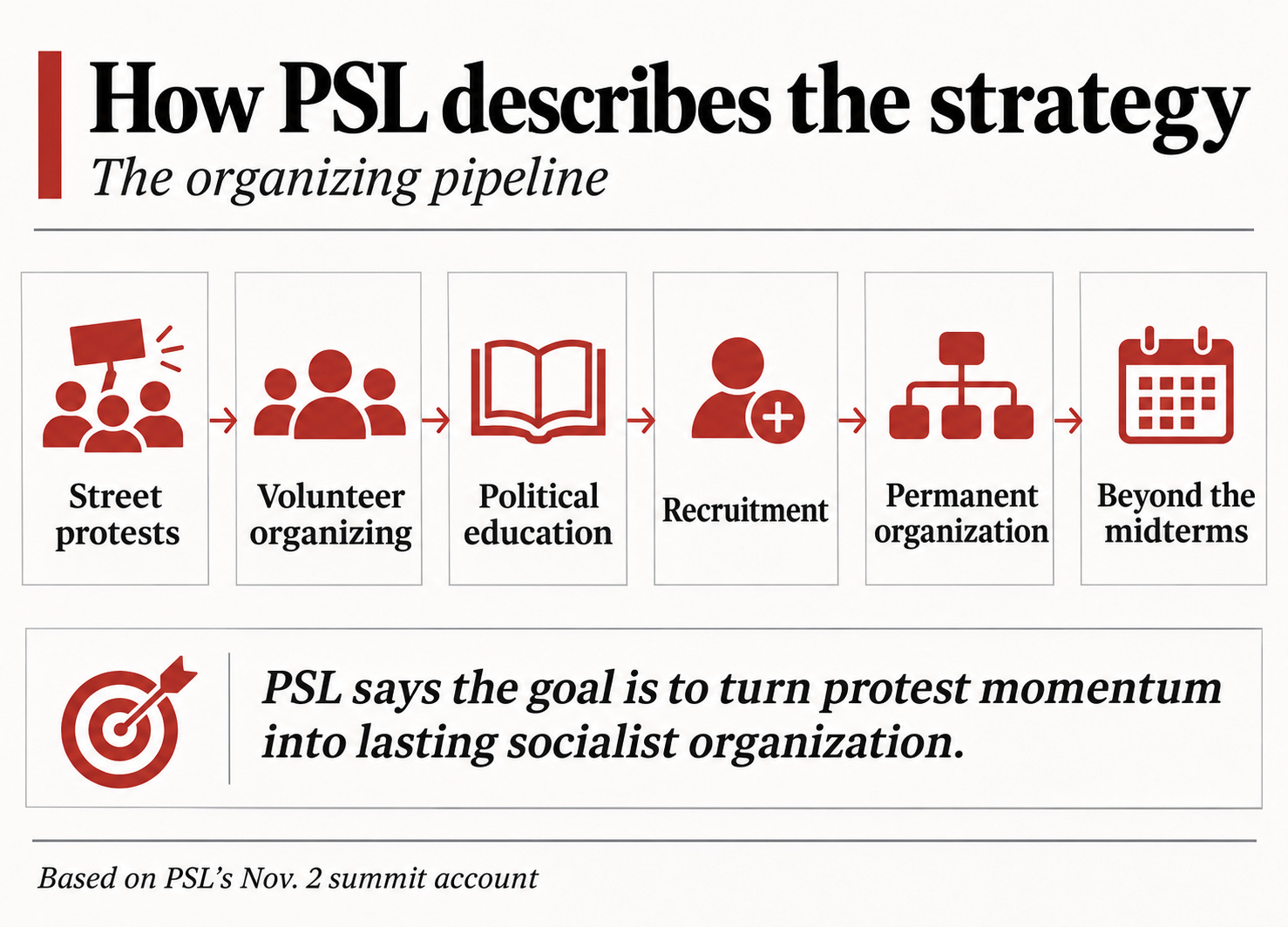
PSL’s post-summit account described the gathering as a mechanism for moving people from protest participation toward socialist organization.
More than one-fifth of registrants were students, a figure that also highlights the emphasis PSL placed on younger recruits.
The party described the summit as a “launching pad” for expanding socialist consciousness, drawing more people toward its ideology and integrating attendees into continued political activity.
That is what makes the 13-state participation particularly notable.
PSL has not publicly identified all 13 states represented at the gathering, and there is not yet evidence of a formally constituted 13-state organization.
But the event clearly functioned as more than a local Minnesota conference.
Organizers were drawing people across state lines into a political project explicitly designed to continue after the immediate protest campaign had ended.
Beyond the Midterms
The most revealing element of PSL’s account is its rejection of the idea that Minnesota’s protest momentum should be redirected primarily into the 2026 election.
“In the months following Jan. 30, there was a concerted effort to turn people’s attention towards the horizon of the midterms,” PSL wrote.
The party criticized a political strategy centered on moving activists away from street mobilization and toward voting, warning against what it called the “endless cycle of midterms.”
PSL is not opposed to elections altogether.
It ran a presidential ticket in 2024 and continues to recruit supporters for electoral campaigns.
But its Minnesota project is framed around a broader objective.
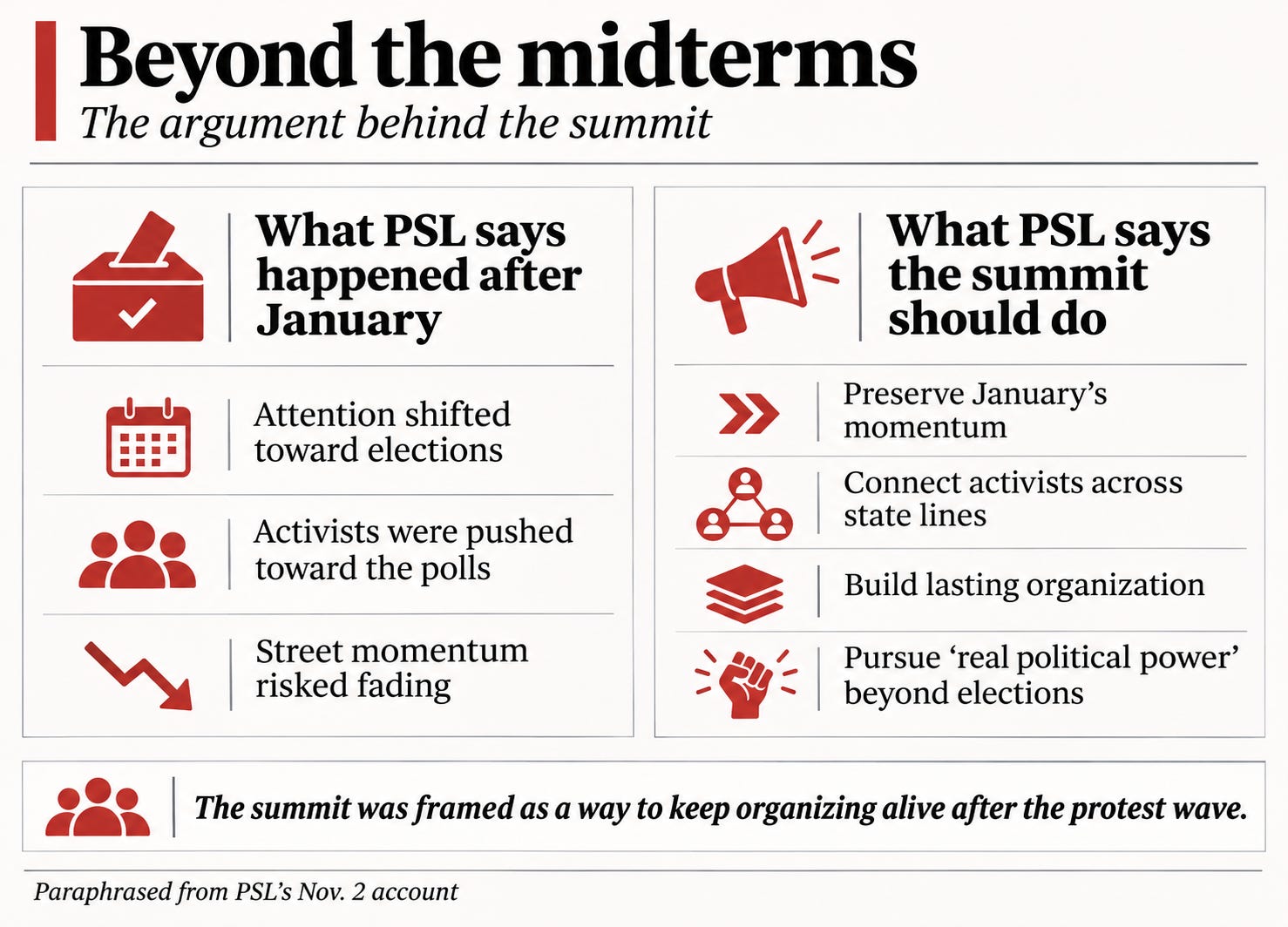
A separate Nov. 2 Liberation News article argued that political activity should continue well beyond Election Day and called for the construction of a socialist movement capable of operating independently of the election cycle.
The Minnesota summit fits directly into that strategy.
Rather than treating election participation as the culmination of political organizing, PSL presents elections as one component within a larger project built around protests, strikes, political education and permanent organization.
Building Something That Lasts
The summit also comes as PSL increasingly promotes nationwide shutdowns and general strikes as instruments of political power.
Earlier this year, the party called for workers, students and consumers to shut down workplaces, schools and commercial activity as part of a broader general-strike strategy.
Minnesota appears to have become a practical case study for that approach.
The January protests created a large pool of politically activated participants. PSL then helped mobilize around those actions, spent months presenting them as a model for future organizing, and ultimately brought hundreds of people from 13 states together for a summit centered on socialism and political power.
What began as resistance to federal immigration enforcement has therefore become something larger for the party.
PSL is attempting to turn the Minnesota protest movement into a pipeline.
The objective, by its own account, is to move people from demonstrations into political education, from political education into permanent organization, and from permanent organization toward a socialist movement designed to survive beyond the midterms.
Minnesota was the testing ground. The October summit suggests PSL now wants to carry the model further.