


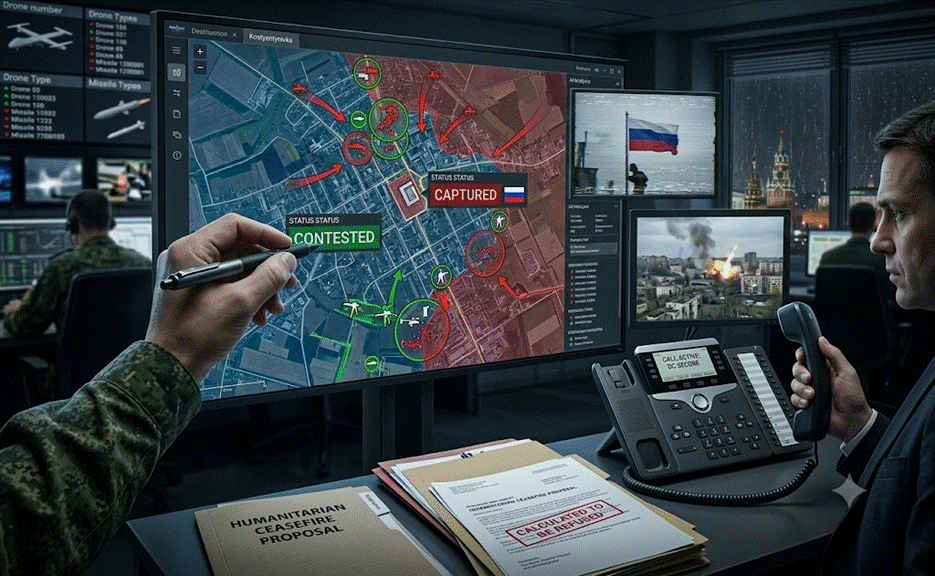
Russian President Vladimir Putin told Donald Trump on July 4 that Russian forces had captured the eastern Ukrainian city of Kostyantynivka—a claim the Institute for the Study of War and Ukrainian forces on the ground immediately disputed as false.
The fabricated victory announcement came three days before Trump’s NATO summit meeting with Volodymyr Zelensky, was followed by a Russian ceasefire proposal Moscow knew Ukraine would reject, and represents what ISW assesses as a coordinated information operation designed to establish a false battlefield “reality” in Western decision-making circles. The episode reveals Russia’s cognitive warfare playbook: manufacture territorial claims, stage diplomatic gestures, then weaponize the refusals to frame Ukraine as the obstacle to peace.


A False Claim Delivered Directly to the White House
The claim didn’t emerge from battlefield reporting or military briefings. Putin staged a July 3 meeting with Russian military commanders, then repeated the Kostyantynivka narrative directly to Trump during a July 4 call that Kremlin aide Yuriy Ushakov confirmed lasted nearly 90 minutes. Ushakov told reporters Putin said Russian forces were “confidently advancing, liberating one settlement after another”—language designed for diplomatic and media consumption, not operational accuracy.
Zelensky responded hours later on X, calling the claim “just another Russian lie, an attempt to generate some kind of a news story.” Ukraine’s 19th Army Corps stated its forces maintain positions throughout Kostyantynivka and continue striking Russian infiltrators. ISW’s assessment, based on geolocated footage, found Russian units raised flags at scattered points but presented no evidence of consolidated control.
Fabricated Evidence and AI-Altered Footage
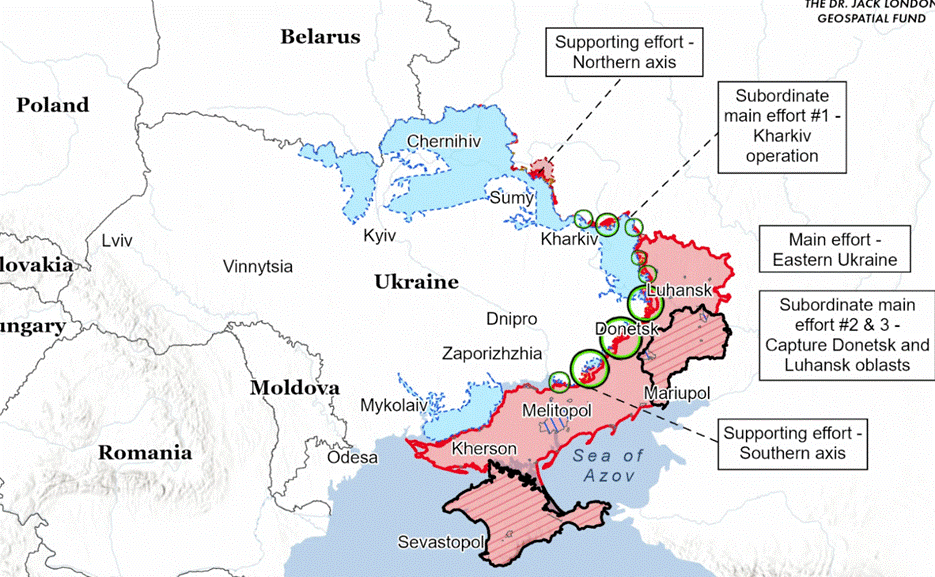
ISW noted that footage released by Russia’s Ministry of Defense may have been altered with artificial intelligence, consistent with what the think tank describes as a wider pattern of manipulated visuals used to manufacture territorial gains Russia has not achieved. The tactic isn’t new: Kremlin officials, ISW observed, “regularly aggrandize tactical Russian advances and present false and fabricated evidence as part of a wider cognitive warfare effort.”
The strategic target wasn’t the battlefield—it was the Trump administration’s perception of battlefield momentum. ISW assessed the Kremlin conducted “a targeted information campaign that aims to highlight the claimed Russian seizure of Kostyantynivka to the Trump administration and Western information space.” The timing, three days before the Ankara summit, was deliberate.

The Staged Ceasefire Trap
Moscow followed the false capture claim with a ceasefire proposal—nominally to retrieve fallen soldiers’ bodies—that Russia’s own defense ministry said Ukraine rejected before the truce window had even opened. ISW identified the sequence as part of a familiar pattern: announce a fabricated territorial gain, offer a short “humanitarian” pause calculated to be refused, then cite the refusal as evidence Ukraine obstructs peace efforts.
The operation unfolded while Russian forces sustained heavy bombardment: Ukrainian officials reported 125 drones and four missiles launched overnight July 4-5, and Zelensky said Russia fired approximately 2,200 strike drones, over 1,730 glide bombs, and 106 missiles in the preceding week. Russia’s foreign ministry, meanwhile, characterized the Trump-Putin call as “businesslike and highly constructive.”
The question isn’t whether Russian troops eventually take the city. The question is whether Moscow’s information operations—rather than verified battlefield facts—establish the baseline for ceasefire negotiations. Putin’s July 4 call demonstrated Russia understands the cognitive battlefield may matter more than the ground one, especially when the audience is an incoming administration eager to broker a deal.