


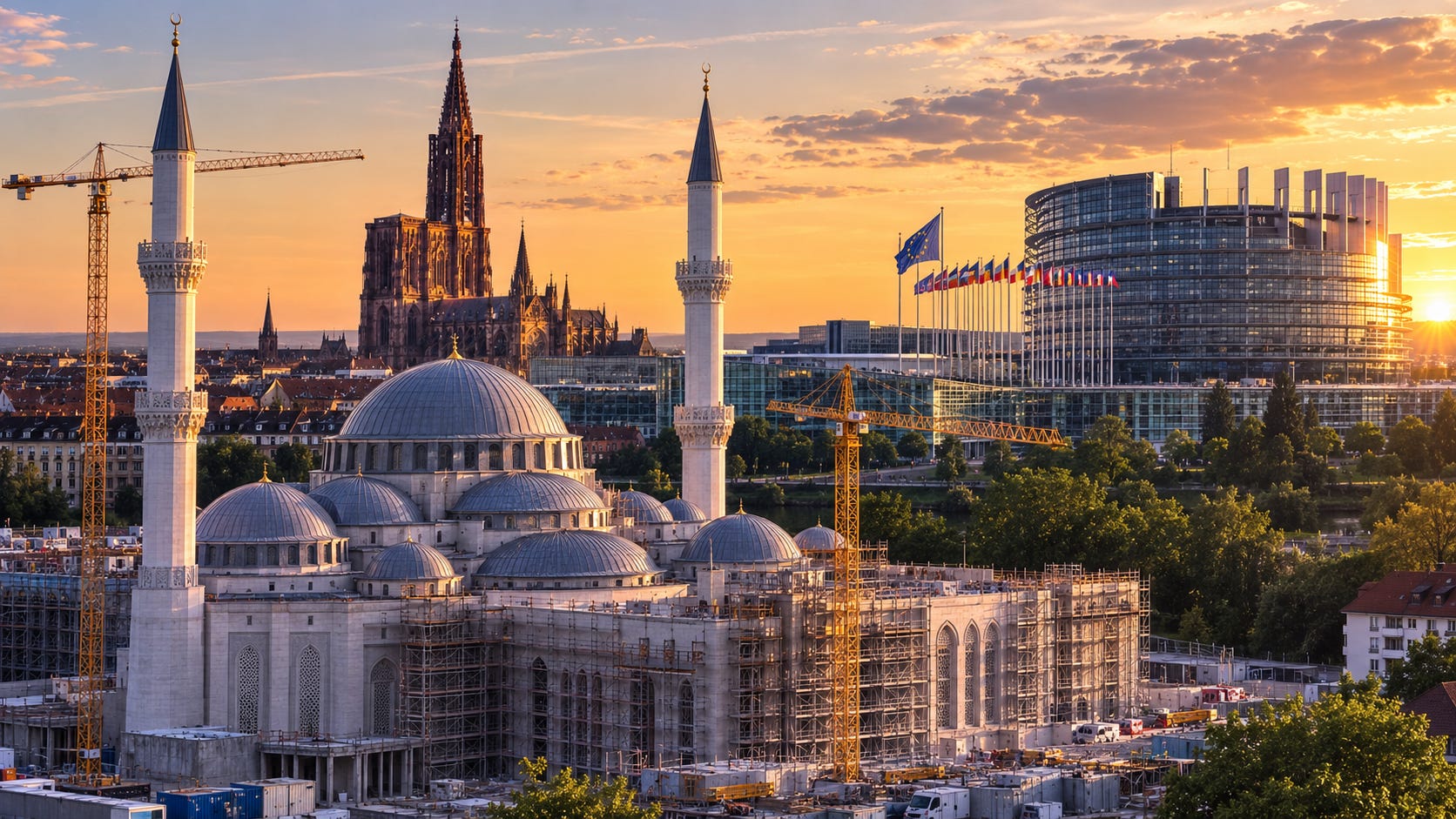
Six kilometers from the European Parliament, in an industrial zone on the edge of Strasbourg, workers are finishing one of the largest mosque complexes ever built in Europe. The Eyyub Sultan Mosque will hold 6,500 worshippers across 10,000 square meters, rise beneath 27 domes and two 36-meter minarets, and cost €32 million when it opens later this year.
It is being built by Millî Görüş, a Turkish Islamist confederation founded in 1969 by former Prime Minister Necmettin Erbakan, who preached that Turkey should abandon its secular constitution and become an Islamic state. The organization is not a mainstream religious body. Germany’s intelligence service designated its German branch an “Islamist extremist group” in 2005; Austria banned Turkish funding of its mosques in 2015; and in July 2021, a French intelligence report tied Millî Görüş to the Muslim Brotherhood, describing its president as meeting Turkish President Recep Tayyip Erdoğan “several times a year.”
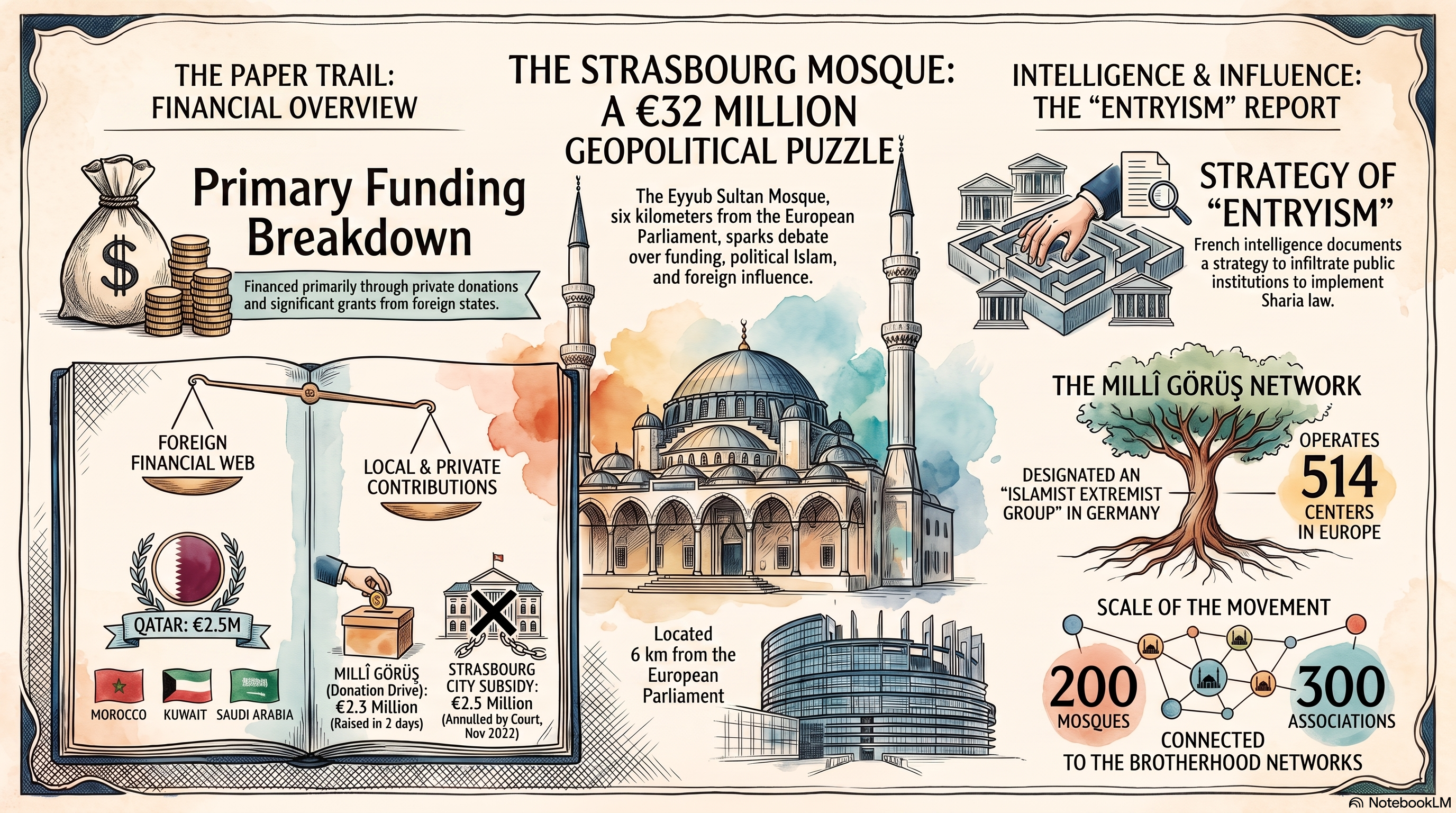
The money to build it has come almost entirely from abroad. Qatar contributed €2.5 million; Morocco, Kuwait, and Saudi Arabia added further grants. Then, in March 2021, Strasbourg’s Green mayor Jeanne Barseghian voted to add €2.5 million of French taxpayer funds on top — prompting France’s interior minister to accuse her, on national television, of “financing foreign meddling on our soil.” A court struck down the subsidy in November 2022. By then, the minarets were already rising.


The Organization Behind the Mosque
Millî Görüş was founded in 1969 by Necmettin Erbakan, Turkey’s first Islamist prime minister, who promoted what he called “National Vision”, gradualist movement to transform Turkey into an Islamic state. A French intelligence dossier released in July 2021 identified the organization as “powerful and centralized,” controlled by president Kemal Ergün, who possesses “absolute power over the Brotherhood at the European level” and is “described as close” to Turkish President Recep Tayyip Erdoğan, “who reportedly meets with him several times a year.”


The organization operates 514 mosques and cultural centers across eleven European countries, including 323 in Germany alone, with an estimated 87,000 members. Germany’s Ministry of Interior designated Millî Görüş’s German branch as an “Islamist extremist group” in 2005. Austria amended its Islam Act in 2015 specifically to ban Turkish funding for Islamic associations and mosques after intelligence warnings about the organization’s influence.
The Strasbourg project is led by Eyup Sahin, who serves as president of Millî Görüş France and vice-president of the French Council of Muslim Faith. After the subsidy annulment, the organization pivoted entirely to private donations. In January 2025, the mosque raised €2.3 million in two days through a live social media campaign.
A Web of Foreign Money
The €32 million project is financed almost entirely from abroad. Qatar contributed €2.5 million. The mosque’s official website lists additional grants from Morocco, Kuwait, and Saudi Arabia. Millî Görüş itself raised €2.3 million in just two days during a January 2025 donation drive.
But French taxpayers also chipped in. In March 2021, Strasbourg’s Green mayor Jeanne Barseghian pushed through a €2.5 million subsidy. She invoked a local legal quirk—due to the region’s complicated history under multiple states, Alsace can still fund religious buildings where the rest of France cannot. Interior Minister Gérald Darmanin erupted, accusing the city of “financing foreign meddling on our soil.” He ordered the subsidy challenged in court. The court struck it down in November 2022. By then, the minarets were already rising.
A New French Intelligence Report
In May 2025, the French Ministry of Interior published a report titled “Muslim Brotherhood and Political Islamism in France. The 73-page assessment documents what it calls “entryism”, the Brotherhood’s covert strategy to infiltrate public institutions, schools, and local governments to implement Sharia law.
The report identifies approximately 200 mosques attracting nearly 100,000 weekly worshippers, 300 associations across religious and educational sectors, and roughly 20 private schools enrolling over 4,200 students connected to Brotherhood networks. It states the movement’s goal is “a state governed by Islamic law” and documents the use of “anti-Islamophobia narratives to deflect criticism” and “promote a belief in state-sponsored Islamophobia to mobilize support.”
The French intelligence report notes that Millî Görüş “made common cause with the Turkish religious Diyanet in Europe.” An analysis by Strategy International observes the report “downplays foreign financial influence, particularly from Qatar,” creating what it describes as “geopolitical blind spots” driven by France’s economic and diplomatic ties to the Gulf state.
European Parliament Warnings
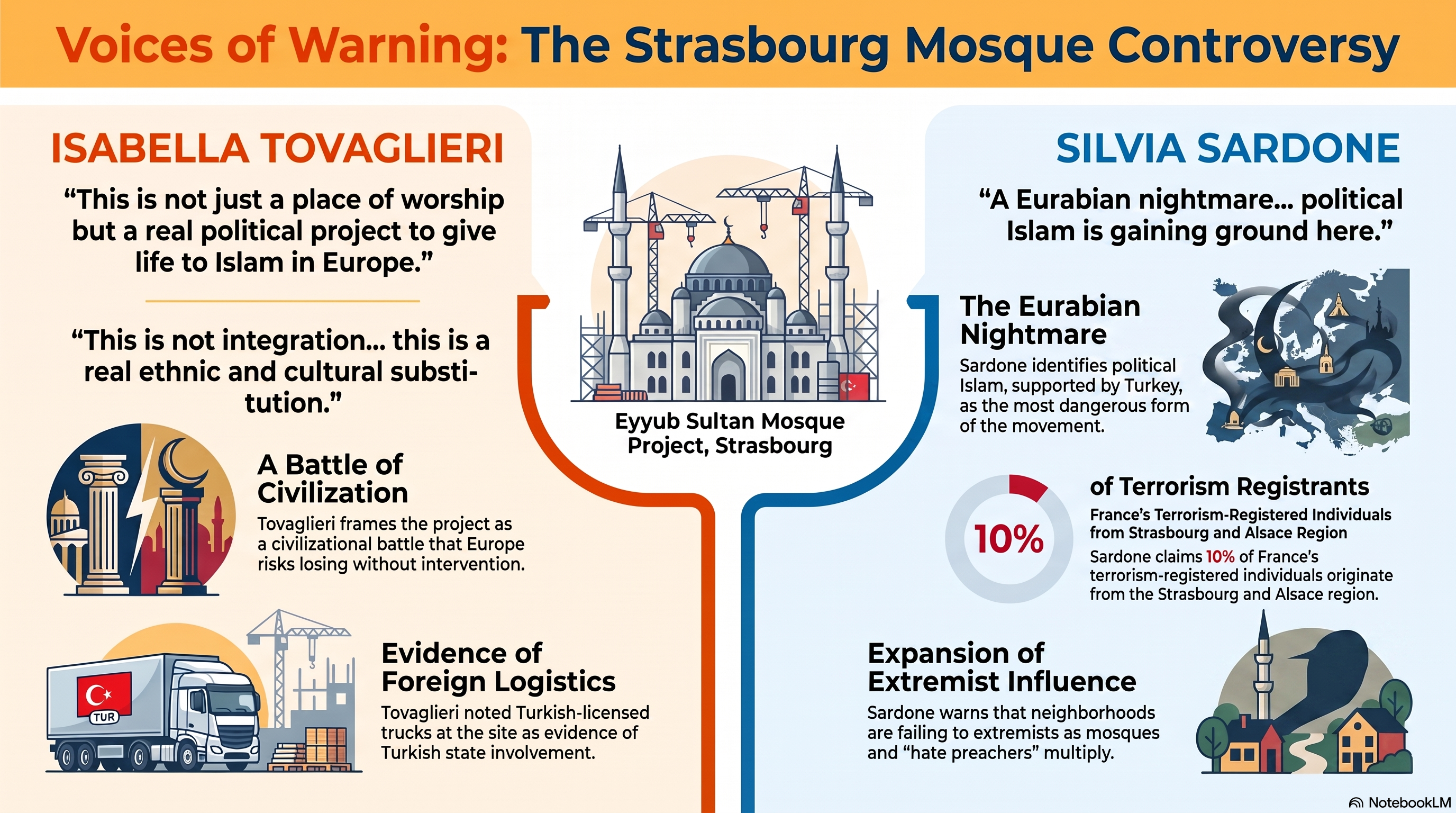
Italian EU parliamentarian Isabella Tovaglieri visited the construction site in September 2021, filming herself in front of the skeletal structure. “This is not just a place of worship but a real political project to give life to Islam in Europe,” she told her audience. She noted that “the trucks used to build the mosque are Turkish trucks, as you can see from the license plate.”
“This is not integration,” Tovaglieri stated. “This is a real ethnic and cultural substitution—a battle of civilization that we risk losing if Europe does nothing.”
Fellow Italian MEP Silvia Sardone warned in 2021 that “ten percent of all those registered for terrorism come from the Strasbourg region and from Alsace in general.” She called the project “a Eurabian nightmare” and said “political Islam, the most dangerous form, supported by Erdoğan’s Turkey, is gaining ground here.”
Sardone observed that Strasbourg already has 27 official mosques plus numerous illegal prayer spaces. “Mosques are multiplying, hate preachers are gaining ground, and entire neighborhoods in several cities are now in the hands of extremists,” she said.
Europe’s Mosque Landscape
The Strasbourg complex is comparable in scale to the DITIB Central Mosque in Cologne, Germany’s largest, which opened in 2017 with Turkish President Erdoğan presiding over the inauguration. The Cologne mosque accommodates 4,000 worshippers and cost €17-20 million. DITIB operates roughly 900 mosques in Germany and is controlled by Turkey’s Diyanet, the government’s religious affairs directorate.
Millî Görüş maintains a parallel infrastructure. Its German branch claims 323 mosques in Germany, 30,000 members, and an estimated 300,000 people attending weekly services across Europe. Belgium’s Islamic Federation, affiliated with Millî Görüş, operates 64 recognized mosques with roughly 50 more awaiting official recognition.
What distinguishes the Strasbourg project is its proximity to the institutions that set European Union policy. The complex rises in the same city where the European Parliament debates immigration policy, counterterrorism measures, and the integration of Muslim minorities.
Construction Timeline and Current Status
The mosque remains under construction as of August 2026. Project president Eyup Sahin stated in December 2021 that structural work was nearly complete, with finishing phases requiring “another two to three years.” The organization has targeted Eid 2026 for opening, though completion dates have slipped multiple times since 2017.
The facility’s planned amenities extend beyond worship space. The complex will include administrative offices, educational facilities, ablution halls, multi-functional rooms, a research and documentation center, a commercial gallery, and a family restaurant, plus parking for 600 vehicles according to the official website. The design incorporates 27 small domes surrounding a large central dome, described on the website as representing “Islamic civilization in the center of Europe.”

The organization posted in March 2026 that it collected over €100,000 during a single Friday prayer, demonstrating the financial support the project commands from its community. A January 2026 statement from Millî Görüş’s eastern branch explicitly denied foreign government funding, asserting construction relies “exclusively on private donations, coming mainly from people living in Europe.”
The cathedral that has defined Strasbourg’s skyline since 1176 now shares the horizon with minarets funded by a network that France’s intelligence services have linked to the global Islamist movement. Whether that represents religious freedom or civilizational transformation depends on which side of the debate you ask. The mosque’s completion will provide a definitive answer to what Europe is willing to build and permit at its political center.