



A senior Qatari education official with documented associations involving a university founded by an Islamic preacher banned from entering the UK and Australia for his views, including glorifying suicide bombings, and an academic center named after Muslim Brotherhood spiritual leader Yusuf al-Qaradawi is scheduled to join the presidents of two prominent American universities at an international policy forum this week.
Ibrahim bin Saleh Al-Naimi, Qatar’s undersecretary of education and higher education, will participate in an October 16 discussion alongside Baylor University President Linda Livingstone and Brigham Young University President Shane Reese. The session, titled “Faith and Higher Education,” is part of the G20 Interfaith Forum’s October 15–17 gathering in Salt Lake City, Utah.
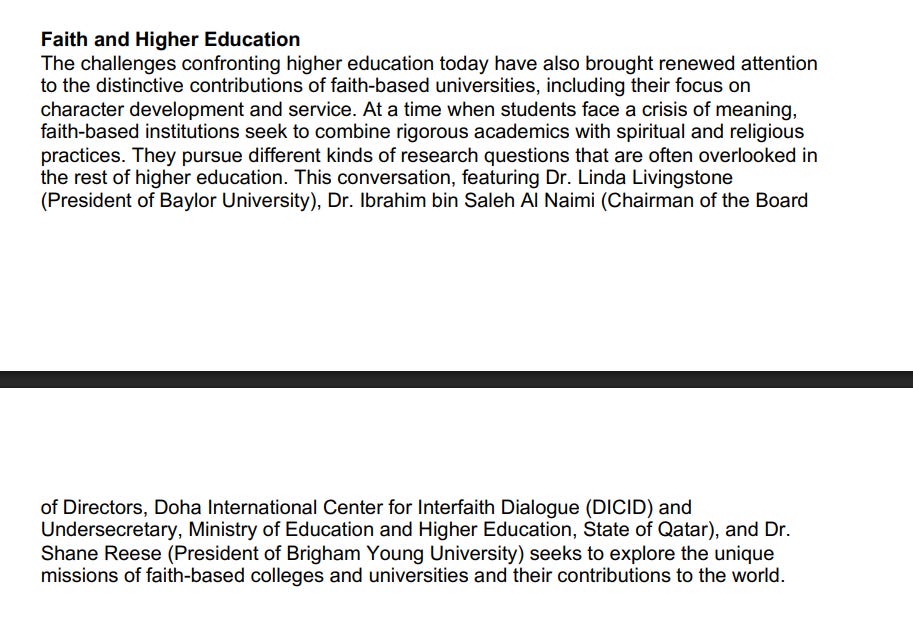
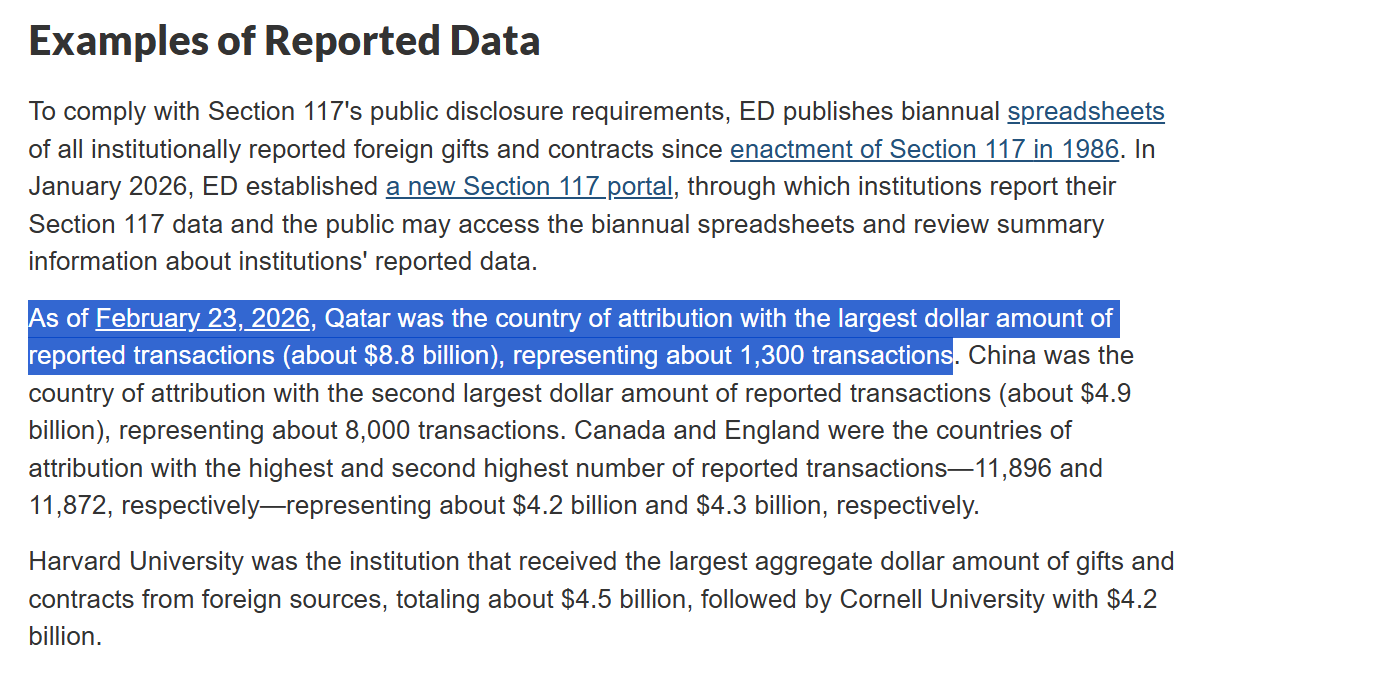
His appearance comes amid mounting scrutiny of Qatar’s extensive financial relationships with American universities. According to a March 2026 Congressional Research Service report, Qatar accounted for approximately $8.8 billion in disclosed foreign gifts and contracts to U.S. higher education institutions as of February 23, the largest amount attributed to any foreign country.
Al-Naimi, however, is more than a visiting government representative. A former president of Qatar University, he has served as an undersecretary in Qatar’s Education Ministry since 2017 and chairs the Doha International Center for Interfaith Dialogue (DICID), an institution that maintains relationships with religious and academic organizations internationally. His background also includes connections to Islamic institutions whose leadership and ideological associations have attracted controversy.
Al-Naimi’s Controversial Institutional Associations
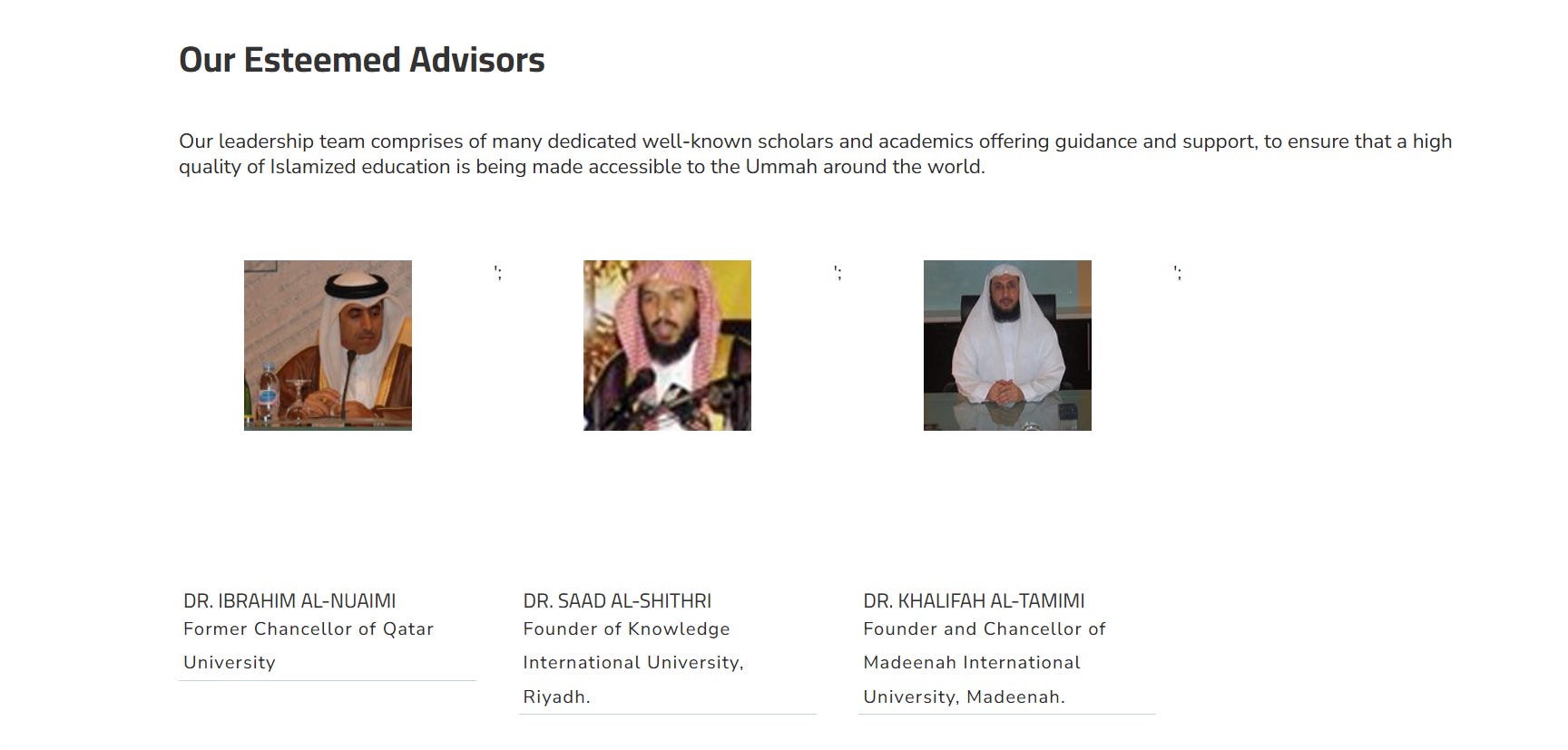
One particularly concerning association involves the International Open University (IOU), formerly known as Islamic Online University, founded by Jamaican-Canadian preacher Bilal Philips. The university’s official advisory committee lists Al-Naimi among its advisors, identifying him as a former president of Qatar University.
Philips has a history of controversies involving extremist rhetoric and government restrictions. In 2010, Britain’s then-Home Secretary Theresa May barred him from entering the country over his extremist views. Australia had previously refused him entry in 2007 over his support for extremist Islamic positions.
Among the statements that attracted scrutiny was a recorded lecture in which Philips distinguished suicide bombing from conventional suicide, portraying certain suicide attacks as legitimate military operations. He argued that such operations should not be considered suicide in the traditional religious sense. The remarks became particularly controversial after The Observer reported that a British mosque attended by the 2010 Stockholm suicide bomber had linked to his lecture.
The university does not specify when Al-Naimi joined its advisory committee or the extent of his involvement. Nevertheless, the listing establishes a formal institutional association between a senior Qatari education official and a university founded by a religious figure who has faced international controversy.
Another connection involves the late Yusuf al-Qaradawi, the spiritual leader of the Muslim Brotherhood until his death in 2022, who also publicly defended suicide attacks against civilians. According to Qaradawi’s official website, he explicitly identifies Al-Naimi, then president of Qatar University, as someone he could approach to distribute his writings.


In May 2010, Al-Naimi’s DICID participated in a symposium at Qatar University alongside its College of Shari’a and Islamic Studies and the Al Qaradawi Centre for Islamic Moderation and Renewal.
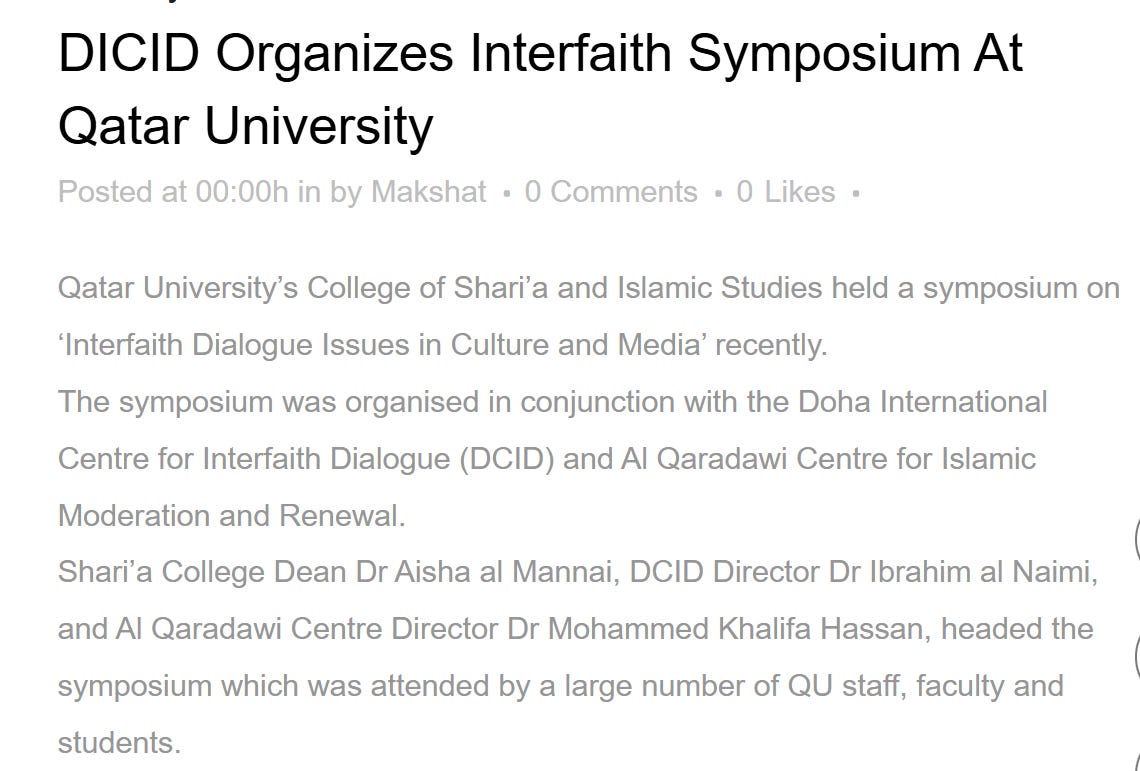
According to DICID’s own account, Al-Naimi and the directors of the other participating institutions headed the event, which addressed interfaith dialogue in culture and media.
These associations are particularly relevant given Al-Naimi’s senior role within Qatar’s education establishment and his growing participation in international academic and religious-policy networks.
BYU’s Longstanding Institutional Relationship With Qatar
BYU, whose president will appear alongside Al-Naimi, has its own history of cooperation with the Qatari government. According to an account published by BYU Studies, Qatar’s ambassador to the United Nations approached the university’s World Family Policy Center in 2003 about organizing an international conference on family policy.
The initiative developed into the 2004 Doha International Conference for the Family, organized under the patronage of Sheikha Moza bint Nasser, chairperson of Qatar Foundation. BYU’s center helped coordinate preparations for the gathering, which culminated in the Doha Declaration concerning family policy and international social norms.
The relationship subsequently extended beyond conference organizing. Richard G. Wilkins, then director of BYU’s World Family Policy Center, was appointed the initial managing director of the Doha International Institute for Family Studies and Development beginning in 2006. The institute was established in cooperation with Qatar Foundation.
Qatar’s Nearly $9 Billion Footprint in American Higher Education
Al-Naimi’s appearance comes against the backdrop of Qatar’s extraordinary financial involvement in American academia. The Congressional Research Service’s March report identified approximately 1,300 Qatar-attributed gifts and contracts totaling $8.8 billion in federal higher-education disclosures.
The figures combine philanthropic gifts with contractual payments, including arrangements supporting American university branch campuses operating in Qatar. They therefore should not be interpreted as $8.8 billion in unrestricted donations to universities on American soil.
From Interfaith Dialogue to International Policy
The broader significance of the conference lies in its stated ambitions beyond religious dialogue. Founded in 2014, the G20 Interfaith Forum seeks to incorporate religious perspectives into international policymaking. Its annual conferences convene religious leaders, academics, government representatives, and civil society organizations to develop recommendations relating to priorities considered by G20 governments.
Although IF20 operates independently of the G20’s formal decision-making institutions, its 2026 program explicitly seeks to connect religious networks with practical policy proposals.
The October gathering includes discussions on expanding religious-literacy programs for teachers and students, developing educational curricula on artificial intelligence, and improving faith-based organizations’ ability to influence international policy.
Those objectives provide the context for Al-Naimi’s appearance alongside the presidents of Baylor and BYU. As a senior official from the country responsible for the largest reported financial footprint in American higher education, Al-Naimi brings both government authority and an established network of religious and academic associations to a conference explicitly concerned with the future of education and public policy.
Al-Naimi’s documented institutional associations, his previous cooperation with IF20 leadership, and Qatar’s extensive relationships with American universities raise important questions about how foreign-government education officials gain access to influential academic and policy networks, and the transparency surrounding those relationships.