



People with indicators of a stronger religious upbringing are more likely to invest in stocks and become self-employed, yet less likely to face criminal charges, according to new research examining Danish population records spanning more than two decades.
The findings, presented at Stanford University on November 12 and summarized on November 17, suggest that religion may influence not simply how much risk individuals are willing to accept, but which kinds of risks they choose to take.
The research was conducted by Jeanet Sinding Bentzen and Anne Sofie B. Knudsen of the University of Copenhagen, alongside Gunes Gokmen of Lund University. Their findings challenge the conventional assumption that religious belief generally encourages caution and discourages risk-taking. Instead, the researchers found that stronger indicators of religiosity corresponded with greater participation in potentially risky economic activities alongside a reduced likelihood of criminal charges.
The research, titled Risky Business? Religiosity and Risk-Taking in Full-Population Danish Data, was also featured on the November 14 program of the National Bureau of Economic Research’s Economics of Religion conference in San Francisco.
Religious Background Linked to Greater Financial Risk-Taking
The researchers examined Danish administrative records covering the country’s population between 1997 and 2021, investigating whether religious background helps explain differences in financial behavior that income and wealth alone cannot fully account for.
One motivation was a longstanding puzzle in household finance. Economic theory suggests that most households should own at least some stocks to diversify their assets, yet large numbers avoid the market entirely. According to Stanford’s summary, roughly 10% of the wealthiest households hold no stocks, indicating that access to money is not the only factor influencing investment decisions.
The researchers found that individuals with higher estimated religiosity were more likely to own stocks and allocate a larger proportion of their assets to equities, exposing themselves to greater financial uncertainty.
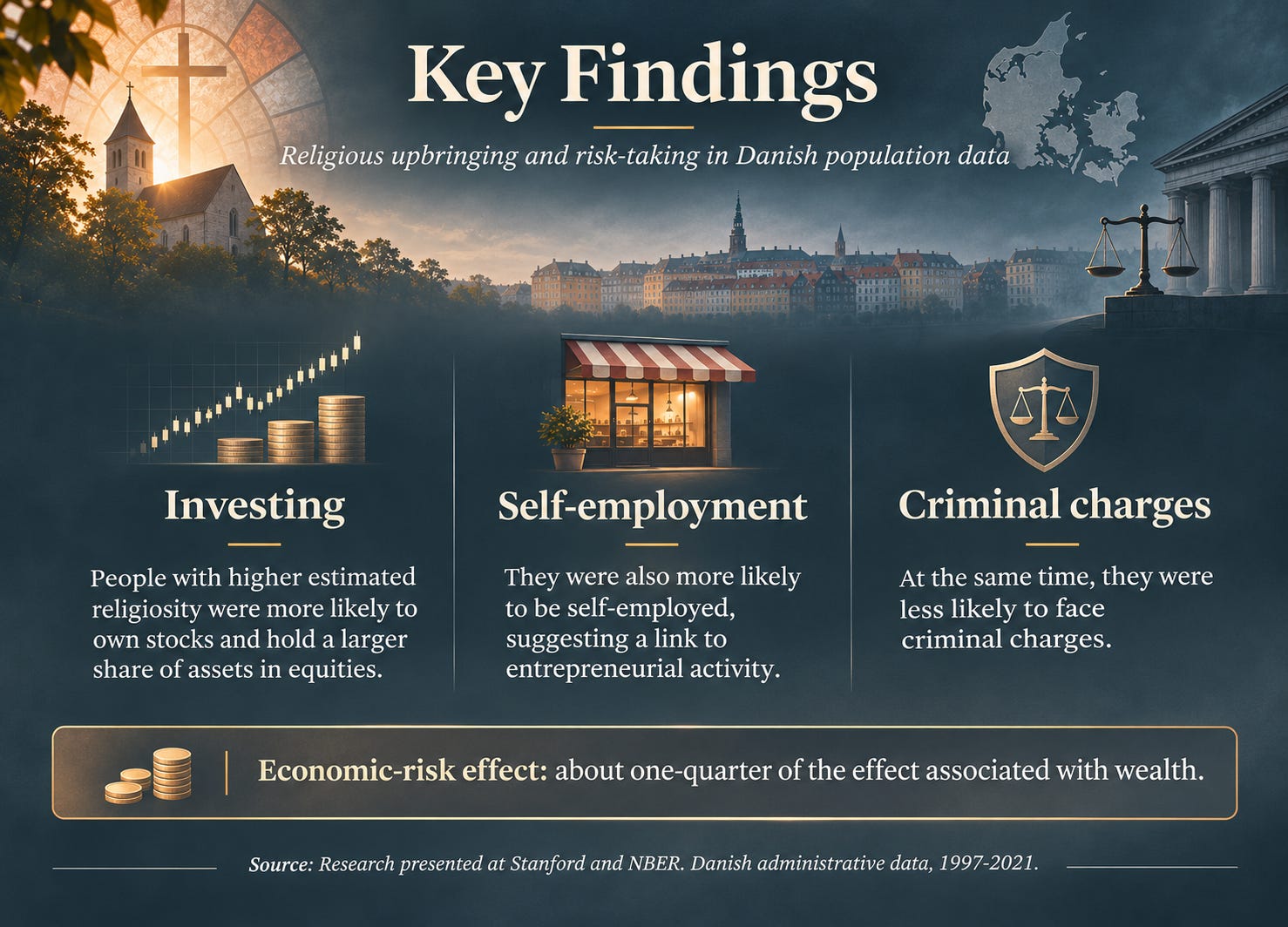
They were also significantly more likely to be self-employed, suggesting an association between religious background and entrepreneurial activity. The effects were substantial enough to stand out alongside conventional economic predictors. According to the research abstract, the estimated relationship between religiosity and economic risk-taking was equivalent to approximately one-quarter of the effect associated with wealth.
However, the pattern reversed when researchers examined criminal behavior. Individuals with higher religiosity scores were less likely to face criminal charges, suggesting that religious background may be associated with greater acceptance of financial uncertainty while discouraging risks involving unlawful conduct.
How Researchers Measured Religion Through First Names
One of the study’s most unusual features is how it measured religious background.
Danish administrative records contain extensive economic and demographic information but do not directly record individuals’ religious beliefs. To overcome this limitation, the researchers developed a measure based on first names.
The approach rests on the observation that religious parents may be more likely to choose names associated with religious traditions. Researchers assigned religiosity scores to names based on their prevalence among religious groups and compared those scores with responses from the European Values Study.
According to Stanford, the resulting scores were considerably more closely associated with religiosity than with other surveyed attitudes.
The approach builds on related research, Names as Cultural Mirrors, published by the Centre for Economic Policy Research in July 2025 and revised in May 2026. That study found that first names could provide measurable indicators of parental religiosity, nationalism, traditionalism, and collectivism.
To test whether the new findings merely reflected differences between families, Bentzen and her colleagues also conducted comparisons involving siblings, who share much of their family background.
The estimated associations declined by approximately half under stricter comparisons but remained statistically significant, according to Stanford’s summary.
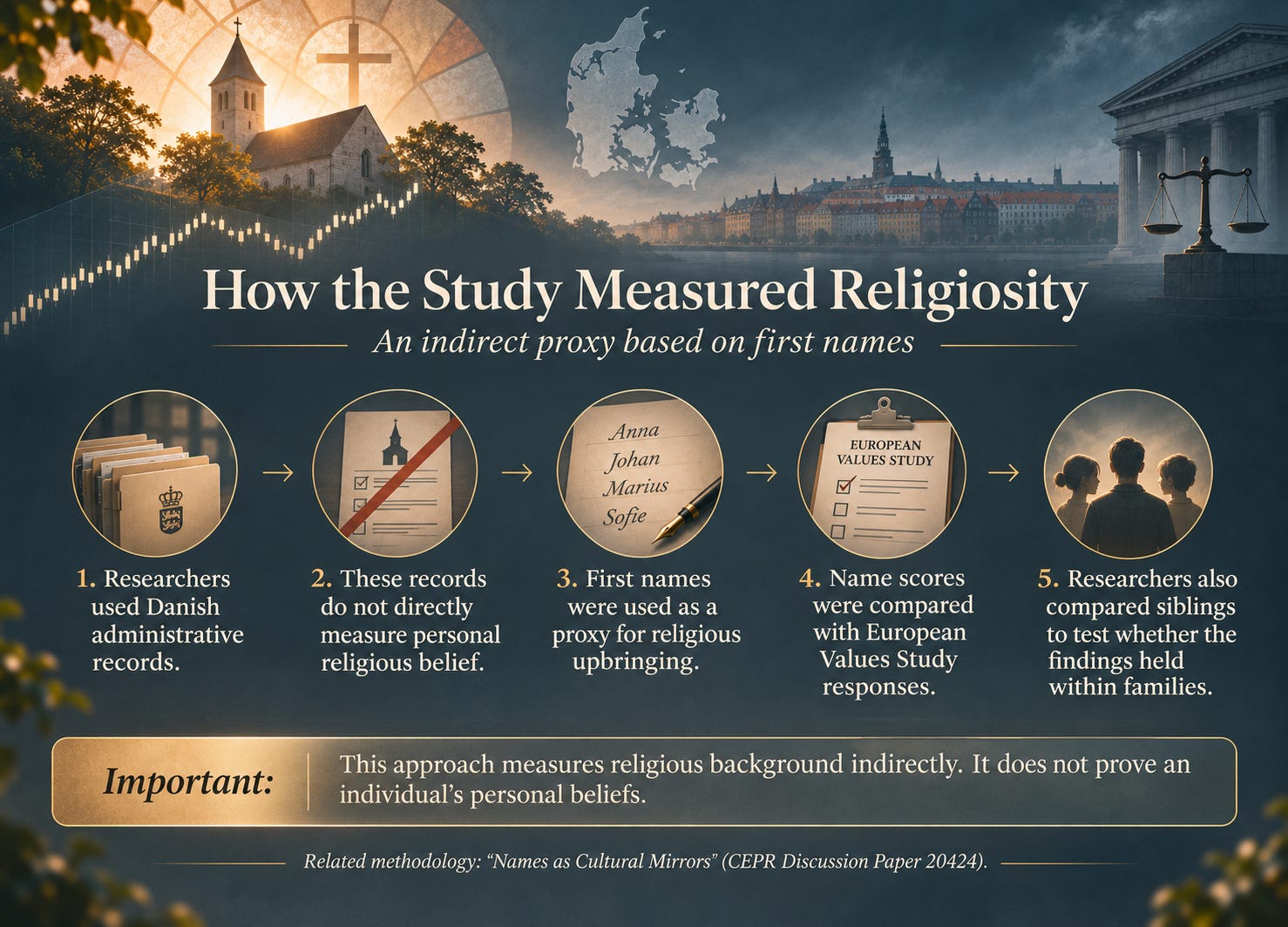
The associations remained statistically significant in sibling comparisons, strengthening the findings while leaving open the possibility of other unmeasured influences. The name-based approach also cannot establish an individual’s personal religious convictions or prove that religion directly caused the observed behavior.
Why Religion Might Encourage Some Risks but Discourage Others
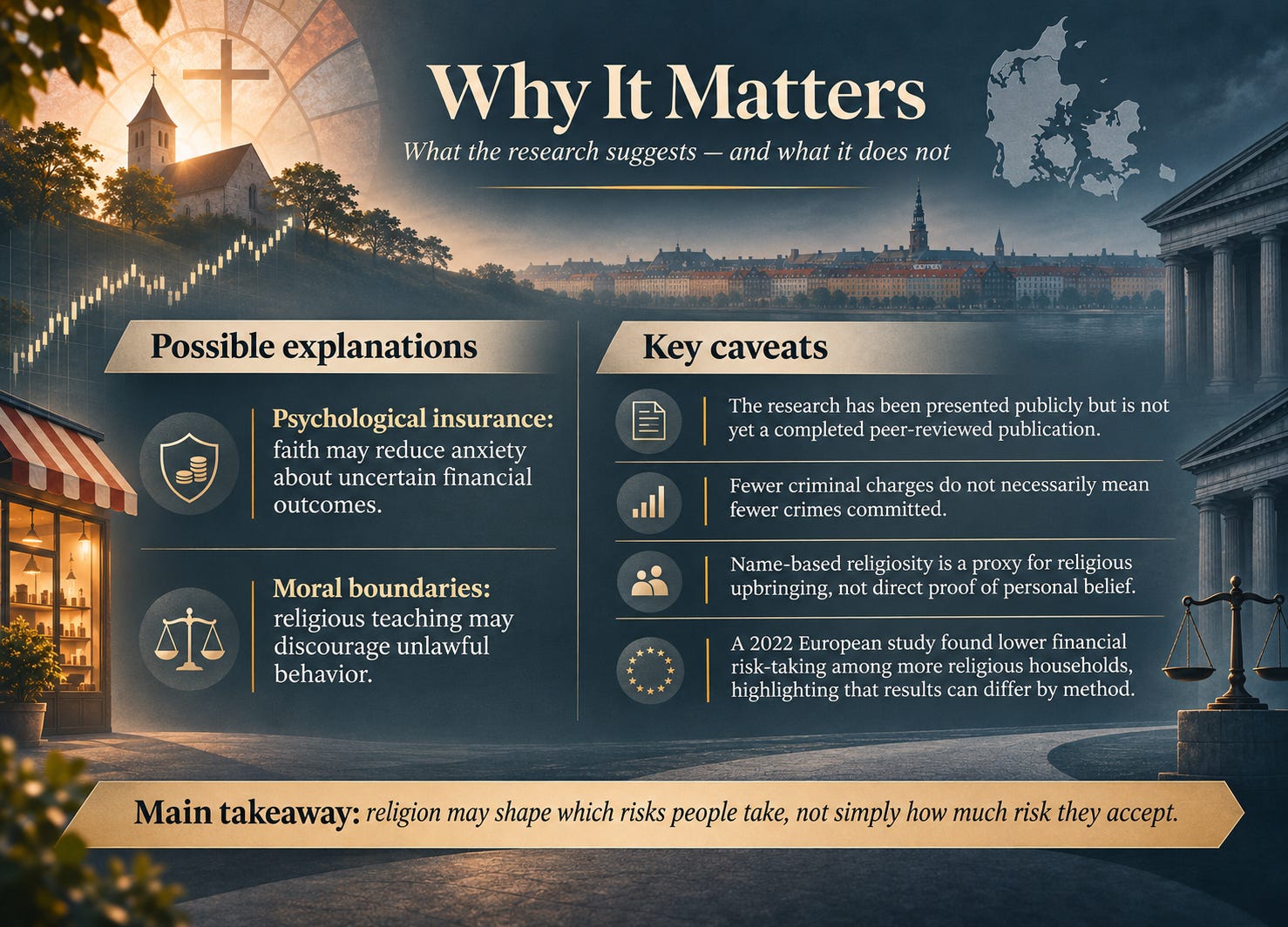
The researchers propose two explanations for the seemingly contradictory findings. The first involves religious coping, the psychological reassurance that individuals may derive from believing in a protective or benevolent God.
Such beliefs could reduce anxiety about uncertain outcomes, effectively providing what the researchers describe as “psychological insurance.” Individuals who feel more secure about the future may consequently be more comfortable making investments or undertaking entrepreneurial ventures.
The second explanation concerns religious teachings that establish moral boundaries around particular forms of behavior. While investing or starting a business may be compatible with religious values, activities involving fraud, violence, or other prohibited conduct can carry additional moral or spiritual consequences for believers.
Religion could therefore encourage certain forms of economic risk-taking while increasing the perceived costs of unlawful behavior.
The researchers also considered whether religious communities offer social networks and informal financial support that make economic risks easier to bear. However, Bentzen suggested that this mechanism may be less important in Denmark, where church attendance is relatively uncommon.
The distinction is particularly noteworthy because previous research has sometimes reached different conclusions. A 2022 study published in the Journal of Empirical Finance found that greater household religiosity was associated with lower financial risk-taking across several European countries. Its findings also suggested that differences between religious denominations influenced attitudes toward financial uncertainty.
However, the earlier study relied on survey-based measures of household financial risk preferences, whereas the new Danish research examines observed behaviors, including actual stock ownership and self-employment. These methodological differences may help explain why the studies reached contrasting conclusions.
Faith and Social Responsibility
Taken together, the findings paint a positive picture of religious upbringing. Individuals with stronger indicators of religiosity were more likely to invest and pursue self-employment, while being less likely to face criminal charges.
Although the study does not establish causation, its findings suggest that religious upbringing may be associated with greater economic initiative and more law-abiding behavior, pointing to a potentially beneficial role for faith in society.