


A new Middle East Forum investigation by journalist Leslie Kajomovitz is drawing scrutiny to the Human Development Fund, a Michigan-based Muslim humanitarian charity whose revenue jumped from $1.08 million in 2023 to $33 million in 2024. Published September 14, the report identified $3.13 million in advertising and promotion, more than $1 million in domestic grants to organizations it says are linked to HDF leadership, and discrepancies in the charity’s reporting of overseas operations. Cross Currents’ review of the underlying Form 990 and HDF’s audited statements confirms the major spending figures and reveals an internal inconsistency in its foreign-operations disclosures. But it also shows that one MEF claim about anonymous foreign grantees reflects IRS reporting rules rather than a choice by HDF.


A Charity That Grew Thirtyfold in a Year
HDF was formed in Michigan in 2023 and reported just over $1.08 million in revenue that year. Its 2024 return reported $33,006,950 in revenue and $11.44 million in expenses, leaving nearly $21.9 million in net assets at year-end.
Roughly half of that 2024 revenue was not cash. HDF’s audited financial statements reported a $16.286 million in-kind medical shipment that was still in transit on December 31, 2024, recorded as both contribution revenue and inventory until distribution.
The financial statements received an unqualified audit opinion for 2024. That followed a qualified 2023 audit in which the prior auditor said it could not obtain sufficient evidence for certain program expenses because contracts, budgets or program-completion reports were unavailable. HDF’s 2024 notes state that management subsequently obtained the necessary documentation.

$3.1 Million in Advertising
The most striking verified figure is HDF’s advertising budget. Its 2024 Form 990 reported $3,132,170 in “advertising and promotion,” split exactly in half between program-service and fundraising expenses, with $1,566,085 assigned to each category.
MEF compared that advertising bill with $2.69 million in grants HDF listed for foreign organizations in Africa, the Middle East and South Asia. The broader Form 990, however, reported $3.70 million in total grants and assistance to foreign organizations, governments and individuals, meaning the advertising figure exceeded the grants to foreign organizations listed on Schedule F, but not HDF’s full foreign-assistance total.
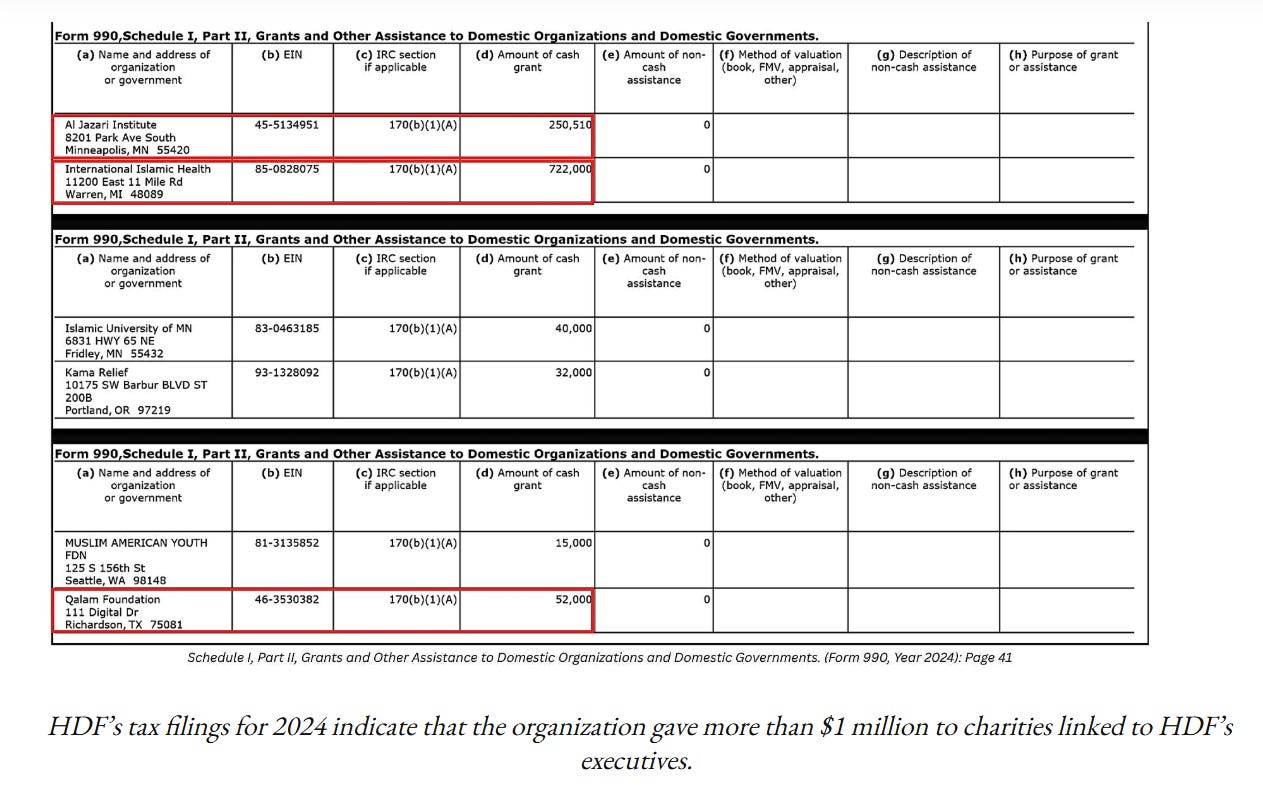
MEF also identified more than $1 million in domestic grants to organizations it says have leadership or institutional overlaps with HDF. HDF’s Schedule I reported $722,000 to an entity named “International Islamic Health,” whose EIN corresponds to the Miftaah Institute; $250,510 to Al Jazari Institute; and $52,000 to Qalam Foundation.
A Real Overseas Reporting Discrepancy
The strongest disclosure issue is more specific than MEF’s article suggests. HDF’s main 2024 Form 990 checked “Yes” when asked whether it maintained an office, employees or agents outside the United States. Yet its Schedule F listed zero foreign offices and zero employees, agents or independent contractors across the regions in which it reported activity.
At the same time, HDF’s Gaza fundraising portal says it has more than 90 “HDF team members in Gaza” and describes aid moving through HDF teams living inside the territory. The filings do not explain how those workers are classified, leaving a genuine discrepancy between HDF’s public description and the personnel totals on Schedule F.
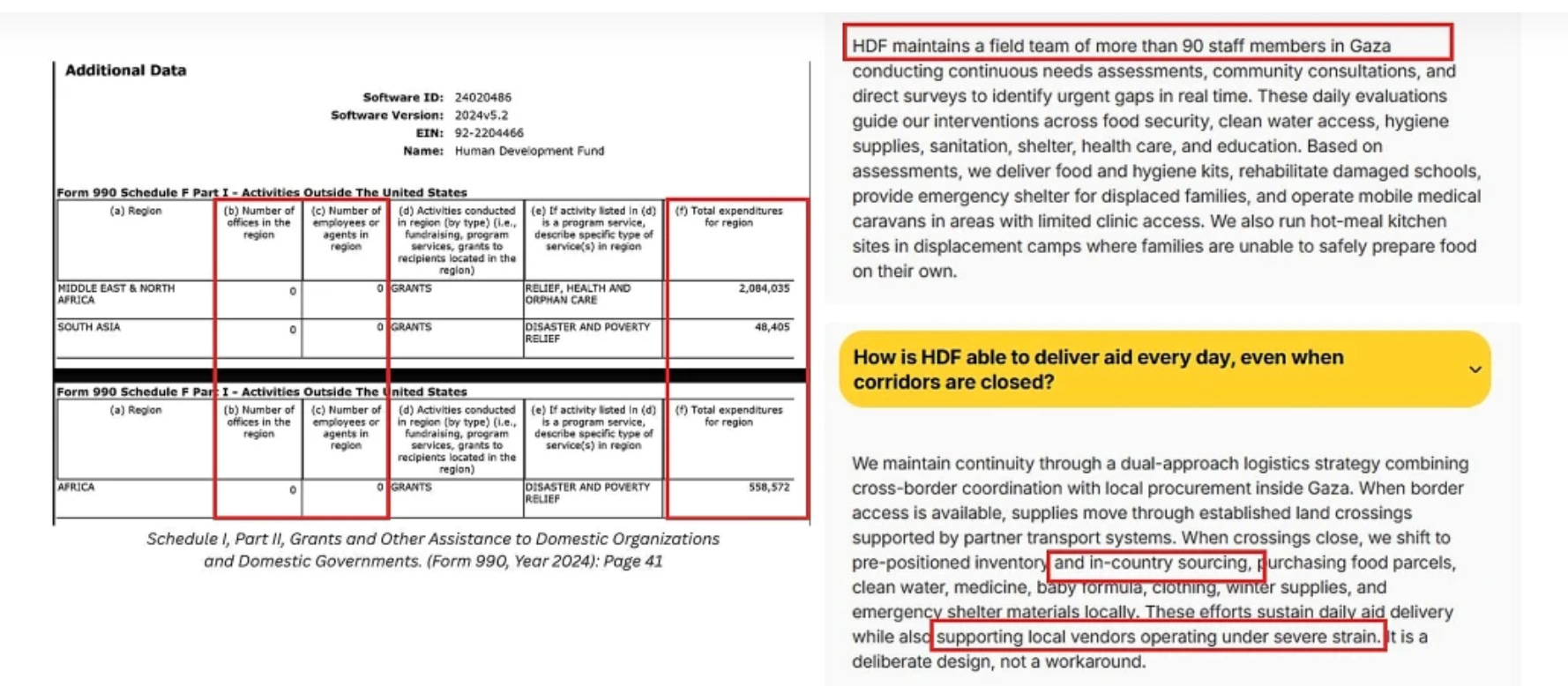
MEF separately criticized HDF for leaving foreign recipient names blank. That point does not hold up as evidence of concealment: IRS instructions explicitly direct Form 990 filers not to complete the recipient-name or EIN columns for foreign organizations on Schedule F. HDF therefore followed the form’s instructions by reporting recipients by region, purpose and amount.
What the Filings Actually Show
The MEF report places HDF within a broader network that includes Omar Suleiman, whom HDF itself prominently features in Gaza fundraising appeals, and leaders connected to Dar Al-Farooq Islamic Center in Minnesota. MEF said HDF did not respond to its questions before publication.
The filings do not, by themselves, establish diversion or misuse of charitable funds. They do show a two-year-old nonprofit that expanded to $33 million in revenue, spent more than $3 million on advertising, distributed large domestic grants to organizations in its religious network, and filed conflicting answers about its overseas footprint. Those are substantial questions for a charity that grew from roughly $1 million to $33 million in a single year, even after correcting the parts of MEF’s analysis that go beyond what the IRS records support.