


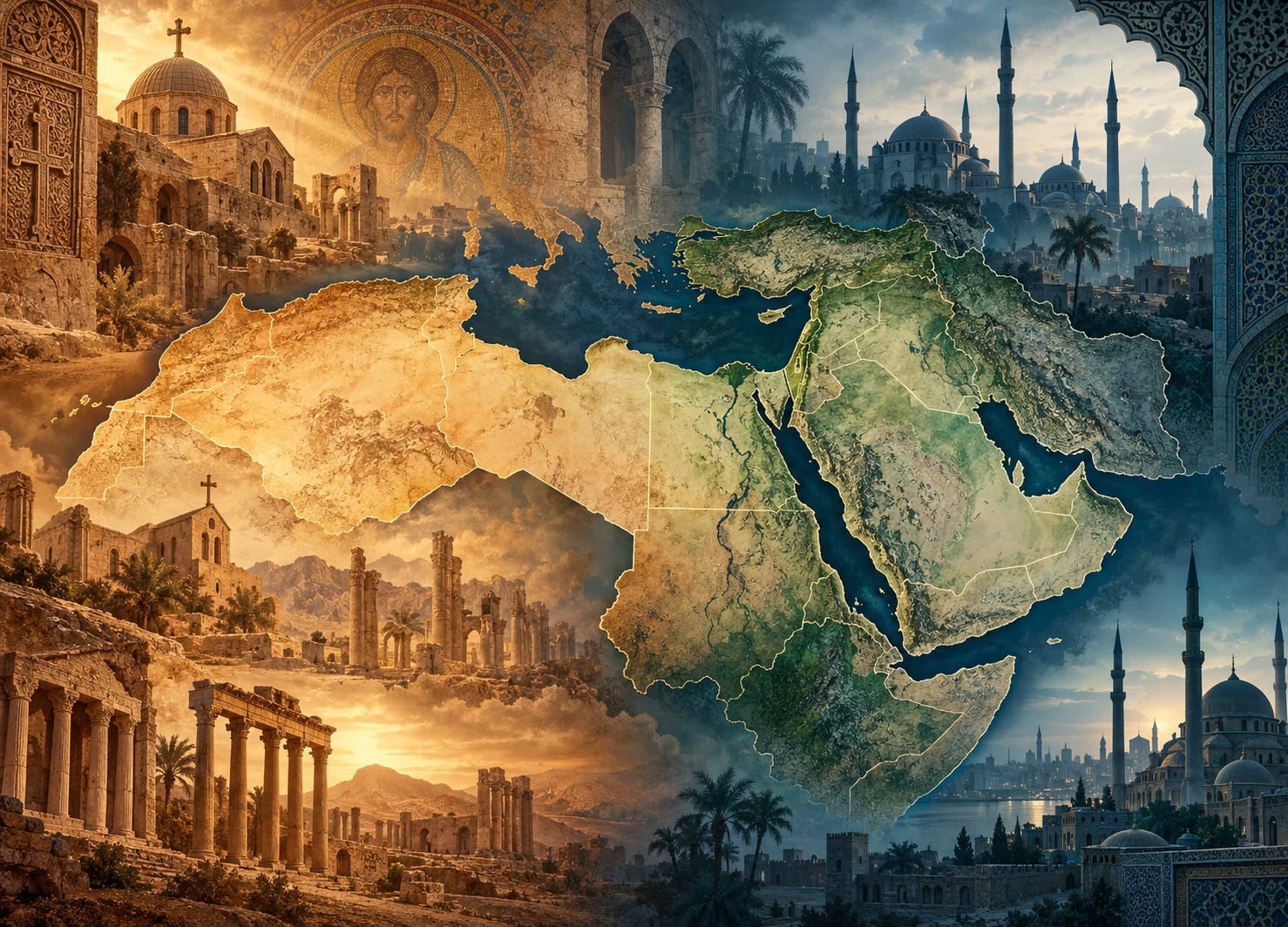
Robert F. Kennedy Jr. said this week that much of the Middle East was once Christian, pointing to a dramatic religious transformation that began with the Islamic conquests and unfolded over centuries. Speaking Monday in Grand Rapids, Michigan, Kennedy asked, “What happened to the Christians? There were millions and millions of Christians.”
He described Egypt, Libya, Algeria, Iraq, Syria and Lebanon as formerly Christian societies and said Christians had fallen from roughly 20% to 4% of the region’s population.
“These were genocides,” Kennedy said. His remarks were reported by The Daily Wire. Kennedy’s terminology and some of his figures compress a far more complicated history. But his broader point raises a striking historical question. Much of the Middle East and North Africa that is overwhelmingly Muslim today was once predominantly Christian.


Before the Muslim Conquests
When Muslim armies expanded beyond Arabia in the seventh century, they did not conquer an already-Muslim Middle East.
Egypt was predominantly Christian. Syria and Palestine were largely Christian territories of the Byzantine Empire. North Africa contained some of early Christianity’s most important centers. Augustine of Hippo lived in what is now Algeria, while Carthage, in modern Tunisia, produced major Christian thinkers.
Mesopotamia, including modern Iraq, contained large Christian communities alongside Jews and Zoroastrians. The Muslim military conquest was extraordinarily rapid. The religious transformation was not.
Cambridge historian Sidney Griffith writes that Christians remained the religious majority in many areas under Muslim rule “until well into the eleventh century.” Political control came first. Islamization followed over centuries.
How Christian Lands Became Muslim
That transformation cannot accurately be reduced either to universally peaceful conversion or mass conversion at sword point.
Christians and Jews generally lived under Muslim rule as dhimmis, protected but legally subordinate communities. Non-Muslims were subject to the jizya poll tax and other restrictions that varied by ruler and period. Conversion to Islam removed those religiously specific obligations and could improve access to political, economic and social advancement. There were also periods of persecution, restrictions on churches, confiscation and coercive pressure.
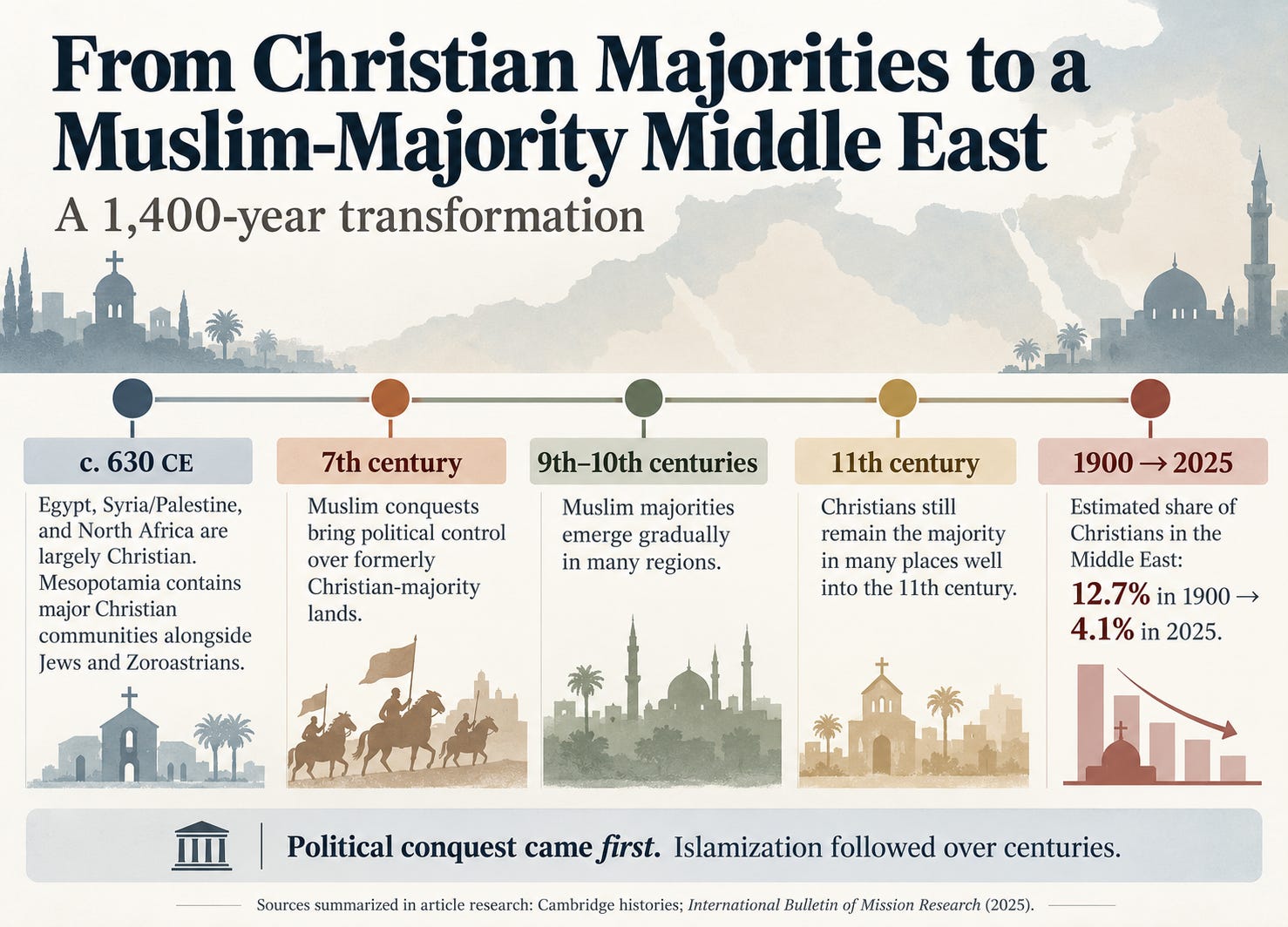
The cumulative result was profound. Territories whose populations had been overwhelmingly or substantially Christian when conquered gradually became overwhelmingly Muslim. North Africa is particularly striking. The indigenous Christian civilization that produced Augustine and flourished around Carthage eventually virtually disappeared, while Christianity survived much more substantially in Egypt and parts of Syria and Iraq.
The Modern Christian Decline
Kennedy’s claim that Christians declined from 20% of the Middle East to 4% has a recognizable basis, although 1948 is not the correct starting point. A 2025 demographic study estimates Christians represented 12.7% of the Middle East in 1900 and 4.1% in 2025.
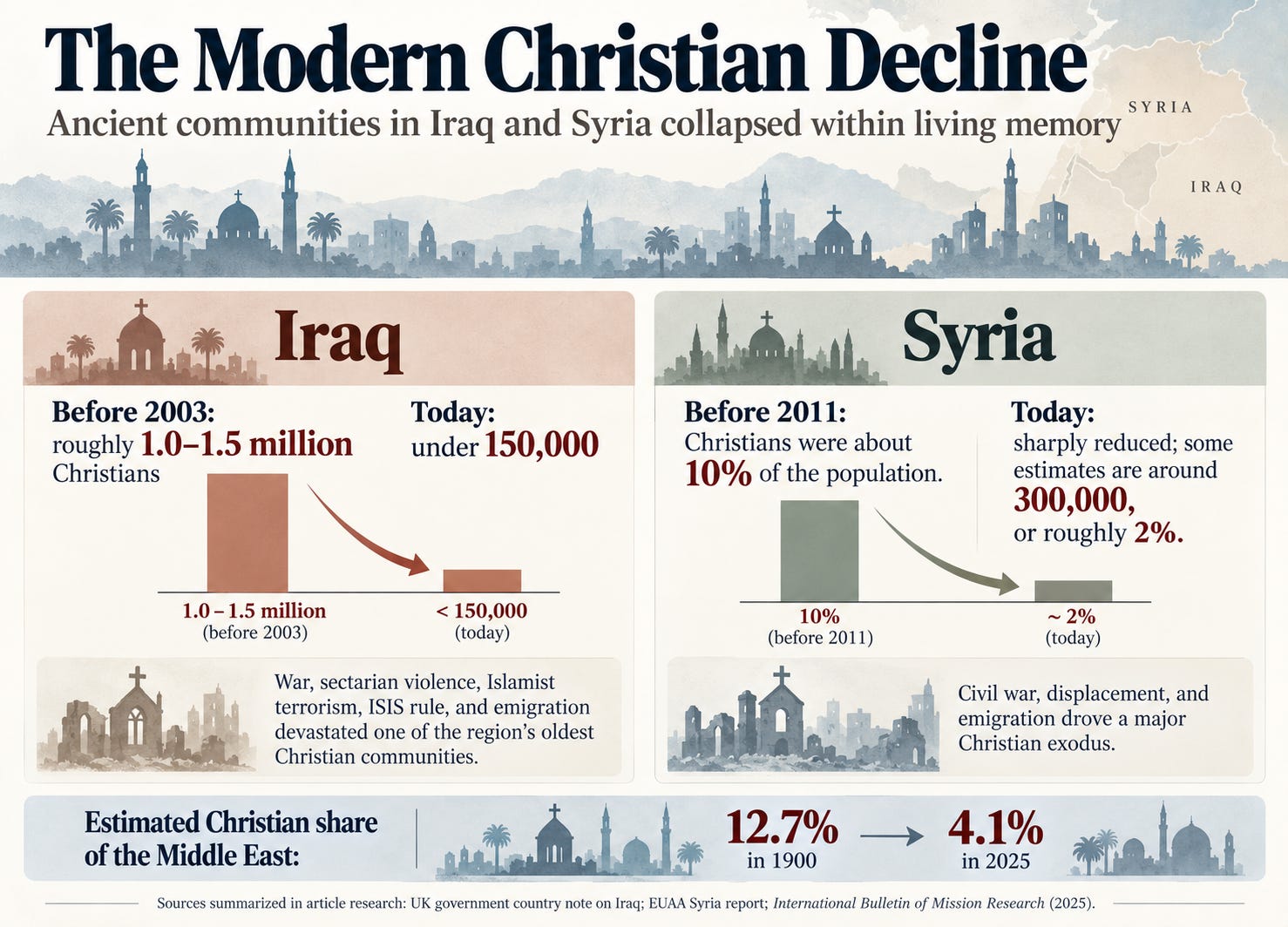
In several countries, the contraction accelerated dramatically in recent decades. Iraq had roughly one million to 1.5 million Christians before 2003. Today the community is a fraction of that size following sectarian violence, Islamist terrorism, ISIS rule and mass emigration. Syria has experienced another major Christian exodus during its civil war.
Kennedy Also Pointed to the Uprooting of the Jews
Kennedy then pointed to a second demographic transformation, one that happened far more rapidly. He said roughly 950,000 Jews lived in Arab countries around 1948 and asked what became of communities that had existed across the region for centuries.
British parliamentary figures put the Jewish population of the Middle East, North Africa and Gulf at approximately 856,000 in 1945. By 2019, only around 4,500 remained, overwhelmingly in Morocco and Tunisia. (hansard.parliament.uk)
They did not simply disappear. Across Arab countries, Jews faced combinations of pogroms, arrests, discriminatory laws, citizenship revocations, confiscation of assets and expulsions. Hundreds of thousands were forced out or concluded they could no longer safely remain.
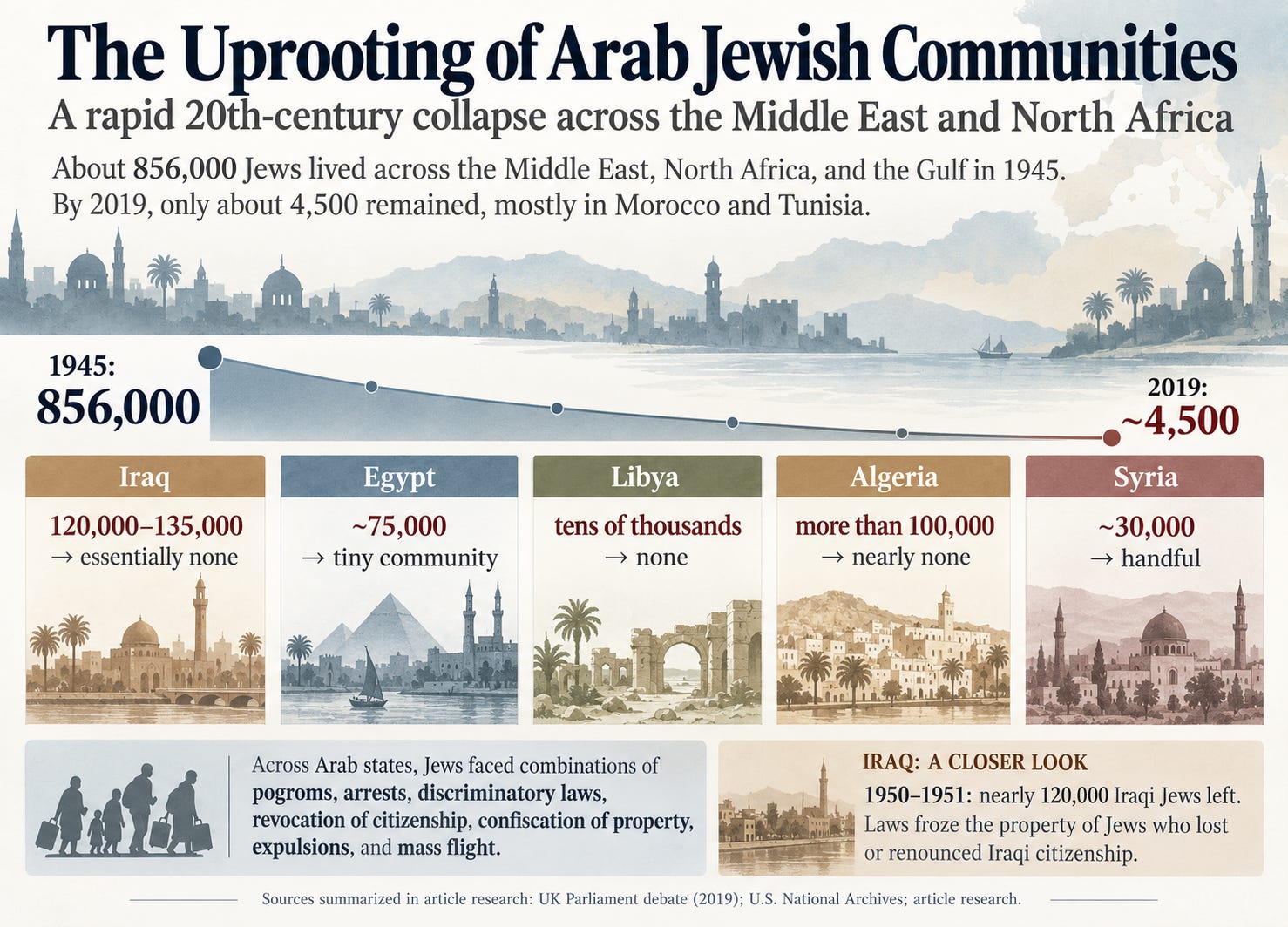
Iraq offers one of the starkest examples. Its Jewish community had existed for roughly 2,600 years. The 1941 Farhud pogrom killed around 180 Jews. After Israel’s establishment, Iraqi Jews faced increasing arrests and persecution.
In 1950 and 1951, nearly 120,000 Iraqi Jews left Iraq. The U.S. National Archives documents how Jews surrendering Iraqi nationality lost citizenship and how the government subsequently froze their property.
Similar combinations of state action, violence and persecution emptied once-large Jewish communities in Egypt, Libya, Syria, Algeria and elsewhere. By the end of the process, Jewish civilizations that had existed across the Arab world for centuries, and in some places for millennia, had been almost entirely uprooted.
A Region Remade
Kennedy’s use of the word “genocide” compresses different historical events and mechanisms into one category. But the scale of the transformation should not be softened.
When Muslim armies conquered Egypt, Syria, Palestine and North Africa, they took political control of lands whose populations were largely Christian. In many places, those populations remained Christian majorities for centuries.
Then the balance reversed. Through centuries of conversion, demographic change and Arabization, under a political and legal system that placed Christians and Jews in a subordinate position and periodically subjected them to persecution, lands that had once been centers of Christianity became overwhelmingly Muslim.
Centuries later came another enormous rupture. In the 20th century, ancient Jewish communities across the Arab world were subjected to persecution, confiscation, expulsion and mass flight until most had been uprooted.
The Middle East was not always overwhelmingly Muslim. Its modern religious map is the result of profound political and demographic transformations stretching across more than 1,400 years. Kennedy reduced that history to a few minutes of political rhetoric. But the transformation he pointed toward was real, and it reshaped an entire region.