


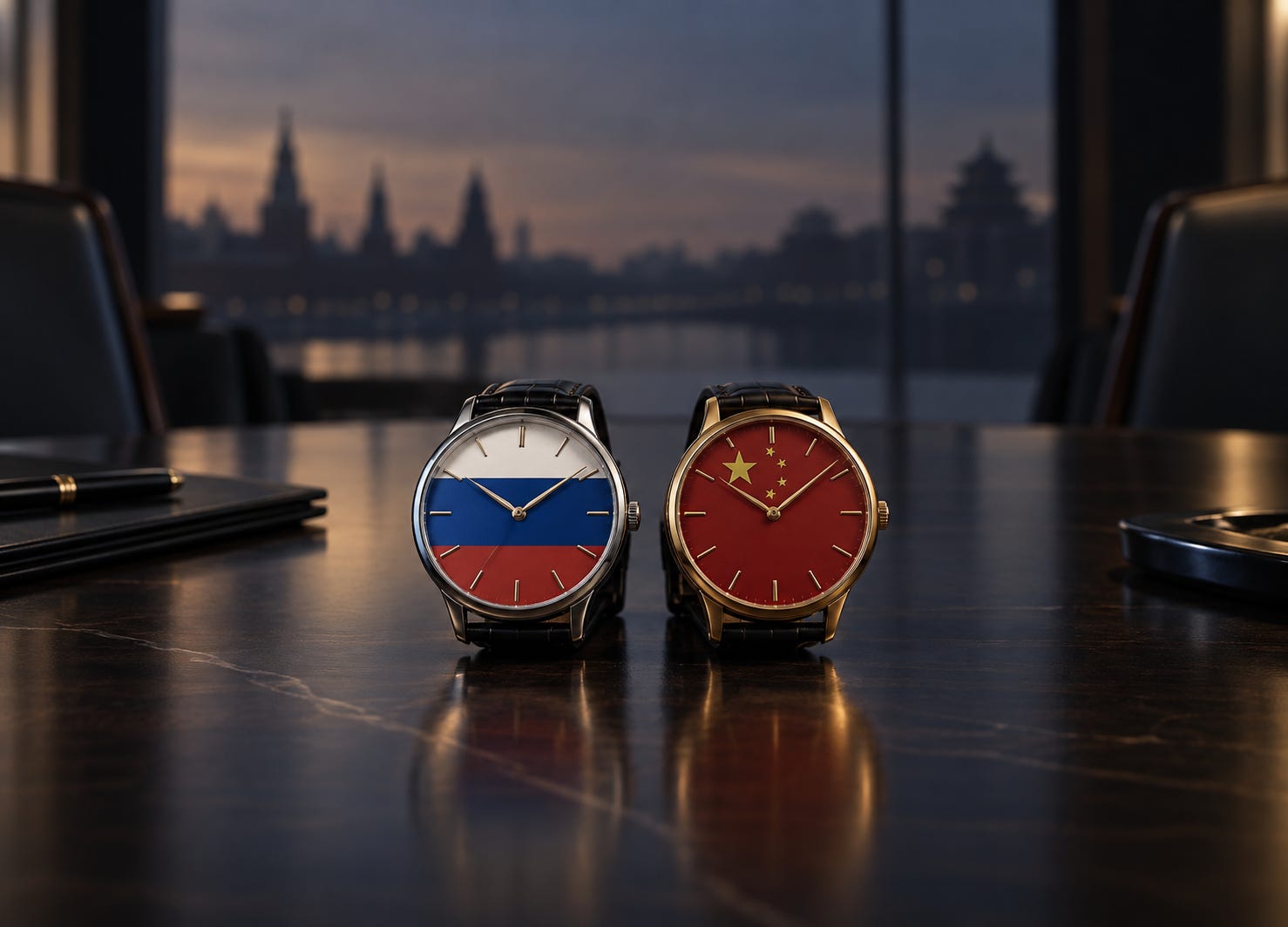
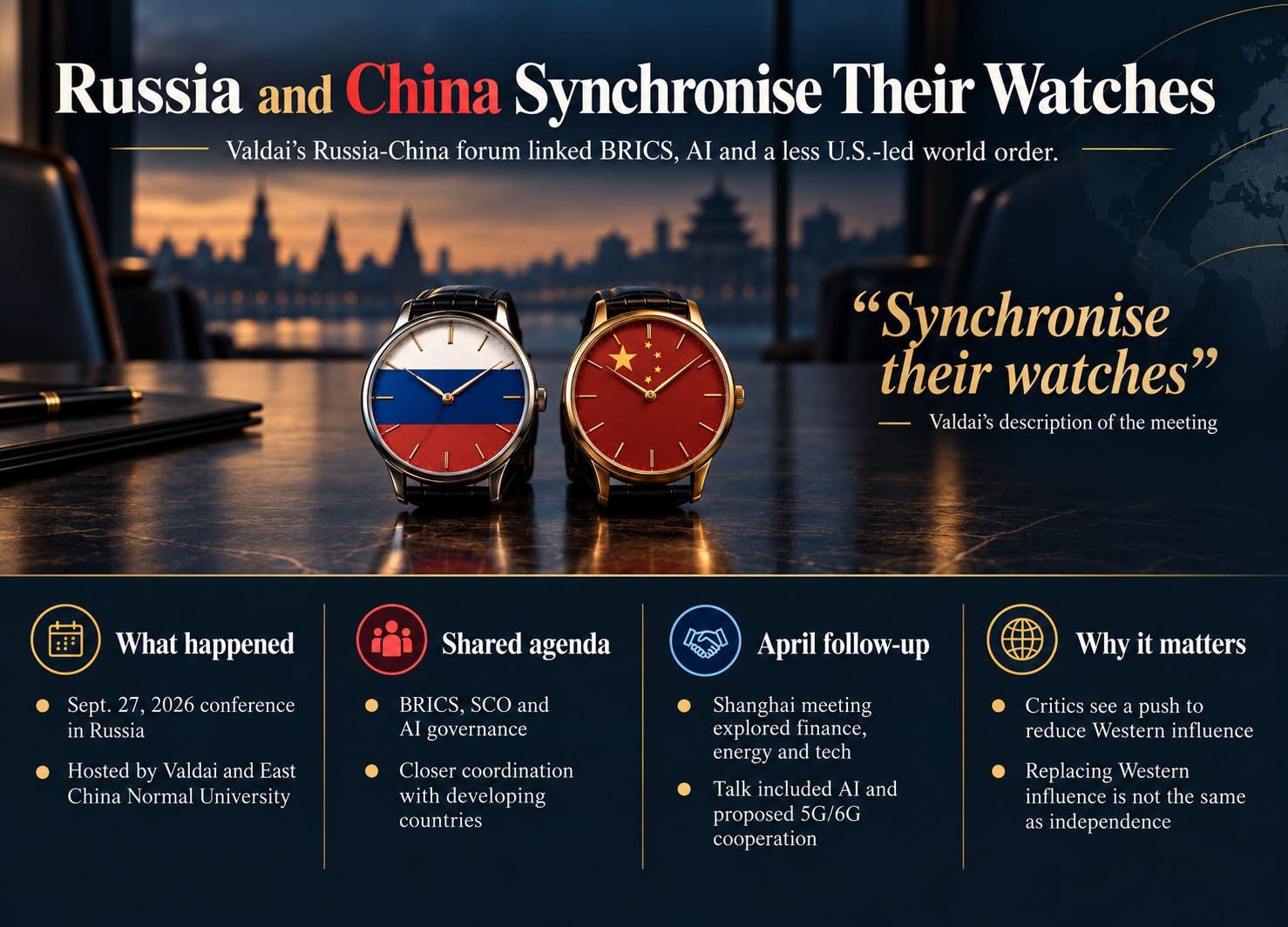
Russian and Chinese foreign policy experts met in Russia on September 27, 2026, to discuss their countries’ roles in reshaping the international order. The conference, organized by Russia’s Valdai Discussion Club and the Centre for Russian Studies at East China Normal University, was part of a twice-yearly series held alternately in Russia and China.
Valdai described the purpose as allowing experts to “synchronise their watches.” Its summary linked BRICS, the Shanghai Cooperation Organisation, international AI governance and cooperation with developing countries to a multipolar order requiring sustained Russian-Chinese diplomatic coordination.
A Shared Agenda for Global Rules
Valdai’s participants included Wang Wen of Renmin University’s Chongyang Institute for Financial Studies, Sergei Karaganov and Anastasia Likhacheva of Russia’s Higher School of Economics, Valdai research director Fyodor Lukyanov, and Wen Jiang of the Xinhua Institute.
Valdai portrayed Russian-Chinese cooperation as helping developing countries escape “neo-colonial dependence” on Western states. Such language presents Moscow and Beijing’s ambitions as “liberation.”
The September gathering followed an April 26–27 conference held by the same organizers in Shanghai. Valdai’s account described discussions of energy connections, financial clearing centers for infrastructure projects, a possible AI consortium and a proposed joint 5G/6G research laboratory.
The April account was explicit about the political objective. It said participants wanted Russia and China to help shape a future world order and “block the West’s destructive activity.”
An American Answer
The problem with the Russian-Chinese pitch is not that countries want more influence. It is that Moscow and Beijing present themselves as liberators from Western power while asking others to ignore how they use power themselves.
Russia invaded Ukraine and has built sanctions-resistant financial networks to sustain its war economy. China’s record includes political repression at home and the use of economic pressure abroad. That makes their language of “sovereignty,” “development” and “decolonization” harder to separate from a broader effort to weaken Western leverage while expanding their own.
The September Valdai conference made that strategy unusually clear. Participants discussed coordinating finance, technology, diplomacy and international institutions in pursuit of an order less shaped by the United States and its allies.
“The problem with the Russian-Chinese pitch is not that countries want more influence. It is that Moscow and Beijing present themselves as liberators from Western power while asking others to ignore how they use power themselves.”
For Washington, the answer should not be apologetic retreat. The United States and its partners should defend the system they built while improving it: open commerce, alliances, transparent institutions and rules intended to constrain powerful states as well as weak ones.
Russia and China call their alternative “multipolar.” Their own discussions show that it is also a strategy for accumulating power and reducing Western influence.
Interesting years ahead_the global economic power base is shifting!