


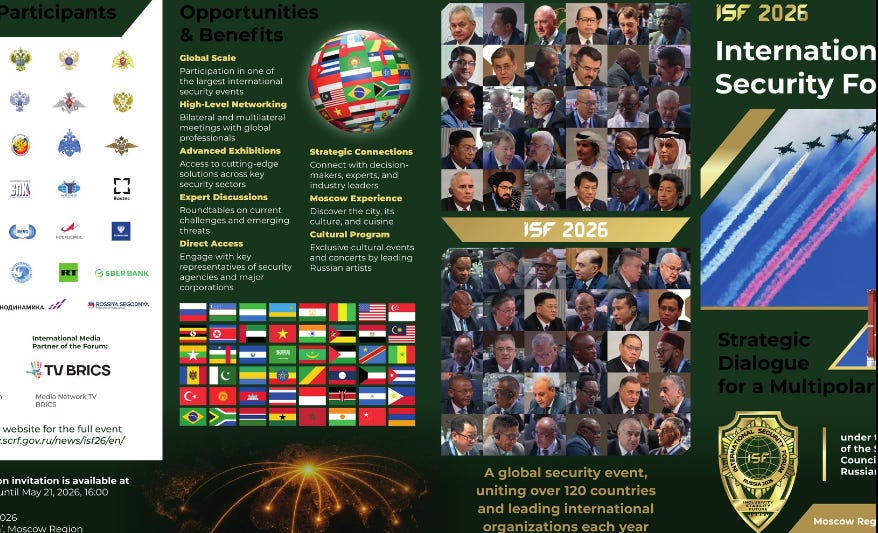
From May 26-29, Russia will host the first International Security Forum under the auspices of its Security Council — an event that transcends typical defense exhibitions to establish a comprehensive worldview casting the West as an existential threat. With delegations from over 180 countries and 26 international organizations invited, the forum represents Moscow’s most ambitious attempt yet to formalize an anti-Western ideological framework and export it to partners across Africa, Asia, and Latin America.
The forum’s program reveals a striking inversion of Western security narratives. Where Washington and Brussels emphasize democratic resilience and counter-disinformation, Moscow positions itself as defender of sovereignty against covert interference. A panel titled “Disinformation and Manipulation as Tools of the West’s Hybrid War against the Global Majority for Maintaining Hegemony” frames information warfare as a Western weapon, while another session on “Countering Neocolonialism as a Priority for Ensuring Security of the Global Majority Countries” elevates anti-colonial rhetoric to national security priority. The term “Global Majority,” appearing throughout the program, signals deliberate ideological alignment with the Global South against what Russia characterizes as Western hegemony.

Civil Society as Security Threat
A dedicated round table titled “NGOs as a Tool for Undermining National Security” reframes civil society, a cornerstone of Western foreign policy, as an instrument of subversion. This session sits alongside discussions of terrorism, hybrid warfare, and weapons systems, effectively placing humanitarian organizations, watchdog groups, and development actors in the same conceptual category as security threats. The message to partners in Africa and Asia is unmistakable: sovereignty requires insulation from independent actors of any kind.
The investigative collective All Eyes on Wagner has documented how Russia’s SVR-controlled organization Africa Politology has lobbied for foreign-agent laws in the Sahel and Central African Republic, with playbooks that include suppression of media and civil society voices. In the CAR, Wagner Group operatives have arrested staff from humanitarian organizations, subjecting them to hostile campaigns.
Ukraine and the Neo-Nazi Narrative
The forum places Ukraine at the center of its ideological architecture. Two sessions explicitly address “Terrorist Methods of the Kyiv regime on the Background of the Spread of neo-Nazism in Ukraine” and “War Crimes of the Kyiv regime: Recording and Systematization.” These panels are framed not as debatable interpretations but as established facts, reinforced by exhibitions featuring films from Russia Today’s documentary section and photographs from conflict zones. The Ministry of Foreign Affairs will present an exhibition specifically on “War Crimes of the Kyiv regime,” suggesting the forum aims less at dialogue than at codifying a singular interpretation for international allies.
This narrative has echoed in Russian diplomatic statements, with Foreign Ministry declarations describing the “Kiev regime” as demonstrating “human-hating neo-Nazi nature” following terrorist attacks. By presenting these characterizations alongside legitimate security discussions, the forum seeks to normalize and internationalize Moscow’s framing of the conflict.
The Russian Apparatus on Display
The forum brings together a comprehensive array of Russian state agencies rarely assembled in one venue. Participating organizations include the Ministry of Foreign Affairs, Ministry of Defense, Federal Security Service (FSB), Foreign Intelligence Service (SVR), Ministry of Internal Affairs, Ministry of Justice, EMERCOM (Emergency Situations Ministry), and Rossotrudnichestvo—the cultural agency that opens Russian cultural centers abroad and operates as a soft power arm of Russian influence.
State corporations Rostec, Rosatom, and Roscosmos will showcase defense technologies, while Rosoboronexport—Russia’s state arms export agency—will present “Russian products for the protection of the population, installations, and land.” The Patriot Park will host exhibitions of “advanced Russian weapon systems and captured equipment,” turning portions of the forum into a weapons showcase for potential buyers.
Global South Outreach
The forum explicitly targets countries outside the traditional Western alliance. Invitations have been extended to “150+ countries of the Global South and East, the CIS, CSTO, EAEU, SCO,” with bilateral and multilateral meetings planned including Russia-Central Asia sessions and Russia-ASEAN events. The forum will operate in eight languages — Russian, Arabic, Chinese, Farsi, Serbian, English, French, and Spanish — with simultaneous translation, signaling serious investment in accessibility for diverse delegations.
Security Council Secretary Sergei Shoigu, who chairs the forum, has indicated that topics were chosen “focusing on the opinions shared by countries of the Global South,” suggesting Moscow has tailored the agenda to resonate with grievances about Western intervention and neo-colonial practices. TV BRICS International Media Network—a Russia-backed media organization with partners including state-affiliated outlets CGTN, Xinhua, and China Radio International, serves as the forum’s international media partner.
The speaker and guest lists for the event have not yet been made public.
The West really did drop the proverbial ball with Russia following the end of the Cold War. Contrast the current East-West divide with the situation of West Germany just 10 years after WWII. The fact that an Orthodox Christian nation is now aligning itself with the world's biggest state sponsor of Islamic terrorism is just mind-blowing. The USA and Russia don't need to be best friends, but a good working relationship would be better for everyday people in both countries.