

Russia's Church-as-Spy-Service: Kremlin Tries to Turn Orthodox Parishes Into an Anti-West Ops
From a Swedish church beside a NATO airport to an FBI warning sent to American parishes, evidence is mounting that Moscow has rebuilt its Cold War influence machine — with priests as operatives.

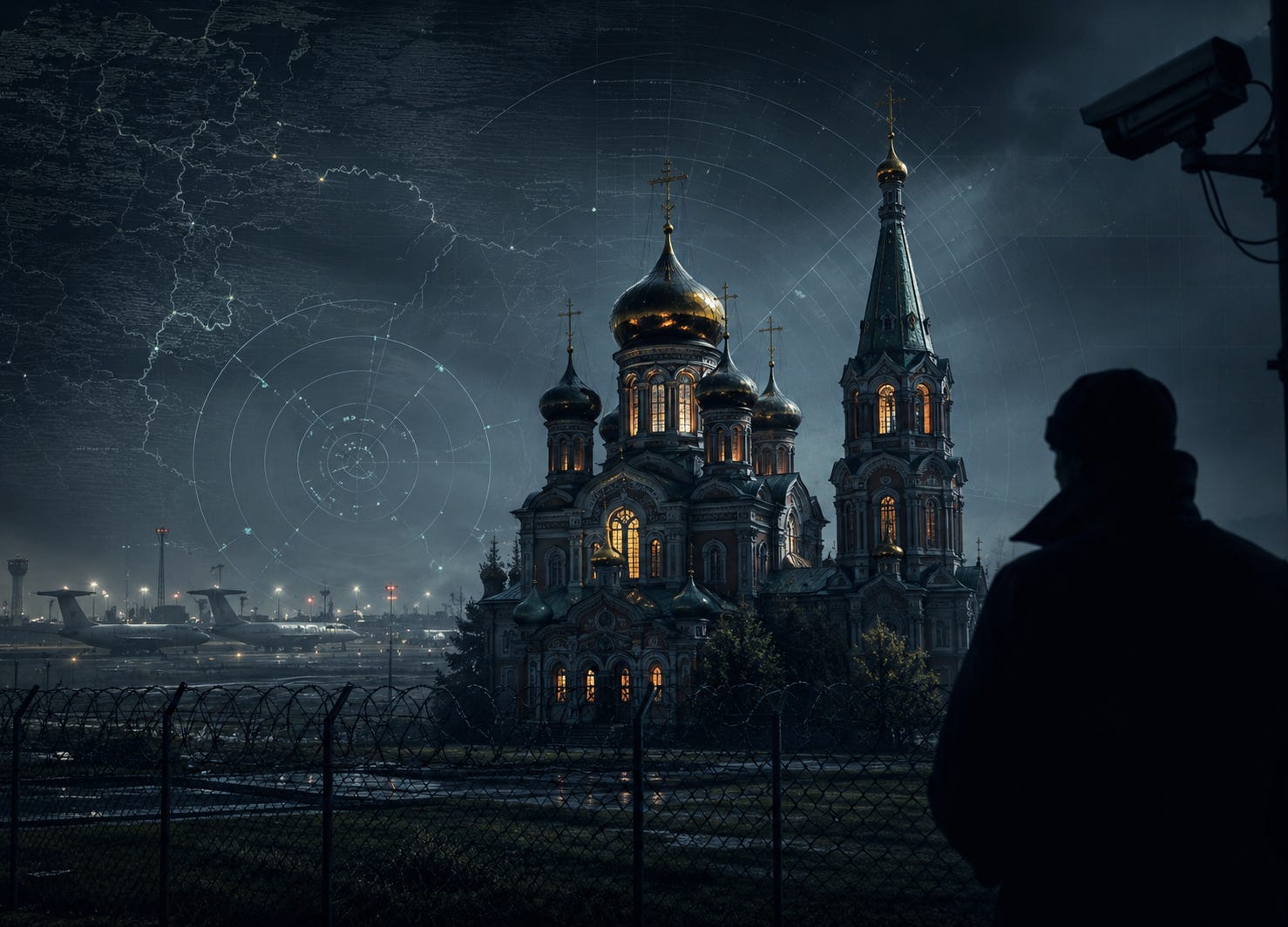
In May 2026, the Kremlin convened what it billed as an “anti-Munich” — an International Security Forum at a concert venue outside Moscow, drawing 4,500 invitees from 120 countries. The event was orchestrated by Russia’s Security Council and its Foreign Intelligence Service, the SVR, and headlined by SVR chief Sergey Naryshkin. But as Russian investigative journalists Irina Borogan and Andrei Soldatov revealed in a Center for European Policy Analysis report, the most telling detail was how Moscow recruited its guest list.
Alongside its embassies and state media, the Kremlin once again leaned on a third, older pillar: the Russian Orthodox Church. Western counterintelligence agencies — in Stockholm, Helsinki, Sofia, and Washington — have spent the past three years documenting that this is not a metaphor. The Moscow Patriarchate, they say, is operating as a deployed asset of Russian intelligence on Western soil, and the targets include American clergy, NATO infrastructure, and the broader Christian community of the West.
The FBI’s warning to American parishes
In the spring of 2023, the FBI quietly warned Russian and Greek Orthodox parishes across the United States that Russian intelligence was using their churches as a recruitment platform. The warning centered on Dmitry Petrovsky, a senior official in the Moscow Patriarchate’s Department for External Church Relations (DECR). When U.S. Customs and Border Protection searched Petrovsky’s laptop on entry in 2021, agents recovered detailed dossiers on prominent American Orthodox priests — including biographical information on their family members, which the FBI assessed could be used for blackmail.
One file, marked “confidential,” laid out the operational protocol: “It is possible to involve employees of the Russian Orthodox Church in operational activities exclusively with the direct sanction of the patriarch.” The document explicitly referenced cooperation between the church and the SVR, GRU, and FSB. There are more than 2,000 Orthodox Christian parishes in the United States.
The church beside the NATO airport
In Sweden, the pattern is even starker. The Church of the Kazan Icon of the Mother of God opened in November 2023 — built just 300 meters from Stockholm-Västerås Airport, which became a NATO strategic hub after Sweden’s accession. Its 22-meter spire violated a 10-meter local zoning cap imposed because of the airport’s proximity. Construction was financed by a foundation run by Rosatom, Russia’s state atomic energy corporation. A Westinghouse nuclear fuel assembly plant sits roughly four kilometers away.
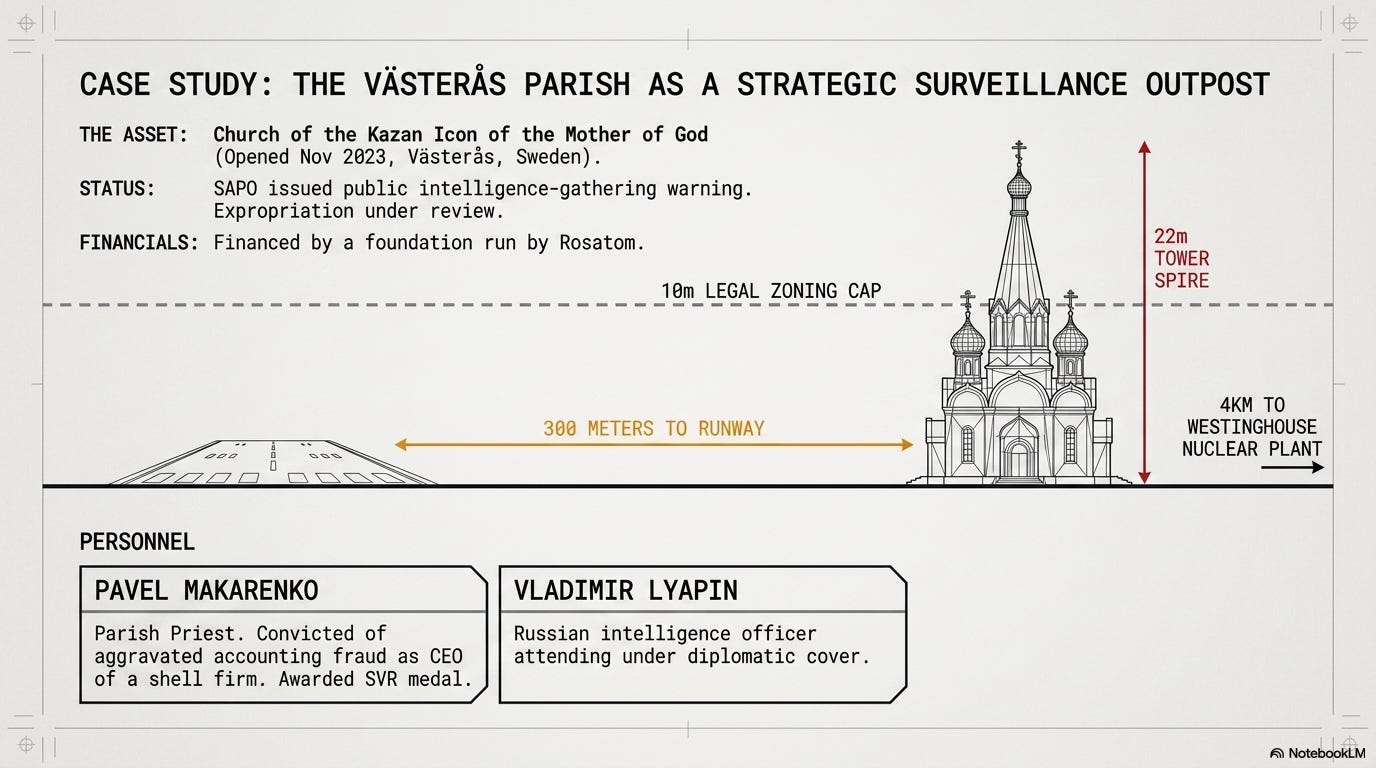
Two weeks after consecration, Sweden’s domestic security agency SAPO issued a public warning that the Moscow Patriarchate in Sweden was being used “as a platform for intelligence-gathering and other activities threatening national security.” Swedish reporters identified one of the diplomats who attended the consecration, Vladimir Lyapin, as a Russian intelligence officer. The parish priest, Pavel Makarenko — convicted in 2021 of aggravated accounting fraud as CEO of a Russian-owned shell firm — had reportedly been awarded a medal for “good service” by the SVR. The city of Västerås is now weighing expropriation of the property.
A continent-wide pattern
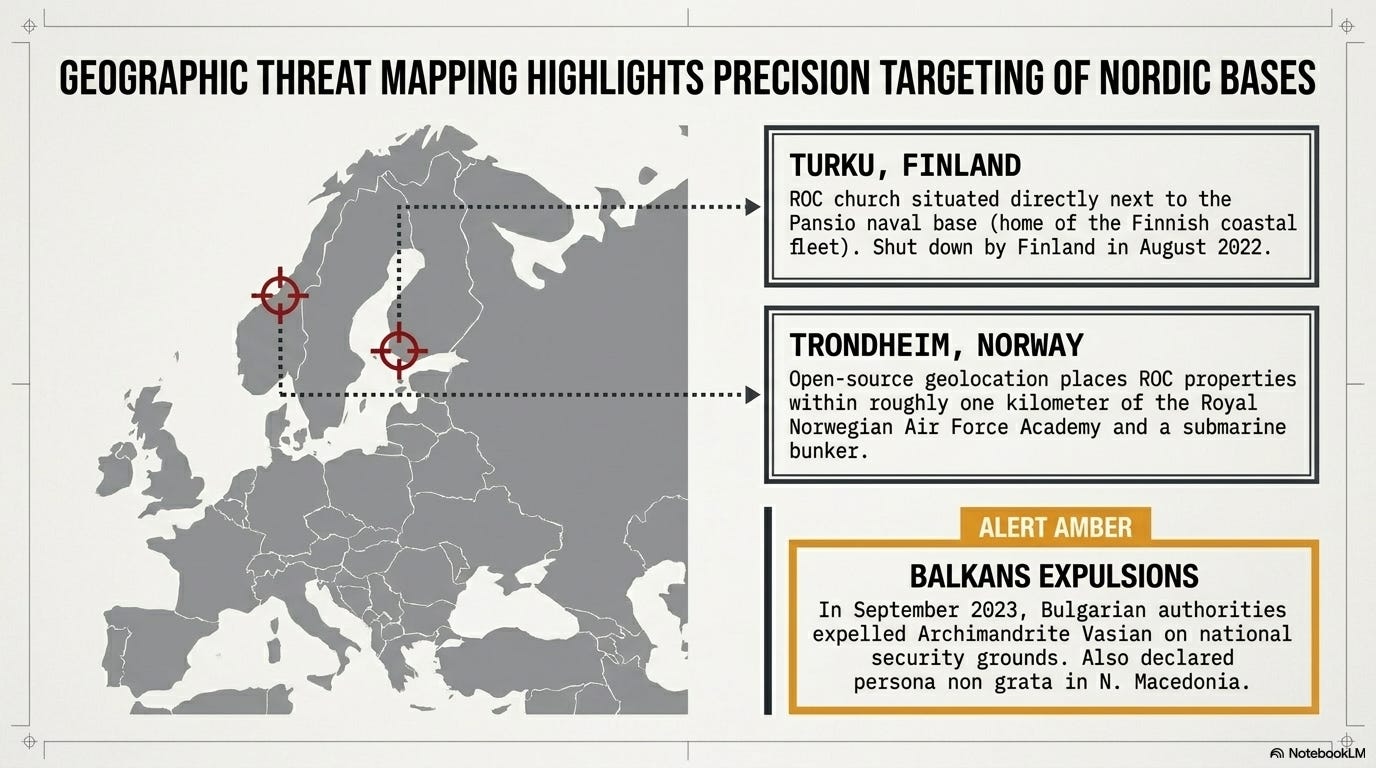
Sweden is not an outlier. Finland shut down the Russian Orthodox church in Turku in August 2022 — it sat next to the Pansio naval base, home of the Finnish coastal fleet. In September 2023, Bulgarian authorities expelled Archimandrite Vasian, head of the ROC in the country, on national-security grounds; he is also persona non grata in North Macedonia.
Open-source researchers geolocated Russian churches in Trondheim, Norway — within roughly one kilometer of the Royal Norwegian Air Force Academy and a submarine bunker.
The man at the top was KGB
The institutional history makes the current operations less surprising. Patriarch Kirill of Moscow, head of the entire Russian Orthodox Church, served as a KGB officer under the codename “Mikhailov” during his posting at the World Council of Churches in Geneva beginning in 1971, according to declassified Swiss federal police records reported by two Swiss newspapers and corroborated by Soviet archive material. The Foreign Policy Research Institute concluded that the Soviet-era system in which the patriarchate operated as a subordinate of state security “endured” after 1991.
On March 27, 2024, the Moscow Patriarchate adopted an official doctrine declaring Russia’s war in Ukraine a “holy war” against “the collective West” — formally codifying the church as an instrument of state confrontation with Western democracies.
What it means for the West
The picture that emerges from CEPA, the FBI, SAPO, and counterintelligence services across NATO is consistent: the Russian Orthodox Church abroad is not a passive religious body that the Kremlin occasionally exploits. It is, by its own internal protocols, a deployable intelligence platform — one that has been used to surveil American clergy, position assets next to NATO airfields and nuclear facilities, and project Kremlin influence into Christian communities from Stockholm to Sofia to suburban America.
With Patriarch Kirill having now declared the West a metaphysical enemy, the question facing Washington and its allies is no longer whether the church is a foreign-influence vehicle. It is what to do about the more than 2,000 parishes already operating inside the United States.
I still can't fathom how Russia, an Orthodox Christian nation, has gotten into bed with Iran, the world's largest state sponsor of Islamic terror. We in the West really blew it following the end of the Cold War. At least we got it right with Germany.