



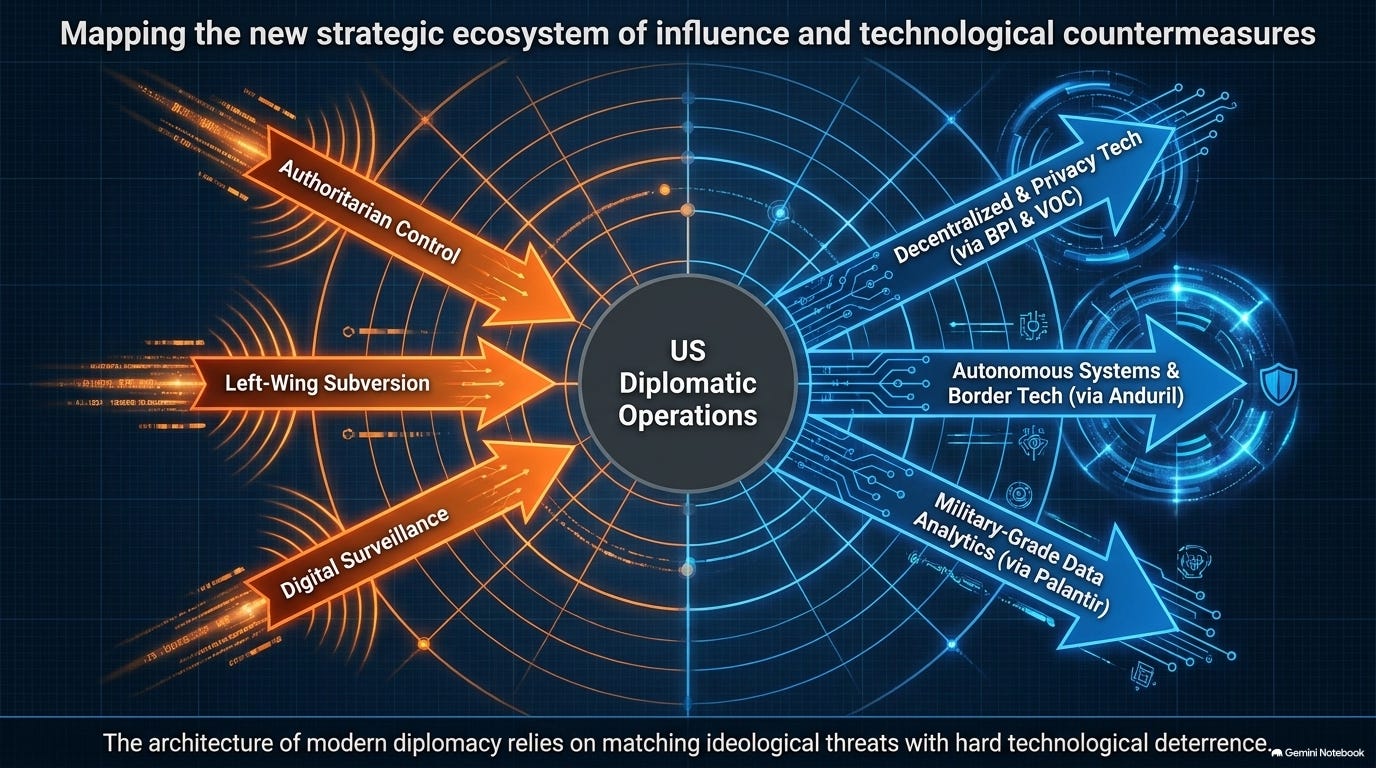
The State Department launched the Freedom Tech Excellence Program in late July, embedding employees from defense technology companies Palantir Technologies and Anduril Industries — alongside the Bitcoin Policy Institute and the Victims of Communism Memorial Foundation — into the department’s diplomatic operations. The program signals Secretary of State Marco Rubio’s pivot away from traditional human rights bureaucracy toward leveraging private-sector capabilities against America’s adversaries.
Under the talent-exchange initiative, employees from the four founding partners will work limited-term assignments inside the State Department on issues including online freedom of expression, countering digital surveillance, privacy-enhancing technologies, and responsible AI governance. Participants will remain employed by their home organizations and receive no State Department pay, according to a department spokesperson.
The partnerships bring distinct capabilities to the table. Palantir, co-founded by Peter Thiel, specializes in data analytics platforms for military and intelligence agencies and recently secured a $10 billion Army contract. Anduril Industries, founded by Oculus VR creator Palmer Luckey, manufactures autonomous defense systems including drones and border security technology.
A Break From Business as Usual
The program represents a renamed and refocused version of the Biden administration’s Franklin Talent Exchange Partnership, which partnered with Intel, Salesforce, and Amazon Web Services. State Department officials told Foreign Policy the program was “reconceived” to focus specifically on digital freedom—a shift that fits within Rubio’s broader State Department reorganization.
“The big opportunity now is that it’s no longer business as usual, and so we’re going to be creative, fast-moving and agile, and think out of the box about how we’re getting this private-sector talent into State,” Michelle Giuda, a former State Department official who served in multiple roles during the first Trump administration, told Foreign Policy. Giuda now leads the Krach Institute for Tech Diplomacy at Purdue University.
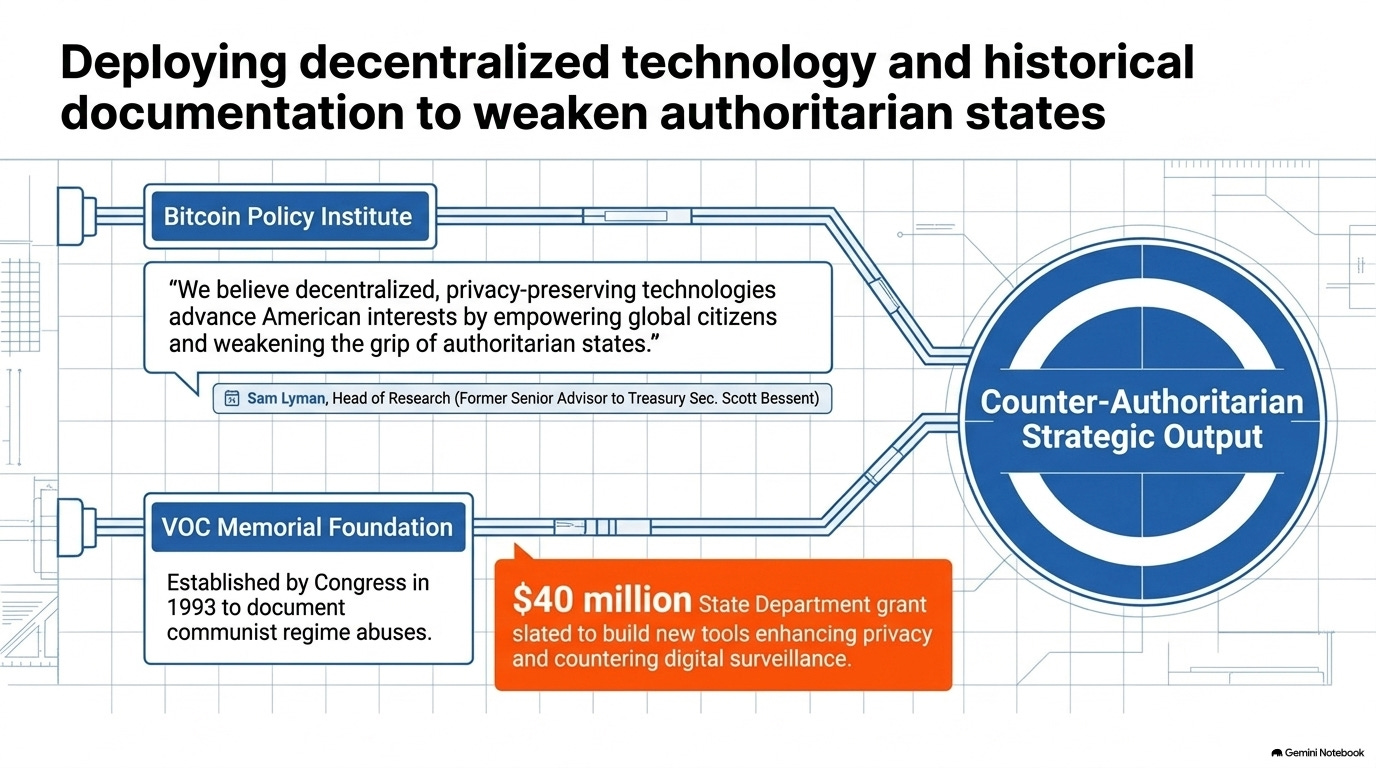
The Bitcoin Policy Institute brings a focus on decentralized technologies as tools against authoritarian control. The organization’s head of research, Sam Lyman, previously served as a senior advisor to Treasury Secretary Scott Bessent. “We believe decentralized, privacy-preserving technologies advance American interests by empowering global citizens and weakening the grip of authoritarian states,” Bitcoin Policy Institute president David Zell stated.
The Victims of Communism Memorial Foundation — established by Congress in 1993 to document abuses by communist regimes — is slated to receive a $40 million State Department grant, the bureau’s largest proposed award this year. The foundation said it was “excited to join this program alongside technology industry giants Palantir Technologies and Anduril Industries, as well as the Bitcoin Policy Institute, to build new tools and policies that advance online freedom of expression, enhance privacy, and counter digital surveillance.”
Broader Realignment
The Freedom Tech Excellence Program launched amid a wider State Department transformation focused on what Rubio calls “left-wing terrorism” and authoritarian influence operations. In July, the department released a report documenting Cuba’s “sustained campaign of subversion” against the United States, including the regime’s infiltration of American radical movements and provision of safe harbor for fugitive American terrorists.
“For nearly seven decades, the Cuban regime has waged a sustained campaign of subversion against the United States,” the report states. “The Cubans perfected a new model for a long war of attrition, organized around espionage, infiltration, sabotage, proxy networks, and a revolutionary infrastructure designed to turn America against itself.”
Rubio also convened a ministerial conference on left-wing terrorism in July, declaring that “left-wing terrorism always ends in bloodshed, misery, and suffering.”
The initiatives coincide with a dramatic restructuring of the Bureau of Democracy, Human Rights and Labor. The bureau’s budget has dropped from over $500 million in 2024 to approximately $190 million in 2026, with staff cuts of up to 80 percent as part of Department of Government Efficiency reforms, according to ProPublica and Politico reporting
Traditional Foreign Policy Critics Push Back
The partner selection has drawn criticism from figures in the traditional foreign policy establishment. Chris Painter, who served as a cybersecurity coordinator at the State Department, FBI, and White House National Security Council, questioned the approach. “It isn’t clear why these initial private-sector partners have any expertise on freedom of expression,” Painter told Foreign Policy. “When you want to talk about freedom-of-expression issues, there are a myriad of civil society organizations that do this.”
Steve Feldstein, a senior fellow at the Carnegie Endowment for International Peace, said he found the recruitment strategy “totally head-scratching,” noting that “Palantir is not developing frontier AI models. Anduril is not considered to be a leader on responsible AI.”
Giuda countered that the criticism reflects outdated thinking. “You want a really broad, diverse perspective with a lot of different vantage points on high tech, the information space, and organizations and teams that understand the surveillance state,” she said. “Whether you’re building next-generation defense technology or fighting censorship on the ground, having a lot of range is really important—I think they started with an initial group that could do that.”
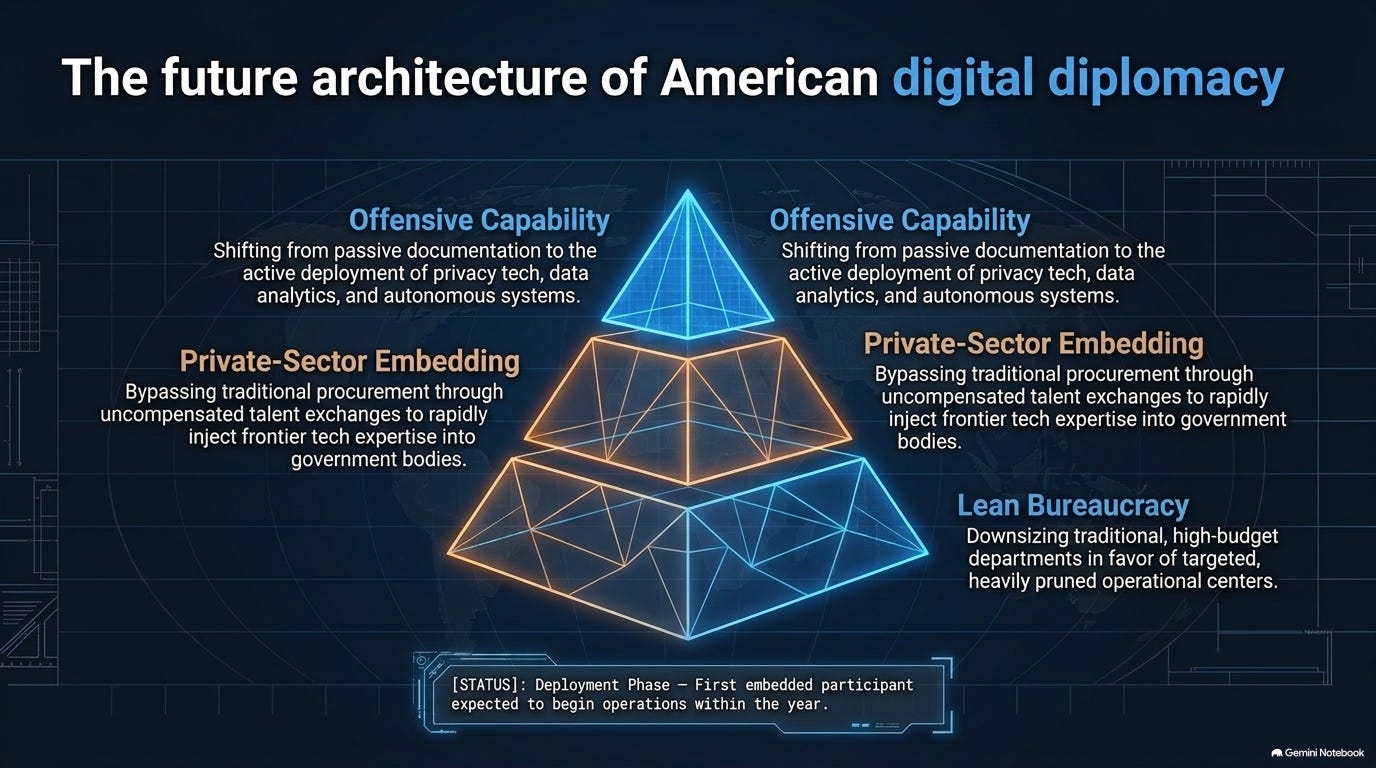
The State Department told Foreign Policy that partnering organizations “are selected based on expertise in digital freedom-related areas that are critical to our national security, including cybersecurity, emerging technologies, data privacy, child online protection, artificial intelligence, and technology policy and governance.” The department expects the first participant to begin work within the year. Specific details about what embedded employees from Palantir and Anduril will work on have not been disclosed.