


Seven major foreign influence operations spanning 25 million social media posts weren’t primarily spreading hate speech, according to a new data-driven study by computer science professor Dr. Emilio Ferrara from the University of Southern California. Rather, Dr. Ferrara argues, they were manufacturing divisiveness by exploiting America’s existing fault lines.
The finding follows a long-standing practice of how adversaries weaponize social media. Russia, Iran, Venezuela, and other state actors weren’t flooding platforms with slurs and dehumanizing rhetoric, the research discovered. Only 18.7% of hostile content qualified as genuine hate speech or identity-based attacks coupled with dehumanizing or inciting language. The rest? Strategic amplification of partisan and geopolitical tensions designed to fracture social cohesion without crossing the line into overt hatred.
The Measurement Error
For years, researchers and policymakers have quantified foreign influence operations through “toxicity” and “hate” rates. But Dr. Ferrara’s analysis of X’s Information Operations archive reveals a fundamental flaw: the detectors measuring “hate” actually capture a broader construct, one of hostile or divisive out-group targeting.
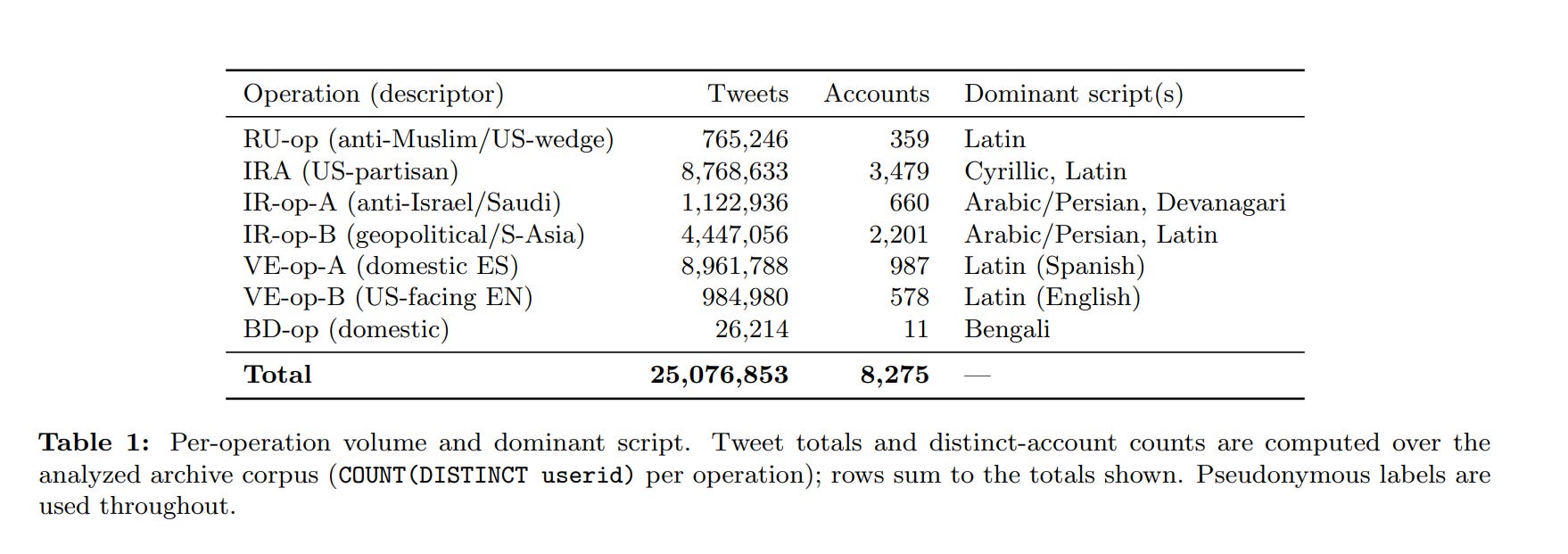
Ferrara’s team analyzed 25.08 million tweets from 8,275 accounts attributed to seven government-backed campaigns. Using a validated two-stage detection system, they typed each hostile post into three categories: identity hate (attacks on protected groups), partisan divisiveness (inflammatory political rhetoric), and geopolitical invective (foreign policy attacks).
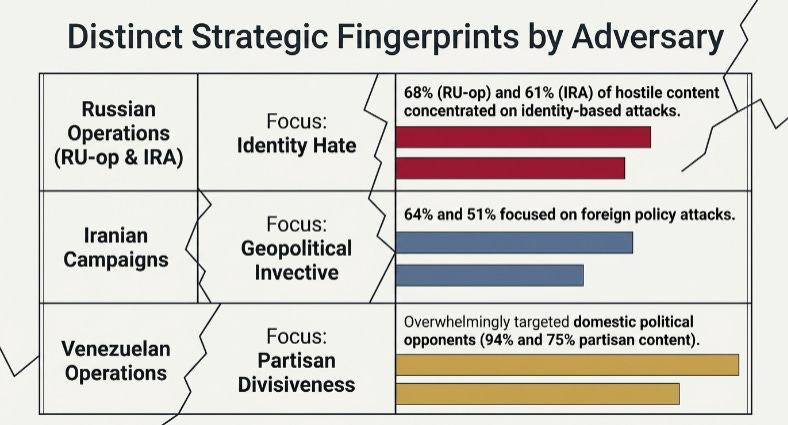
The composition varied dramatically. Russian operations (RU-op and IRA) concentrated on identity hate—68% and 61% respectively. Iran’s campaigns focused on geopolitical invective (64% and 51%). Venezuela’s operations overwhelmingly targeted domestic political opponents (94% and 75% partisan content).
“Reporting all of it as hate therefore overstates hate roughly twofold,” the study concluded.
The Identification-Imitation-Amplification Pattern
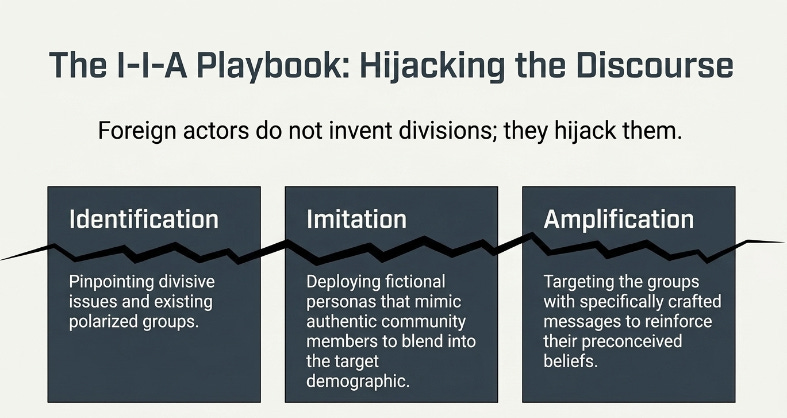
The strategy mirrors what some intelligence analysts now call the “Identification-Imitation-Amplification” framework. Foreign actors don’t create divisions but rather they identify existing polarized groups and divisive issues, then amplify them through fictional personas that imitate authentic community members.
“CEIOs necessitate as the first step, identifying divisive issues, as well as polarised groups and targeting them with specifically crafted messages to reinforce their pre-conceived beliefs,” according to research published in Intelligence and National Security. The goal isn’t promoting ethnic or religious hatred directly, it’s deepening in-group loyalty while intensifying out-group hostility.
A separate analysis of 56.3 million posts from 18 state-linked operations found that while toxic content represented just 1.53% of total posts, it generated disproportionately high engagement—20.63 interactions per post versus 3.46 for non-toxic content. Russian operations particularly leveraged this dynamic, with toxic posts averaging 86.08 engagements.
Strategic Implications
Content moderation focused narrowly on hate speech misses the broader manipulation. The real threat isn’t slurs but the strategic presentation of selective truths designed to deepen existing fractures in democratic societies.
As Ferrara’s study notes, three independent expert annotators could only agree moderately on where divisiveness ends and hate begins. That ambiguity is precisely what adversaries exploit—operating in the gray zone where content inflames without quite crossing into prohibitable hatred.
The campaigns aren’t about hate. They’re about fracture.
Divide and conquer: the premise is as old as conflict itself.