


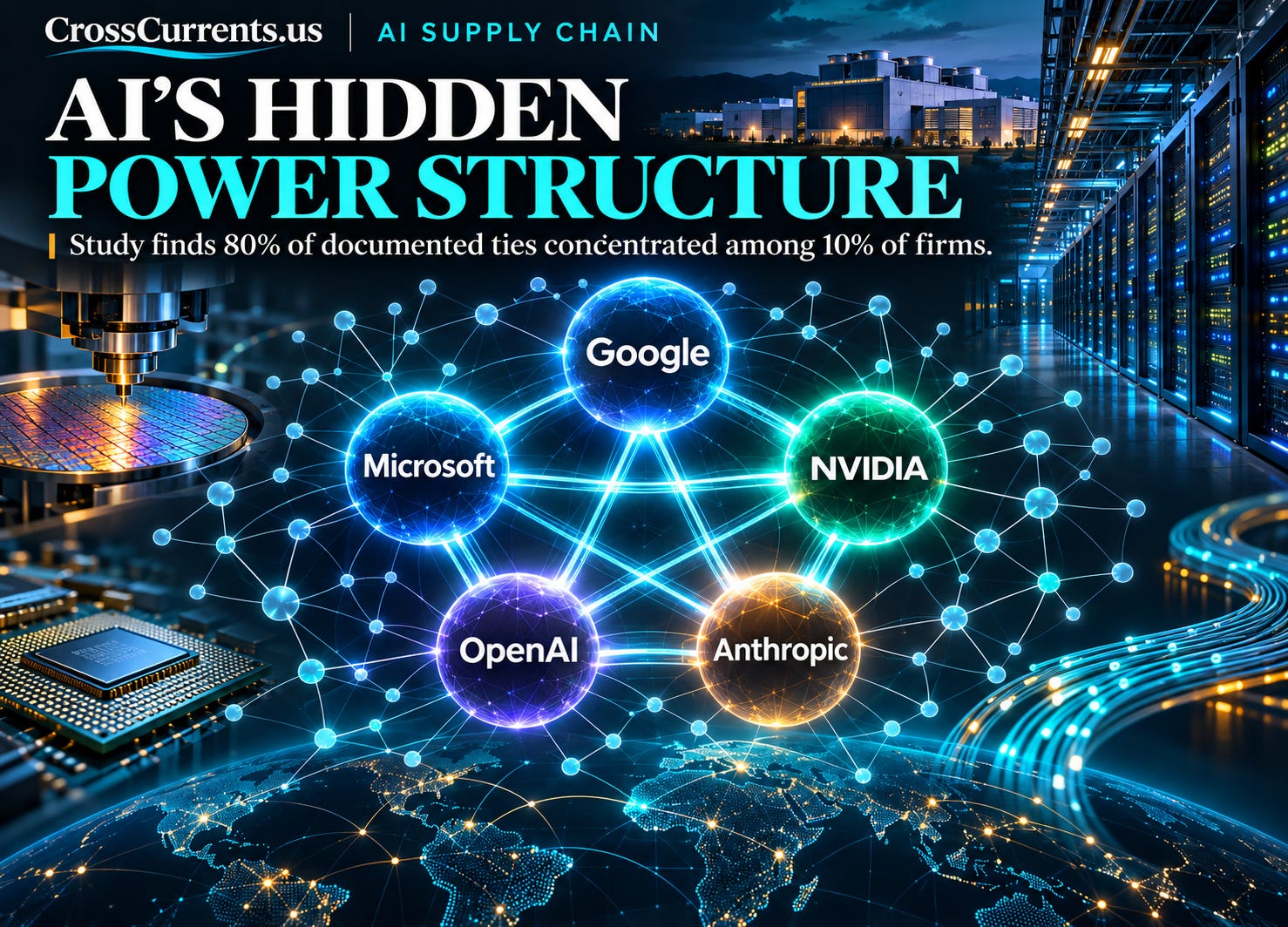
A small group of companies accounts for the overwhelming majority of documented business relationships in the artificial intelligence industry, according to a newly published study that maps the complex network of investments, technology suppliers, and infrastructure providers underpinning the global AI economy.
The research, released November 18 by researchers at Stanford University and Carnegie Mellon University, found that the most connected 10% of companies accounted for 80% of measured relationships in its filtered corporate network. The concentration was even higher in computing hardware and AI models, where the corresponding figures reached 85.5% and 84.6%.
The measurement counts documented relationships over time rather than unique contracts, financial value, or market share.
The findings offer a detailed look at an industry increasingly interconnected through financing, semiconductor production, computing infrastructure, and strategic partnerships. They also identify potential supply-chain chokepoints, including companies whose influence extends far beyond the consumer-facing AI products attracting the most public attention.
A Small Circle at the Center of AI
The 80-page study, titled Mapping the AI Supply Chain: Dependencies, Vulnerabilities, and Market Concentration in the AI Ecosystem, examined more than 13,000 publicly available documents dating from November 2022 through October 2026.
Using automated extraction and network analysis, the researchers identified approximately 9,700 unique organizational actors. A more restrictive analysis produced a network of 4,520 actors, while the principal concentration calculations focused on 3,677 companies with established business relationships.
Google, NVIDIA, Microsoft, OpenAI, and Anthropic emerged as the five most connected companies in the study’s centrality rankings.
Google recorded the highest number of connections and ranked first in a measure of how frequently a company bridges otherwise separate portions of the network. OpenAI led a separate ranking measuring connections to other influential actors, while NVIDIA ranked first in the number of organizations reachable within two downstream steps.
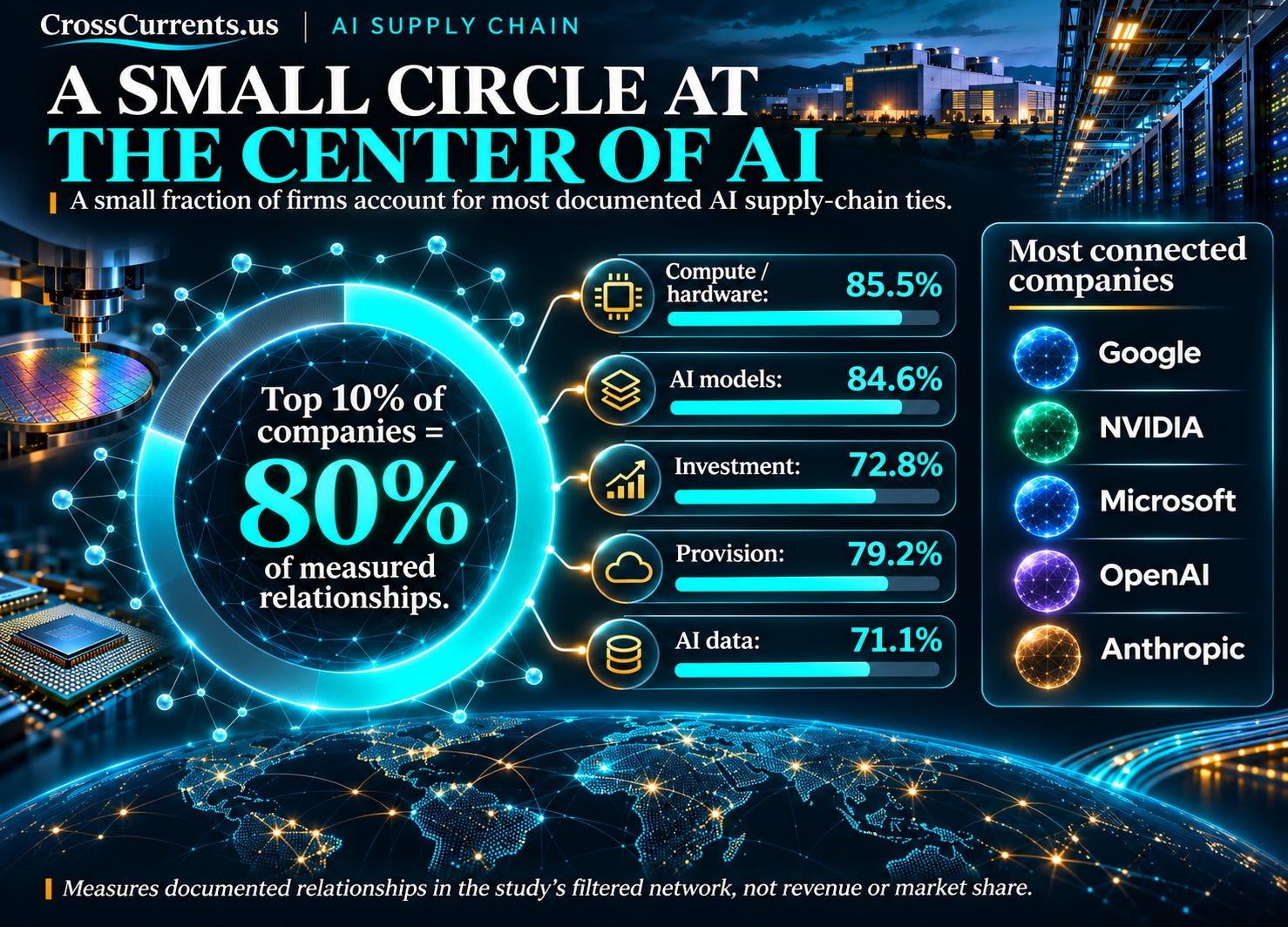
The concentration extended across several categories. The most connected 10% of companies accounted for 72.8% of recorded investment relationships, 79.2% of provision relationships, and 71.1% of AI data relationships.
These percentages measure the concentration of documented corporate ties, not revenue or market share. Nevertheless, they illustrate how a comparatively small group of companies sits at the center of an expanding network of AI development and deployment.
The Companies Behind the Models
One of the study’s more revealing findings concerns the companies supplying the infrastructure that AI developers depend upon.
When the researchers shifted from measuring connectivity to examining which companies occupied the most upstream positions in the supply chain, the rankings changed dramatically.
Taiwan Semiconductor Manufacturing Company (TSMC), Groq, Crusoe, GMI Cloud, IREN, and Broadcom occupied the highest positions in the study’s general supplier hierarchy, which measures the direction of documented provision relationships.
Their prominence highlights a fundamental distinction between developing AI models and supplying the infrastructure necessary to operate them.
AI developers require advanced semiconductors, data centers, electricity, networking equipment, and computing capacity. The companies providing these resources can occupy strategic positions even when their names are less familiar than those of major chatbot developers.
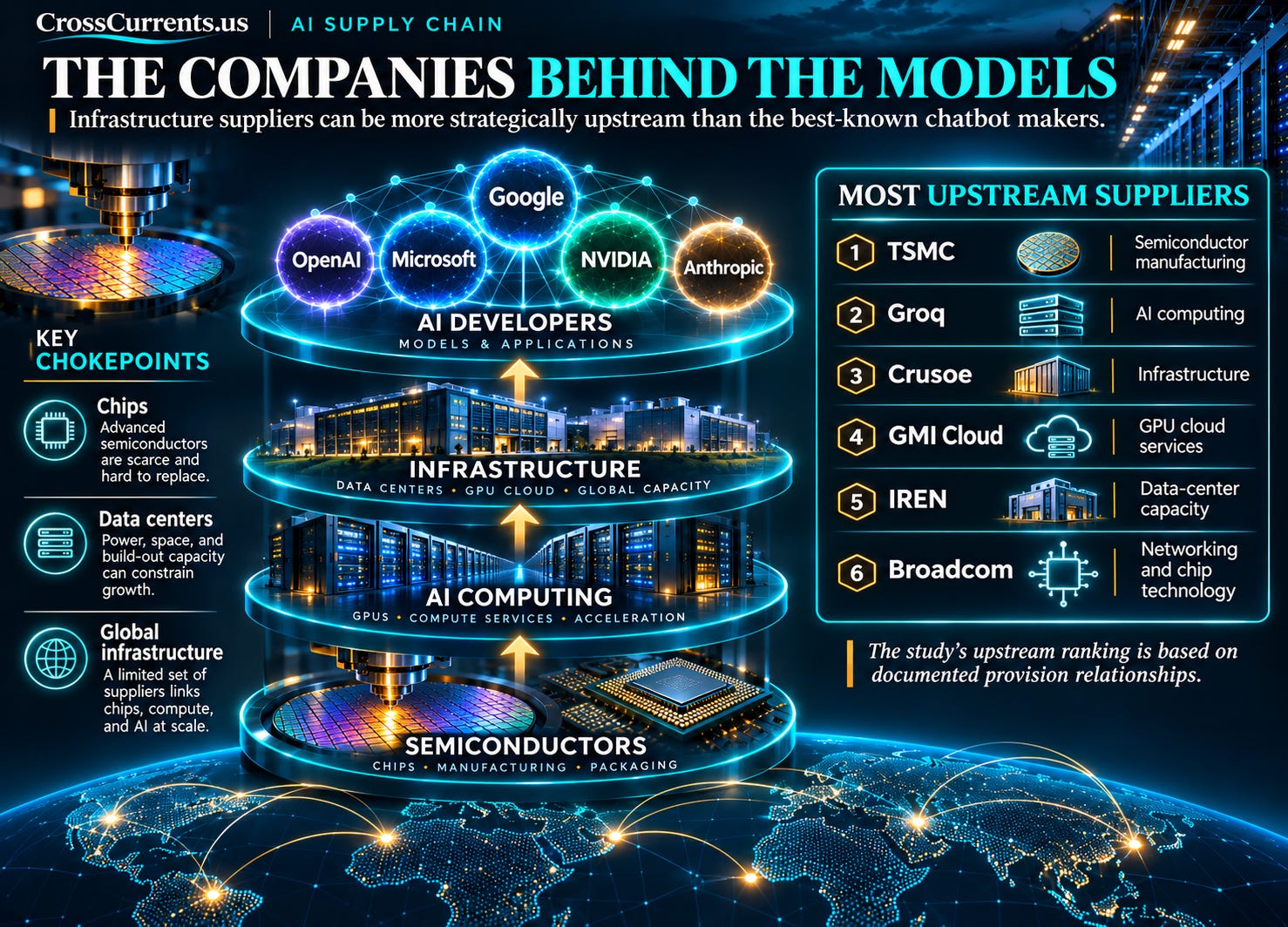
The implications extend into geopolitics. TSMC’s central position underscores the importance of Taiwan’s semiconductor industry, while the broader network demonstrates why access to computing hardware and infrastructure has become integral to international technology competition.
The researchers also identified corporate communities clustered around major companies. One included OpenAI, Microsoft, AMD, Oracle, and SoftBank. Another contained Anthropic, Amazon, Salesforce, and Palantir, while a separate cluster included DeepSeek, Alibaba, ByteDance, and Huawei.
These groupings reflect patterns of documented interactions rather than evidence of formal alliances or coordination between every participant. They nevertheless show how business relationships frequently overlap within the industry.
Investment and Technology Are Increasingly Intertwined
The study also examined the financial relationships linking major AI companies, identifying arrangements in which firms simultaneously participate as investors, technology providers, customers, and strategic partners.
One example involves Microsoft, the Abu Dhabi-based technology company G42, investment firm MGX, and OpenAI.
Microsoft announced a $1.5 billion investment in G42 in April 2024. G42 is a founding partner of MGX, which subsequently invested in OpenAI. OpenAI and G42 have also partnered on AI data-center infrastructure in the United Arab Emirates.
The resulting network connects American technology companies and Emirati investment interests through overlapping financial and commercial arrangements.
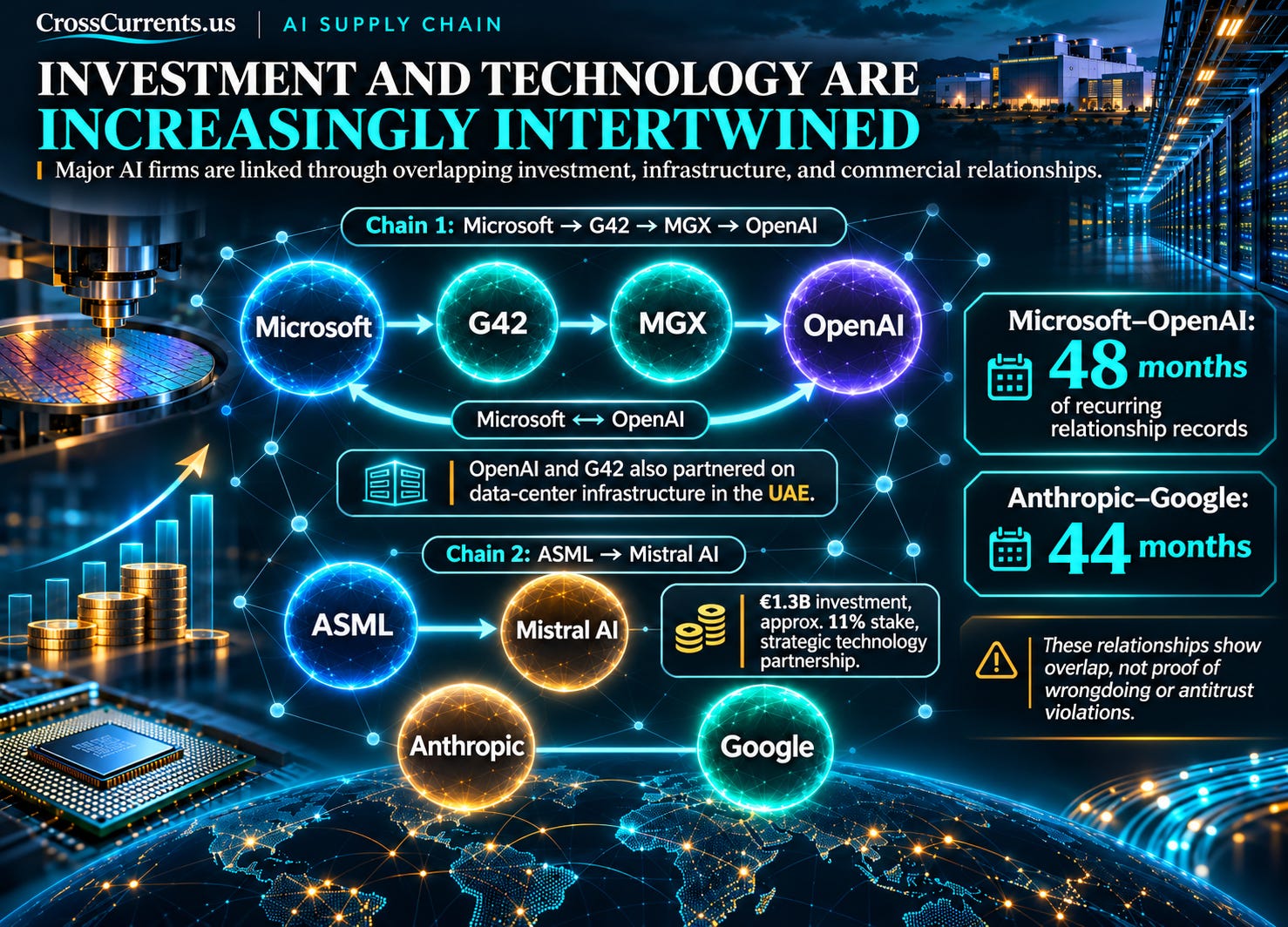
Another example involves Dutch semiconductor equipment manufacturer ASML, which announced a €1.3 billion investment in French AI developer Mistral AI in September 2025. The transaction gave ASML an approximately 11% stake and an advisory role on Mistral’s Strategic Committee, alongside a long-term technology collaboration.
Such arrangements demonstrate how capital and technology increasingly flow between different layers of AI production.
The researchers also found that Microsoft and OpenAI appeared together in relationship records spanning 48 distinct months, while Anthropic and Google appeared together across 44 months. These figures represent recurring documented relationships, not separate monthly contracts.
Although overlapping financial relationships can raise questions about competition, dependence, and circular financing, the study does not establish that these particular arrangements are unlawful or improperly structured.
Mapping an Industry Still Difficult to Measure
The Stanford and Carnegie Mellon researchers acknowledge important limitations in their findings.
Their dataset draws on publicly accessible material, including news coverage, company announcements, and industry publications. Its collection process began with 36 major AI model providers, meaning the results are more comprehensive around prominent developers than around less-publicized suppliers.
The use of automated extraction also introduces possible classification errors, while confidential contracts and private business relationships remain outside the researchers’ visibility.
Consequently, the figures establish concentration within the documented network rather than the precise distribution of economic power across the entire AI industry. The research is also a preprint and has not been independently peer-reviewed.
Still, the authors have made their dataset publicly available, alongside an interactive map allowing users to examine relationships among companies over time.
The research provides a framework for understanding an increasingly interconnected industry in which control over essential hardware, financing, and infrastructure may be as consequential as leadership in AI model development.
It also raises a broader question for governments attempting to regulate or secure the technology’s future: whether their policies adequately account for the complex international supply chains on which the world’s most advanced AI systems depend.