

The 1776 Welcome of King George III on the South Lawn
Trump welcomed King Charles with Continental Army soldiers, turning a state visit into a tribute to America’s improbable victory and constitutional endurance.

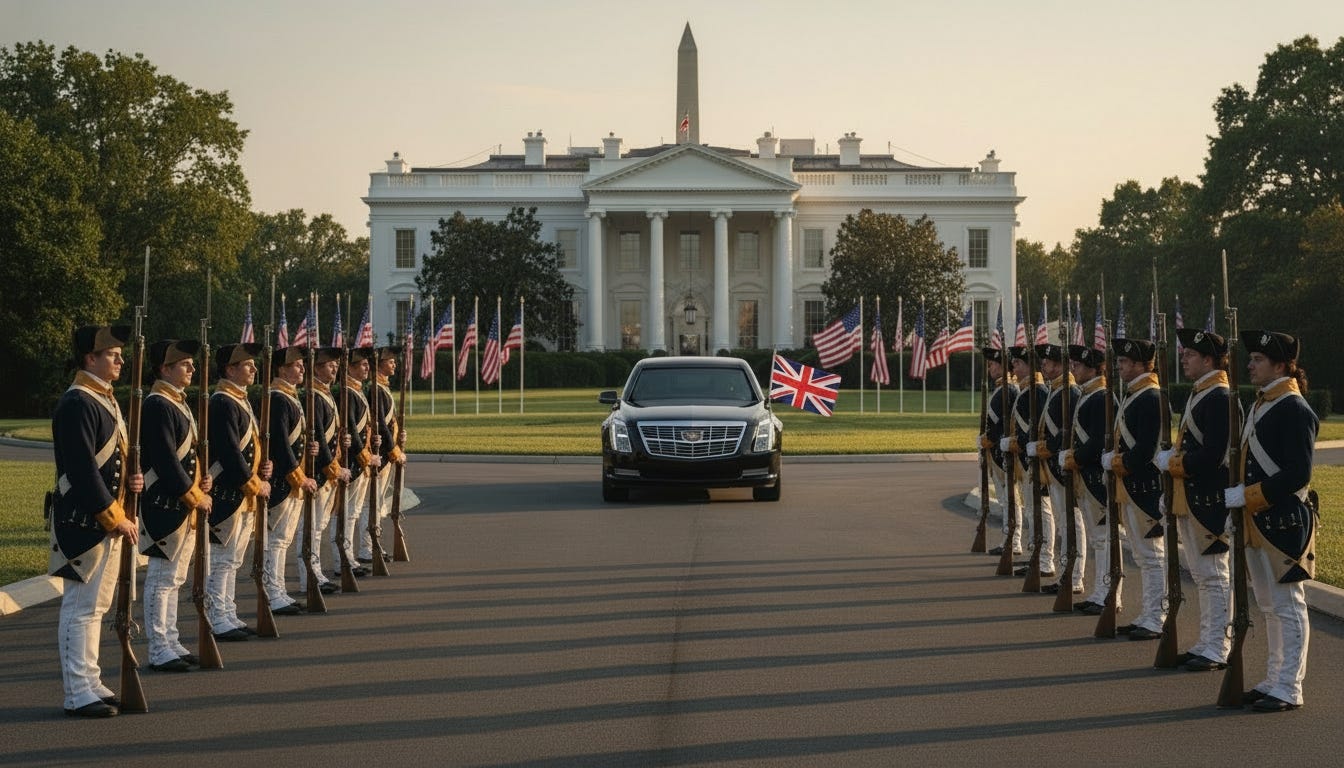
On Monday afternoon, President Trump greeted King Charles III on the South Lawn of the White House with the usual pomp: military band, 21-gun salute, ceremonial inspection of troops. The troops, however, were unusual. Standing at attention in full Continental Army regalia; tricorn hats, blue coats with buff facings, muskets at their shoulders, were Revolutionary War reenactors. The soldiers who fought Charles’ great-great-great-great-grandfather George III were now serving as the honor guard for his descendant’s state visit.
The White House billed the visit as commemorating the 250th anniversary of American independence, which explains the historical costuming. Still, there’s something undeniably pointed about the specific choice. Other symbols were available — the current military, the flag, the Constitution under glass. Trump chose the guys in the same Revolutionary dress who beat the British Empire.

The Revolutionary War soldiers weren’t there by accident. They represented the beginning of something genuinely remarkable: the first successful implementation of Enlightenment political philosophy at the scale of an entire nation. What the philosophers of the 18th century imagined, government by consent, natural rights, separation of powers, the American revolutionaries actually built.
The achievement starts with the improbability of the military victory itself. When the Continental Army formed in 1775, it consisted primarily of farmers, merchants, and artisans with no professional military training. They faced the most powerful navy in the world and a battle-tested professional army. The colonies had no capacity to manufacture arms in quantity, no financial resources, no unified command structure. The British controlled the seas and could land troops wherever they chose.
Standard strategic analysis predicted certain American defeat. Colonial militia had never defeated British regulars in pitched battle. The resources were laughably mismatched. Yet these farmers and merchants, wearing whatever uniforms they could assemble, fought an eight-year war and won.
Then came the harder part- turning military victory into lasting government. The revolutionaries didn’t just declare independence; they created an entirely new form of political organization. Federalism divided power between states and national government. Separation of powers prevented any single branch from dominating. A written constitution, ratified by the people themselves, established the rules everyone would follow. These weren’t just innovations; they were the operating system for the first large-scale republic in modern times.
And it worked. The Constitution ratified in 1788 remains the operational framework of American government 238 years later. The same document, with amendments. The political system bent under pressure, survived a civil war, adapted to massive territorial expansion and demographic change, and kept functioning. The peaceful transfer of power between parties, John Adams to Thomas Jefferson in 1801, set a precedent that has held through 46 presidencies.
The intellectual architecture matters as much as the military victory. The Founders took abstract Enlightenment principles, natural rights, popular sovereignty, limited government, and translated them into concrete institutional design. The Bill of Rights protected individual freedoms from government overreach. Federalism allowed both local autonomy and national coherence. The separation of powers created friction by design, making tyranny difficult even when attempted.
These frameworks became the template that shaped modern democracy worldwide. When other nations wrote constitutions, they studied the American model. When revolutionaries articulated their goals, they echoed the Declaration of Independence. The specific mechanisms, bicameral legislatures, judicial review, enumerated powers, spread because they proved functional at scale.
The 250-year anniversary commemorates not just independence but endurance. A quarter-millennium is substantial for any political system. The American republic has outlasted monarchies, empires, and ideological experiments that rose and fell in that span. It survived industrialization, urbanization, multiple wars, economic collapses, and profound social transformations while maintaining constitutional continuity.
This makes the Revolutionary War categorically different from a typical colonial uprising. Independence alone isn’t exceptional — many colonies achieved it. What distinguishes America is what came after: building institutions that actually worked, protecting rights that actually mattered, creating a system that could adapt without collapsing. The revolutionaries didn’t just reject British rule. They constructed something better and made it last.
When Charles addressed Congress later that day, he invoked shared heritage and “checks and balances” on executive power. Gracious words from a constitutional monarch visiting a republic that rejected monarchy as its founding principle. The moment captured something worth celebrating: two nations that went to war 250 years ago now maintain one of the world’s most important alliances, united by principles the American revolutionaries pioneered.
The Continental Army won a war everyone expected them to lose, then built a republic everyone expected to fail. Two hundred fifty years later, that republic hosted the heir to the British throne for a state dinner celebrating the anniversary of rebellion against his ancestor. The sheer improbability of that outcome, not just independence, but success, stability, and global influence, makes the Revolutionary War worth commemorating with a bit of theatrical flair. The guys in tricorn hats earned their place on the South Lawn.
What is unique in the American Revolution is that it is a revolution brought about by violence that did not end up devouring its own, such as the French or Russian. This was no doubt aided by its being brought about by men who were established as pillars of society who viewed revolution as truly the final option, not by lower-class rabble or criminals who acted first and thought later.