


On November 7, 1941, exactly one month before Pearl Harbor, President Franklin Roosevelt received a 25-page intelligence assessment that should have changed history. Curtis Munson, a businessman conducting confidential investigations for the White House, had just completed weeks of interviews with FBI agents, Office of Naval Intelligence officers, and Japanese Americans across the West Coast. His conclusion was unequivocal: “There is no Japanese ‘problem’ on the Coast. There will be no armed uprising of Japanese.”
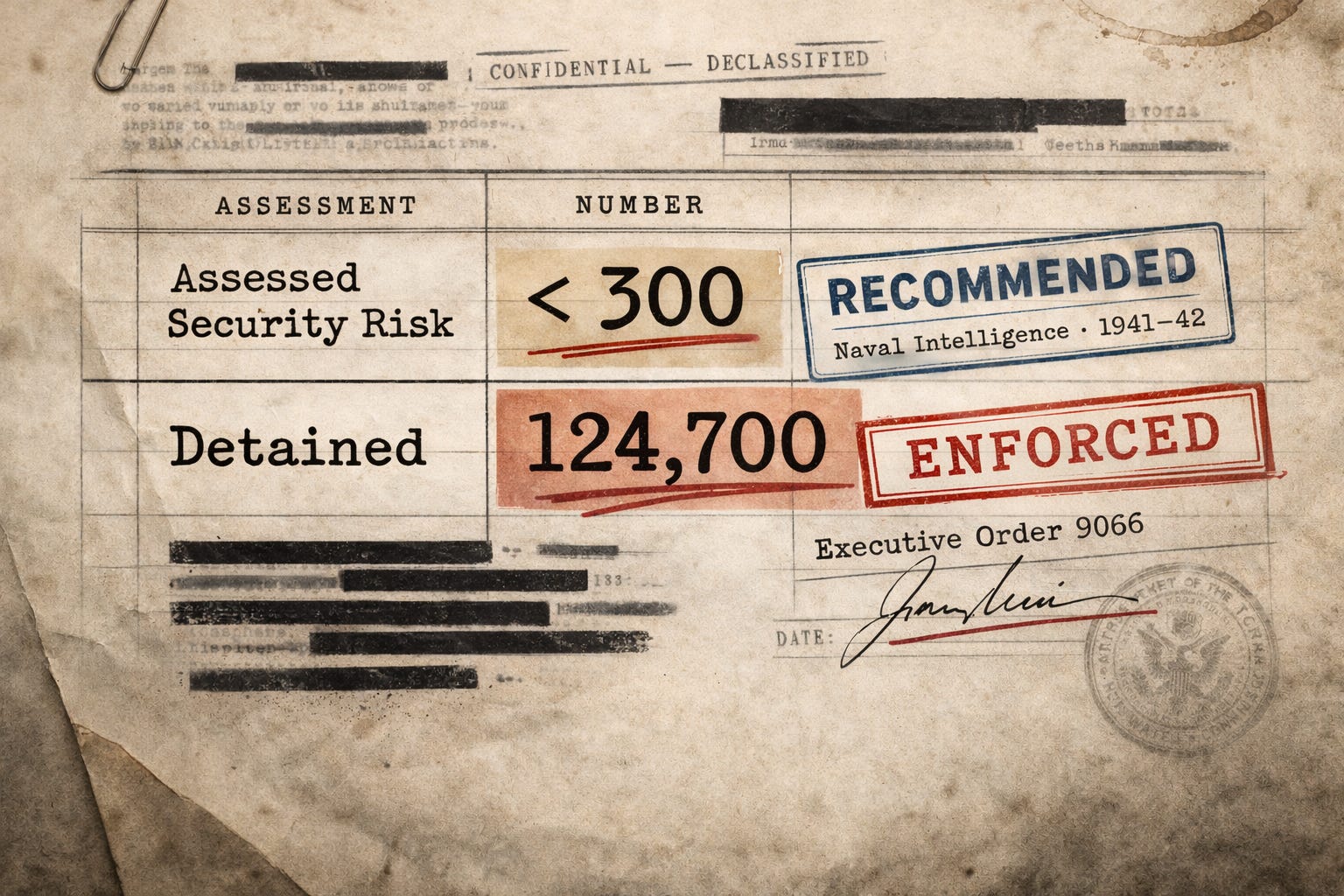
Ten weeks after Pearl Harbor, Roosevelt signed Executive Order 9066 anyway.
The story of Japanese American internment is usually framed as a wartime panic, an understandable if regrettable overreaction in the fog of war. But the documentary record tells a different story—one about the gap between what a government’s intelligence apparatus says and what its political leadership decides to hear. It’s a pattern worth understanding, because it didn’t happen once. It happened repeatedly, over the course of 18 months, as report after report reached the same conclusion while policy moved in the opposite direction.
What the Intelligence Actually Said
The Munson Report wasn’t a rushed assessment. Munson had spent time in each of the three Naval Districts covering the entire West Coast, consulting with the FBI and ONI, interviewing both Japanese Americans and their neighbors. He broke down the population into categories: the Issei (first generation immigrants), the Nisei (American-born citizens), and the Kibei (American citizens educated partly in Japan, considered the highest risk group).
Even about the Issei, legally barred from citizenship and potentially still loyal to Japan, Munson noted they were “considerably weakened in their loyalty to Japan by the fact that they have chosen to make this their home and have brought up their children here. They expect to die here.”
The Nisei were “universally estimated from 90 to 98 percent loyal to the United States,” Munson wrote. “They are pathetically eager to show this loyalty. They are not Japanese in culture. They are foreigners to Japan.”
On the question of sabotage risk, Munson was direct: “The Japanese are hampered as saboteurs because of their easily recognized physical appearance. It will be hard for them to get near anything to blow up if it is guarded.” His assessment concluded that “there is far more danger from Communists and people of the Bridges type on the Coast than there is from Japanese.”
Two months after Pearl Harbor, Lieutenant Commander Kenneth Ringle of Naval Intelligence provided an even more precise assessment. Of the entire Japanese American population, he estimated fewer than 300 individuals—not 300,000, but 300—might act as agents or saboteurs. The problem, he argued, was “no more serious than the problems of the German, Italian, and Communistic portions of the United States population” and should be “handled on the basis of the individual, and not on a racial basis.”
These weren’t amateur opinions. This was the considered judgment of the professional intelligence services tasked with protecting American security.
The Decision Made Against Intelligence
On February 19, 1942, Roosevelt signed the executive order authorizing military commanders to exclude anyone from designated military areas. Attorney General Francis Biddle had opposed the policy in writing, calling mass removal “ill-advised, unnecessary and unnecessarily cruel.” He warned it would violate constitutional rights. The President was not persuaded by his own Attorney General’s legal judgment any more than by his intelligence services’ security assessment.
The military justification that prevailed came not from intelligence analysis but from General John DeWitt, commander of the Western Defense Command. His final recommendation to the Secretary of War made no pretense of relying on evidence: “The Japanese race is an enemy race and while many second and third generation Japanese born on United States soil, possessed of United States citizenship, have become ‘Americanized,’ the racial strains are undiluted.”
DeWitt’s most revealing argument was what became known as the “Invisible Deadline for Sabotage” theory. The complete absence of any sabotage or espionage by Japanese Americans wasn’t evidence of loyalty—it was, in his view, “a disturbing and confirming indication that such action will be taken” in the future. By this logic, the lack of evidence became evidence.
It would be nearly impossible to design a more perfect inversion of how intelligence assessment is supposed to work.
The Gap That Lasted Years
Perhaps more illuminating than the initial decision is what happened next. By May 1943, Secretary of War Henry Stimson and his assistant John McCloy had concluded that exclusion of loyal Japanese Americans no longer had any military justification. General George Marshall agreed. But the exclusion wasn’t lifted until December 1944, a delay of 18 months.
The Commission on Wartime Relocation and Internment of Civilians, reviewing the record decades later, reached an unambiguous conclusion: “The inescapable conclusion from this factual pattern is that the delay was motivated by political considerations.” Stimson presented his position to Roosevelt and the Cabinet in May 1944. The President declined to act until the first Cabinet meeting after the November election.
For a year and a half, roughly 110,000 people remained behind barbed wire not because military necessity required it, not because intelligence assessment justified it, but because political leaders believed releasing them before an election would be costly.
What Gets Lost in Translation
The standard narrative of wartime panic obscures something more troubling about how institutions process information. This wasn’t a case of missing intelligence or analysts failing to provide clear guidance. The intelligence services did their job. They investigated thoroughly, applied professional judgment, and delivered unambiguous assessments.
The breakdown happened in the space between analysis and action, in the gap between what professional staff recommended and what political leadership decided. That gap has a specific shape: it tends to widen when public pressure is high, when the politically safer path contradicts the analytically sound one, and when the people bearing the cost of the decision have no political constituency.
Earl Warren, then California’s Attorney General and later Chief Justice of the Supreme Court, provides a case study. He advocated vigorously for mass removal, presenting maps to the Tolan Committee showing Japanese American land ownership concentrated near power lines, railroads, and military installations. The pattern seemed sinister until you realized that coastal land well-suited for farming and cheap scraps along infrastructure were among the only properties available to people barred by law from owning better land. Warren’s maps documented not a conspiracy but the effects of discriminatory property laws.
Yet the maps were persuasive precisely because they looked like intelligence analysis while requiring none of its discipline. They offered the appearance of evidence-based reasoning without the burden of actual evidence.
What the Record Shows
Not a single Japanese American was convicted of espionage or sabotage during World War II. The 1943 loyalty review program—despite its coercive circumstances—confirmed what Munson and Ringle had reported years earlier. And when Japanese Americans were finally allowed to serve in combat, the 442nd Regimental Combat Team became one of the most decorated units in American military history.
The intelligence analysts had been right. The professional judgment they offered in 1941 and 1942 reflected reality more accurately than the political judgments that overrode them. This creates an uncomfortable question: if intelligence services provide accurate assessments but lack the institutional power to ensure those assessments shape policy, what exactly is their function?
The answer matters beyond this particular historical episode. Democracies invest enormous resources in professional bureaucracies specifically to prevent decision-making driven purely by political pressure or public panic. The theory is that judges, intelligence analysts, military planners, and civil servants can provide ballast—not blocking elected leaders, but ensuring decisions rest on accurate information about consequences.
When that ballast fails, when the information systems are functioning but the decision-making process systematically ignores them, something has gone wrong at the level of institutional design. You end up with governments that spend billions collecting intelligence they don’t use, that employ experts whose expertise doesn’t inform policy, that build systems of review that don’t actually constrain action.
On February 19, we mark the anniversary not just of an injustice but of an institutional failure. The system worked as designed right up until the moment it needed to matter. The intelligence was there. The constitutional objections were raised. The professional military leadership eventually recognized the policy couldn’t be justified. None of it made a difference until political considerations shifted.
That’s worth remembering, because the conditions that produced that gap—the pressure of public fear, the political cost of defending an unpopular minority, the gap between what analysis shows and what feels safe to decide—don’t belong uniquely to 1942. They’re features of democratic governance under stress. The question is whether the institutional architecture designed to handle that stress actually works when tested, or whether it collapses precisely when it’s needed most.
The documentary record from 1941 to 1944 provides one answer. It’s not a reassuring one.