


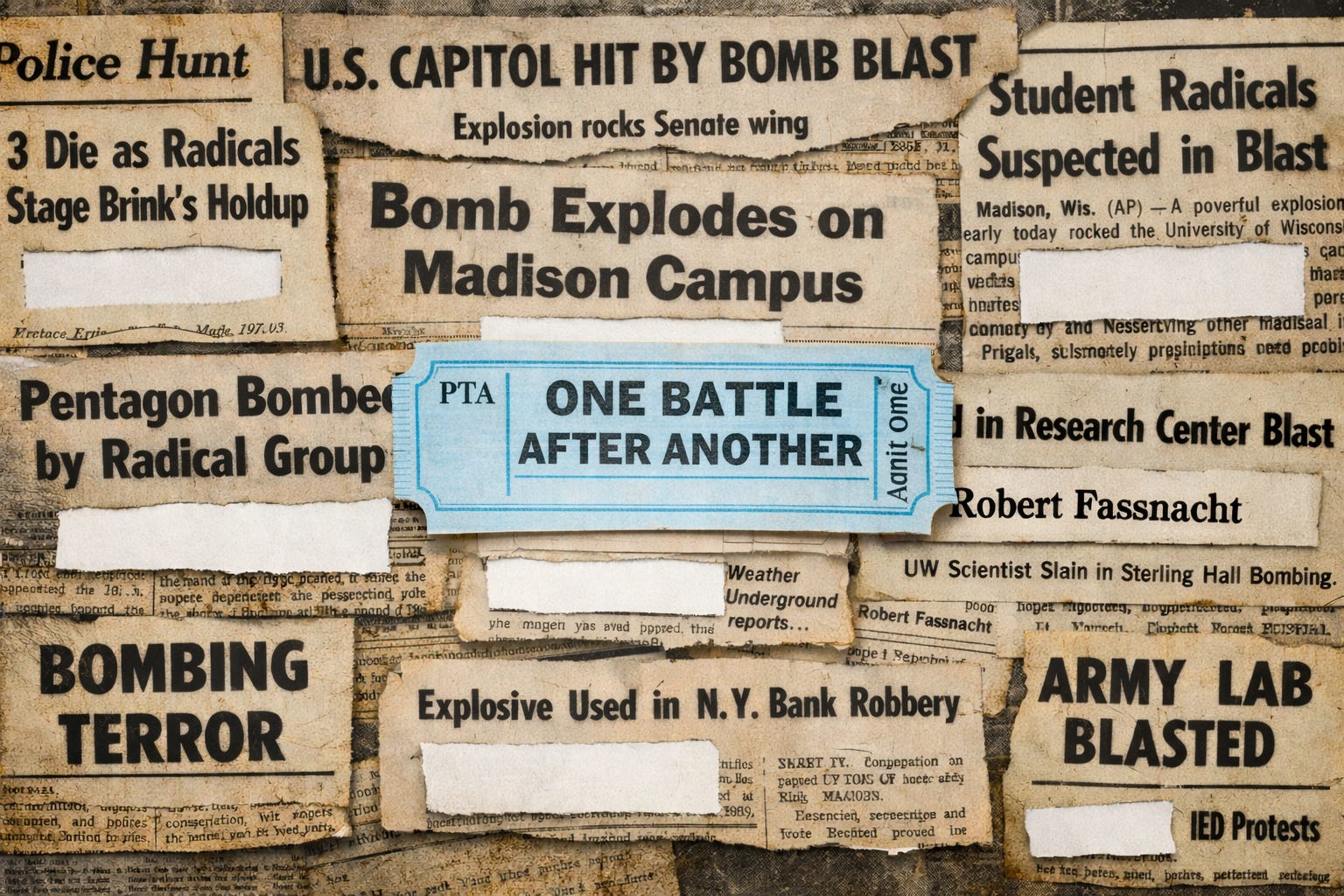
The 1970 Sterling Hall bombing killed Robert Fassnacht, a 33-year-old physics researcher, at 3:42 AM while he worked late preparing for a family vacation. His children were 3 and 1. This week, I watched Paul Thomas Anderson’s $175 million film about 1970s revolutionaries. It took me two hours and forty-two minutes to realize—Fassnacht isn’t there.

One Battle After Another, which won six BAFTAs last weekend and stands as the frontrunner for Best Picture, draws inspiration from Thomas Pynchon’s Vineland, a novel itself inspired by groups like the Weather Underground. The film follows a far-left revolutionary collective conducting armed raids, planting bombs, and shooting a security guard during a bank robbery. Critics have called it “wickedly entertaining” and “screwball fun.” It currently holds a 94% rating on Rotten Tomatoes.
I kept waiting for Fassnacht to appear—or someone like him.
The Bombing Campaign Nobody Mentions
Between 1971 and 1972, the FBI recorded approximately 2,500 domestic bombings in the United States. That’s nearly five per day. The Weather Underground alone claimed responsibility for bombings at the U.S. Capitol (1971), the Pentagon (1972), and the State Department (1975). A splinter group from Students for a Democratic Society killed researcher Robert Fassnacht in their attack on the Army Mathematics Research Center at the University of Wisconsin-Madison. The May 19th Communist Organization’s 1981 Brink’s robbery left three people dead.
These aren’t peripheral details. They’re the story. Yet Anderson’s film, like Hollywood’s broader treatment of 1970s radicalism, treats revolutionary violence as backdrop rather than foreground, a necessary evil on the path to righteous resistance.
The distinction matters because of what gets curated out. Graduate student Bill Evans, who discovered Fassnacht’s body that night in Sterling Hall, told University of Wisconsin researchers he still experiences flashbacks 50 years later. “That’s the part I’m trying to forget and the reason I haven’t talked about it in all these years,” Evans said in a 2020 interview. He described finding Fassnacht face-down under concrete rubble, in a foot of water from broken pipes.
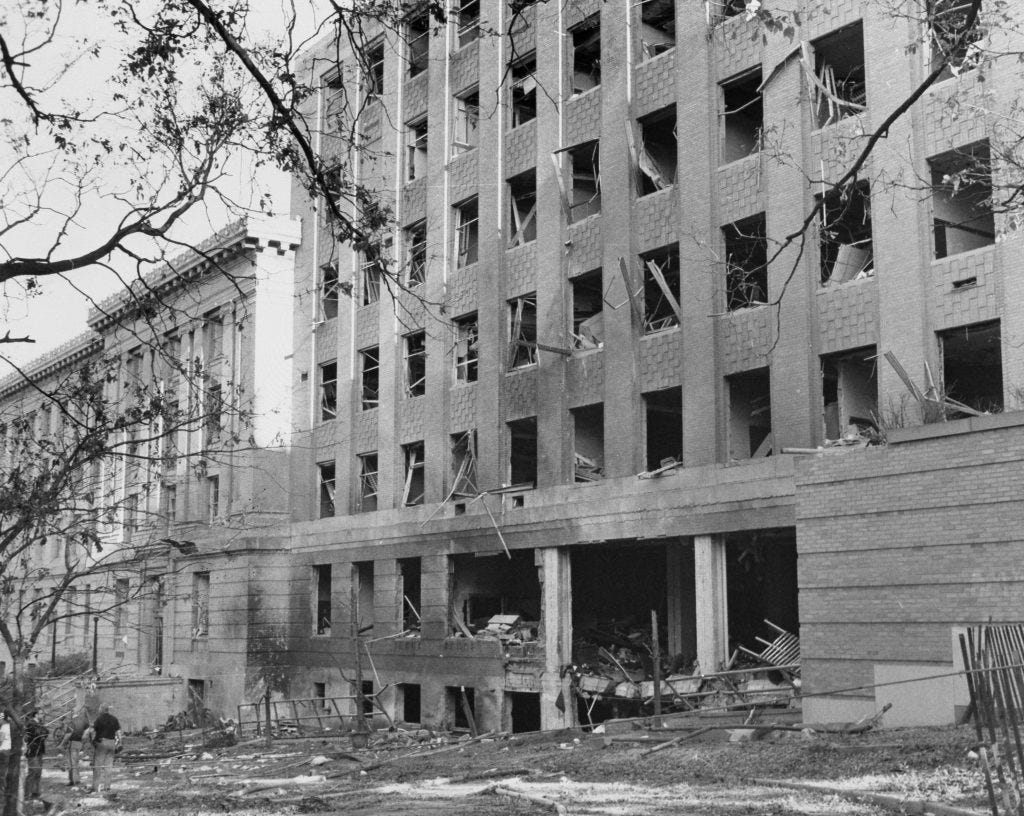
The four bombers intended to destroy the Army Mathematics Research Center on upper floors. Fassnacht’s physics lab happened to be in the basement. His research on superconductivity had no connection to military work. He was, in the clinical language of revolutionary movements, collateral damage.
Hollywood’s Evolution of Memory
What’s striking isn’t that Anderson made a film about revolutionaries, it’s how the portrayal has softened over successive decades. The 2002 documentary The Weather Underground presented members candidly discussing their actions, including Bernardine Dohrn’s later admission: “We were not brave.” Robert Redford’s 2012 film The Company You Keep depicted former radicals as conflicted, carrying the weight of their choices.
Anderson’s 2025 version features Leonardo DiCaprio as a “paranoid stoner” whose revolutionary past reads as youthful idealism gone slightly astray. The violence happens—raids, shootings, explosions—but it’s staged with what critics admiringly call “propulsive energy” and “breathless momentum.” Sean Penn’s fascist villain receives attention as a “grotesque” caricature. The security guard killed in the French 75’s bank robbery appears in perhaps two scenes. We don’t learn his name, meet his family, or linger on what his death means.
This curation reveals itself in small choices. Test screening reports indicate Anderson cut eight to ten minutes based on audience feedback, his first time conducting such screenings since Boogie Nights in 1997. Which scenes were removed? Did any involve consequences of the group’s violence? We don’t know, but the final cut emphasizes what one reviewer called “the intimate father-daughter story, which is the heart of the matter.”
The Pattern in the Archive
Stephanie Fassnacht, Robert’s widow, raised three children in Madison, working for decades at the University of Wisconsin just blocks from where her husband died. She told CBS in 2012 she harbored “no ill will” toward bomber Karl Armstrong, but held the Board of Regents responsible for security failures that night.
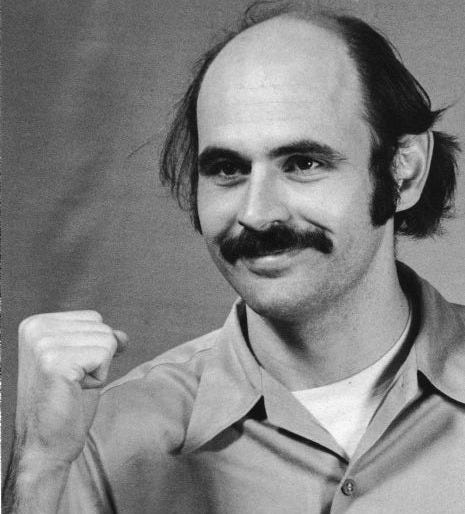
That distinction deserves attention. The actual people affected by 1970s revolutionary violence often express more nuance than either their attackers or Hollywood’s subsequent dramatizations. They recognize institutional failures, question the war that sparked the rage, yet refuse to accept that bombs were the answer. Their complexity gets flattened when violence becomes genre convention.
The 1970s bombing epidemic ended not because the revolutionaries won, but because they aged out, burned out, or went to prison. Nixon’s concern about “revolutionary terror” as a threat to national security proved overblown. But between 1970 and 1981, domestic bombings killed dozens of Americans, some military or government personnel, others graduate students working late or security guards on shift.
When Anderson frames this history as “screwball adventure,” when critics praise its “entertaining” depiction of armed resistance, when audiences leave theaters calling it “wickedly fun,” something important has been lost. Not moral clarity exactly, the Vietnam War remains indefensible, and institutional racism persists—but perhaps moral seriousness about what violence actually costs.
Robert Fassnacht was cooling down laboratory equipment with liquid nitrogen when the explosion occurred. His son Christopher became a physics professor at UC Davis. His twin daughters graduated from the University of Wisconsin-Madison, walking past the memorial plaque installed for their father in 2007.
They’re not in Anderson’s film either.
As a whole, the entertainment industry is a cesspool. Movies/TV/music/video games/the internet are filled with depictions of graphic violence all of the time and treating the subject so casually does nothing to help the problem. The glorification of murderers by the media by spreading their names/likenesses/manifestos has to stop as well. If pop culture is a reflection of morals, America is in big, big trouble.