


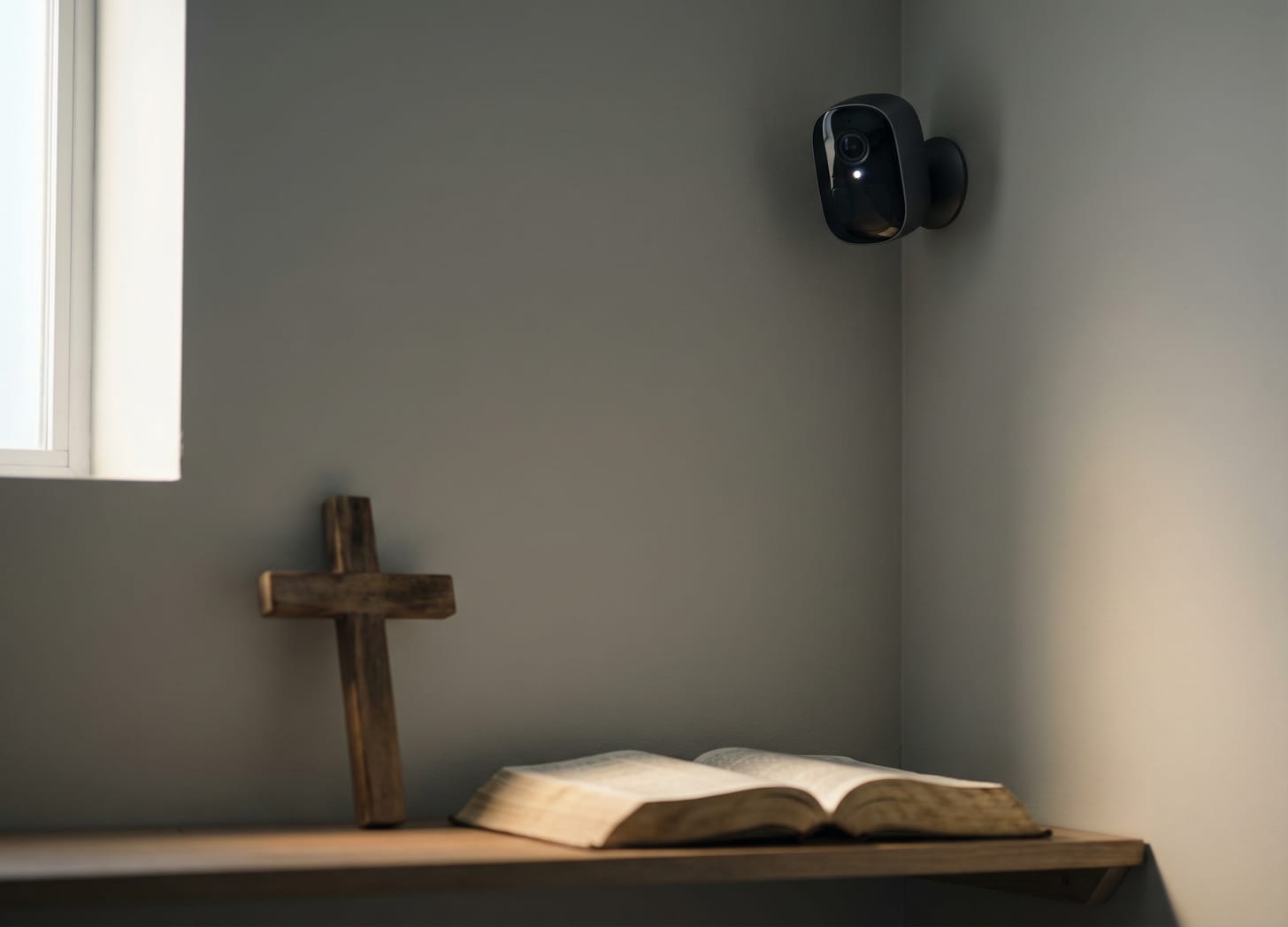
Yesterday, millions of Christians worldwide celebrated Easter in the open air, with packed sanctuaries, sunrise services, and family gatherings that spilled across front lawns. But in major Chinese cities, congregations marked the resurrection in living rooms with curtains drawn, rotating locations weekly, members arriving in staggered intervals to avoid detection.
This wasn’t 300 AD Rome. This was 2026.
On October 9, 2025, Chinese police detained Pastor Wang Lin of Zion Church in the dead of night while he traveled to Shenzhen. Within 24 hours, authorities had transported pastors from Beijing, Shanghai, and Guangzhou to the city of Beihai in a coordinated nationwide sweep. The scale revealed deliberate planning. One of China’s largest underground churches, with roughly 5,000 members across dozens of branches, was being systematically dismantled.
In January, police raided the Early Rain Covenant Church, detaining leader Li Yingqiang and several others. The crackdown followed warnings from authorities that there would be “no leeway for unlicensed churches in 2026.” By December, approximately 100 members of another unofficial church near Wenzhou had been detained in a single sweep.
The historical parallel feels too obvious to be analytically useful. Christians worshiping in secret to avoid state persecution? Of course we’ve seen this before. But the obviousness obscures something more interesting. What happens when ancient patterns of religious suppression meet the enforcement tools of a modern surveillance state? The Romans had crude mechanisms and ideological ambiguity. China has sophisticated technology and clear doctrinal opposition. The differences matter more than the similarities.
What the Catacombs Actually Were
The popular image of early Christians hiding in Roman catacombs to worship is largely mythological. Scholarly consensus now holds that catacombs served primarily as burial sites, not secret churches. Christians didn’t build elaborate underground networks to evade persecution. They buried their dead in existing graveyards, often alongside pagans and Jews. The Christian catacombs in Rome date from the end of the second century to the beginning of the fifth century, periods that included both intense persecution and relative tolerance.
When persecution intensified under emperors like Diocletian, enforcement was spectacular but inefficient. Imperial edicts in 303 AD ordered churches razed and scriptures burned, but implementation depended on local governors with varying levels of enthusiasm. The Roman state lacked the bureaucratic infrastructure for systematic religious monitoring. Persecution was episodic, geographically inconsistent, driven more by local accusations and political opportunism than centralized policy.
This created space for ambiguity. A Christian in one province might face arrest and execution while another practiced openly with minimal interference. The enforcement mechanism was crude, relying on informants, public accusations, and theatrical trials. Christians could often avoid persecution simply by keeping a low profile during dangerous periods.
The Architecture of Modern Control
China’s approach is fundamentally different. In 2018, the State Administration of Religious Affairs was absorbed into the United Front Work Department, a more ideologically rigid department charged with controlling civil society. The previous administration had maintained working relationships with many unauthorized religious leaders. The merger signaled a shift from pragmatic management to doctrinal enforcement.
Under President Xi Jinping’s “Sinicization” campaign, the government demands that all religions align with Communist Party values. The Five-Year Planning Outline for Christianity explicitly requires “upholding the leadership of the Communist Party of China” as a prerequisite for religious practice. This isn’t about preventing political opposition. It’s about subordinating theological authority to party ideology.
The enforcement mechanisms reflect this absolutism. Facial recognition cameras are now required in all registered churches, installed “in all four corners, including the pulpit” to monitor attendees. GPS tracking allows authorities to detect covert religious gatherings. Online religious content is banned outside approved platforms. The surveillance apparatus doesn’t just punish violations. It makes sustained evasion nearly impossible.
Grace Jin Drexel, whose father Jin Mingri remains detained after the Zion Church crackdown, described the coordination to Foreign Policy. “The amount of effort that the state government used to transport all these leaders from across China to Beihai just showcases the level of coordination and intensity.” This is persecution as bureaucratic system, not episodic violence.
The Choice That Wasn’t
China officially recognizes two Christian bodies. The Three-Self Patriotic Movement for Protestants and the Chinese Patriotic Catholic Association. Both operate under tight party control. Every decision requires party approval, including baptisms, sermons, and appointments. Jin Mingri spent a decade as an ordained pastor in a state-approved church before founding Zion in 2007. His daughter explained the suffocating dynamic. “In every single decision, you were made aware that you’re not serving Christ as our Lord and King, you are constantly weighing between two masters.”
The theological problem is structural, not incidental. A religion that claims ultimate authority transcendent to the state cannot genuinely submit to ideological control while maintaining doctrinal coherence. The Three-Self churches resolve this tension through theological compromise, which is precisely what house churches refuse to accept.
This creates a different kind of underground than the catacombs. Early Christians could practice openly once persecution ended because Roman paganism had no comprehensive ideological opposition to Christianity. The conflict was political, centered on refusal to honor emperor worship rather than doctrinal. When Constantine converted, there was no theological barrier to Christianity becoming the official religion.
China’s opposition is doctrinal at its core. The Communist Party cannot tolerate Christianity practiced without party mediation because the claim “Christ is Lord” directly contradicts the party’s claim to ultimate authority. This isn’t a temporary political conflict waiting for a more tolerant emperor. It’s a permanent theological impasse.
The Gray Area That Vanished
Through the 2000s and early 2010s, China operated with what participants described as “gray area” tolerance. Churches like Zion weren’t officially approved but were largely left alone if they avoided political confrontation. Local authorities might demand removal of public crosses or monitor congregations, but Zion grew large enough that “you could press ‘find church’ on the Chinese version of Google Maps and you can get there.”
The 2018 institutional restructuring eliminated that ambiguity. Grace Jin Drexel noted the shift. “They see religion now as an enemy of ideology. And so then there no longer can be this gray area. And you can see this increasing wiping away of the gray area that you had in the past.”
The crackdown uses fraud charges as its legal mechanism. Pastors are accused of collecting tithes without government recognition, therefore operating as fraudsters. Wang Yi, founder of Early Rain Covenant Church, was detained in December 2018 along with about 100 other members. He was later sentenced to nine years for “inciting subversion of state power.” The charges provide legal cover for what is fundamentally ideological enforcement.
What Actually Works Underground
The interesting question isn’t whether Christianity will survive in China. Scholars generally agree it will. Yang Fenggang, a professor at Purdue University, told The Guardian that “the most the authorities can do is to punish the few outspoken and most prominent church leaders and break these large churches into smaller meeting groups.” He added that smaller groups were more effective at recruiting new members.
This reveals the practical limits of surveillance-state persecution. China can crush visible institutions and prominent leaders, but the cellular structure of house churches proves remarkably resilient. Small groups meeting in homes, constantly rotating locations. One church member, speaking anonymously, described the adaptation. “Our church struggles to find a safe venue without fear of being reported. Along with the possible risk of being monitored, parents are also forced to exclude children under 18 years old from attending any religious activities.”
The cost is real. Families can’t worship together, children grow up outside the faith community, and every gathering carries risk of arrest. But the structure persists precisely because it can’t be fully mapped by surveillance technology. Facial recognition works on fixed locations. GPS tracking identifies patterns. Small, mobile groups operating through personal networks are harder to detect than large congregations in known buildings.
The Romans couldn’t eradicate Christianity because they lacked the tools for systematic enforcement. China can’t eradicate it despite having those tools because the faith adapts to cellular structures that surveillance struggles to penetrate. Different constraints, similar outcome.
The Test Continues
Early Rain Church released a statement following the January raids calling on members to “hold fast to the faith, to love one another, and to remain united amid persecution.”
Yesterday, as Christians elsewhere celebrated Easter in packed cathedrals built to last centuries, these believers marked the resurrection in conditions designed to prevent exactly that kind of permanence. The parallel to early Christianity isn’t that both involved catacombs. It’s that both involve the test of whether faith can sustain itself when institutions are deliberately prevented from forming.
The catacombs were never really about hiding. They were burial sites where Christians maintained identity through symbols and gatherings at martyrs’ tombs. Modern China’s underground church isn’t hiding either. It’s maintaining theological coherence in a system designed to make that structurally impossible.
The historical question isn’t whether this looks like early Christianity. It’s what we learn when the same test is administered with completely different tools. Ancient Rome’s crude enforcement and modern China’s sophisticated control both struggle with the same problem. You can prevent public institutions. You can punish visible leaders. You can make practice costly and dangerous. But the cellular structure of belief, passed through personal relationships in small groups, keeps regenerating in the gaps surveillance cannot fully close.
That’s not romanticism. It’s institutional analysis. The faith that survived Diocletian’s edicts and Constantine’s conversion is now surviving facial recognition and GPS tracking, not because it’s unchanged, but because the forms that work underground in 300 AD happen to work underground in 2026. Different enforcement mechanisms. Same structural resilience. The catacomb test continues.
The more things change, the more they stay the same.