


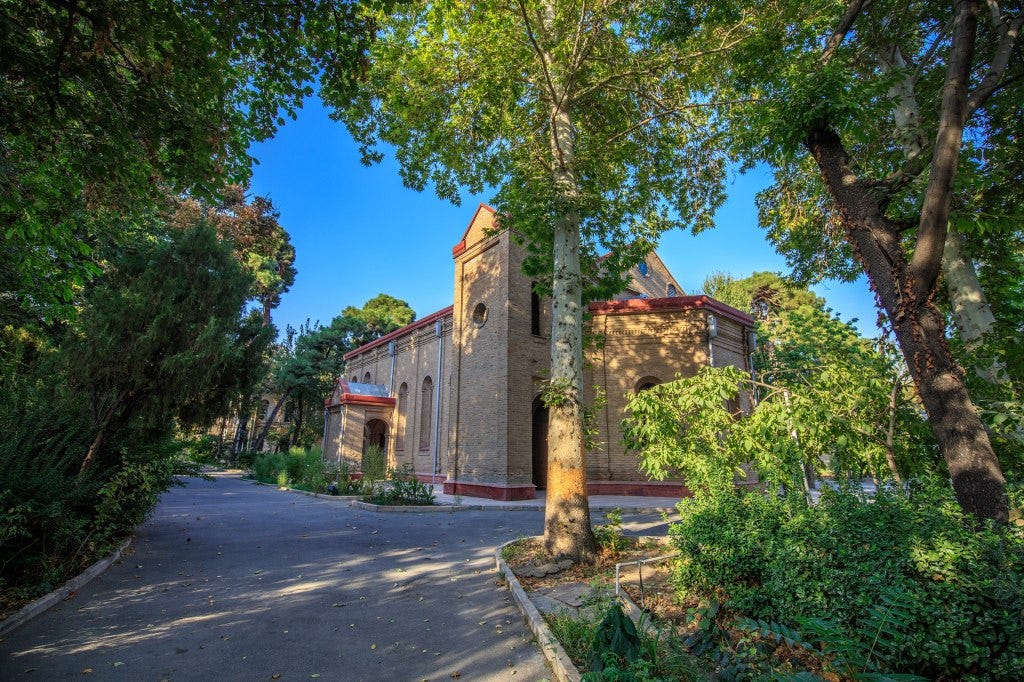
Iranian authorities are moving to seize St. Peter’s Evangelical Church in Tehran and evict roughly 20 Armenian and Assyrian Christian families from the compound. The confiscation rests on a Revolutionary Court order from 1998 directing the church complex—including the church, two schools, and residential homes—to be transferred to the Execution of Imam Khomeini’s Order (EIKO), a powerful state-linked entity.
The Council of Evangelical Churches of Iran, which administers St. Peter’s, did not learn of the ruling until 2008. When it challenged the decision, the Islamic Republic refused to renew the council’s registration, effectively ending any legal defense.


Administrative Erasure
The families have reportedly been told to leave within two weeks and worship elsewhere. Many are low-income residents who have lived in the compound for years. Rev. Sargez Benyamin, a former pastor now in exile, told Article18 that they “have no chance to survive without church support,” and that church leaders have been threatened with arrest if families refuse to comply.
Six Iranian Ministry of Intelligence agents visited the site on June 28, stayed for several hours, and told residents, “We have come so that you can become accustomed to our presence.” The sentence has the chill of bureaucracy learning to speak like occupation.
Property as Power
The Jerusalem Post, citing church sources and diaspora reporting, says authorities have already seized a 10,000-square-meter garden belonging to the church, with four IRGC officials reportedly occupying it under a newly issued deed. Church employees and members are now treated as trespassers on land historically belonging to the church. Iranian authorities maintain the church improperly rented parts of the property to members.
Authoritarian systems rarely announce religious punishment outright. They cite land disputes. They claim paperwork was improper. They invoke violations of rules. Sometimes the rules are real enough to be useful. The effect is what matters: a church becomes a trespasser inside its own memory.
The Evangelical Problem
St. Peter’s belongs to a category the Islamic Republic prefers to manage rather than destroy outright. Iran’s constitution recognizes some “ethnic” Christians, including Armenian, Assyrian, and Chaldean communities. But the same system treats Christian converts, evangelism, Persian-language worship, and house churches as threats to national security. The UK’s June 2026 country guidance notes that recognized Christians must be registered, churches are monitored to prevent attendance by converts from Muslim backgrounds, and noncompliant churches have been closed.

Protestant Christianity unsettles Tehran because it crosses boundaries. It speaks Persian. It attracts converts. It implies that conscience is prior to the state and religious identity cannot be reduced to ancestry.
Escalating Pressure
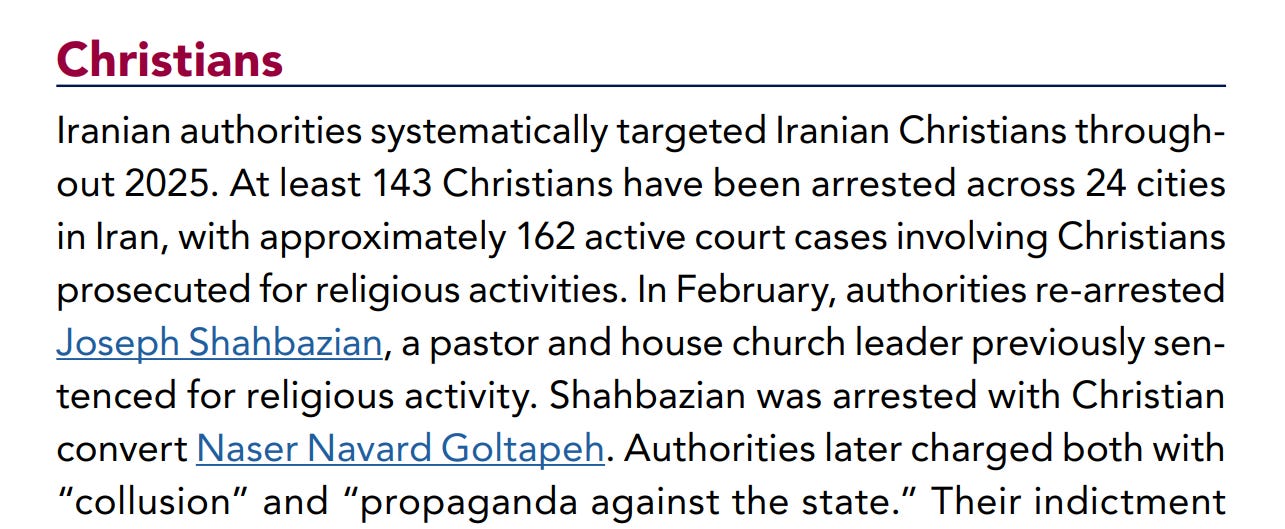
The US Commission on International Religious Freedom’s 2026 Iran report describes an environment in which religious freedom conditions remain poor and the government has escalated targeting of non-Shi’a Muslim minorities, including Baha’is, Jews, Christians, Sufis, and Sunnis. The report notes that Iranian state media portrayed Christians as national enemies and accused Evangelical Christians of collaboration with foreign “Zionist” churches. At least 143 Christians were arrested across 24 cities in Iran during 2025.
In that atmosphere, a Protestant church with American missionary roots is not simply an old building. It is an object onto which the regime can project foreign conspiracy, internal weakness, and revolutionary grievance.
When Institutions Fall
What is happening at St. Peter’s belongs to the history of how states domesticate civil society. First they decide which communities are legitimate. Then they decide which activities those communities may perform, which language they may use, which people they may welcome, which property they may own. At the end, the community still exists in theory. It simply cannot breathe.
The most durable forms of repression often arrive through administrative instruments before they arrive through ruins. A church does not need to be burned to be erased. It can be reclassified. Its leaders can be threatened. Its residents can be ordered out. Its property can be transferred. Its worshippers can be told to find somewhere else to pray.
Religious freedom lives in buildings, deeds, schools, homes, liturgies, languages, and the courage of people who keep showing up to pray. When those things are taken, a civilization is not merely losing property. It is losing the places where memory becomes resistance.