


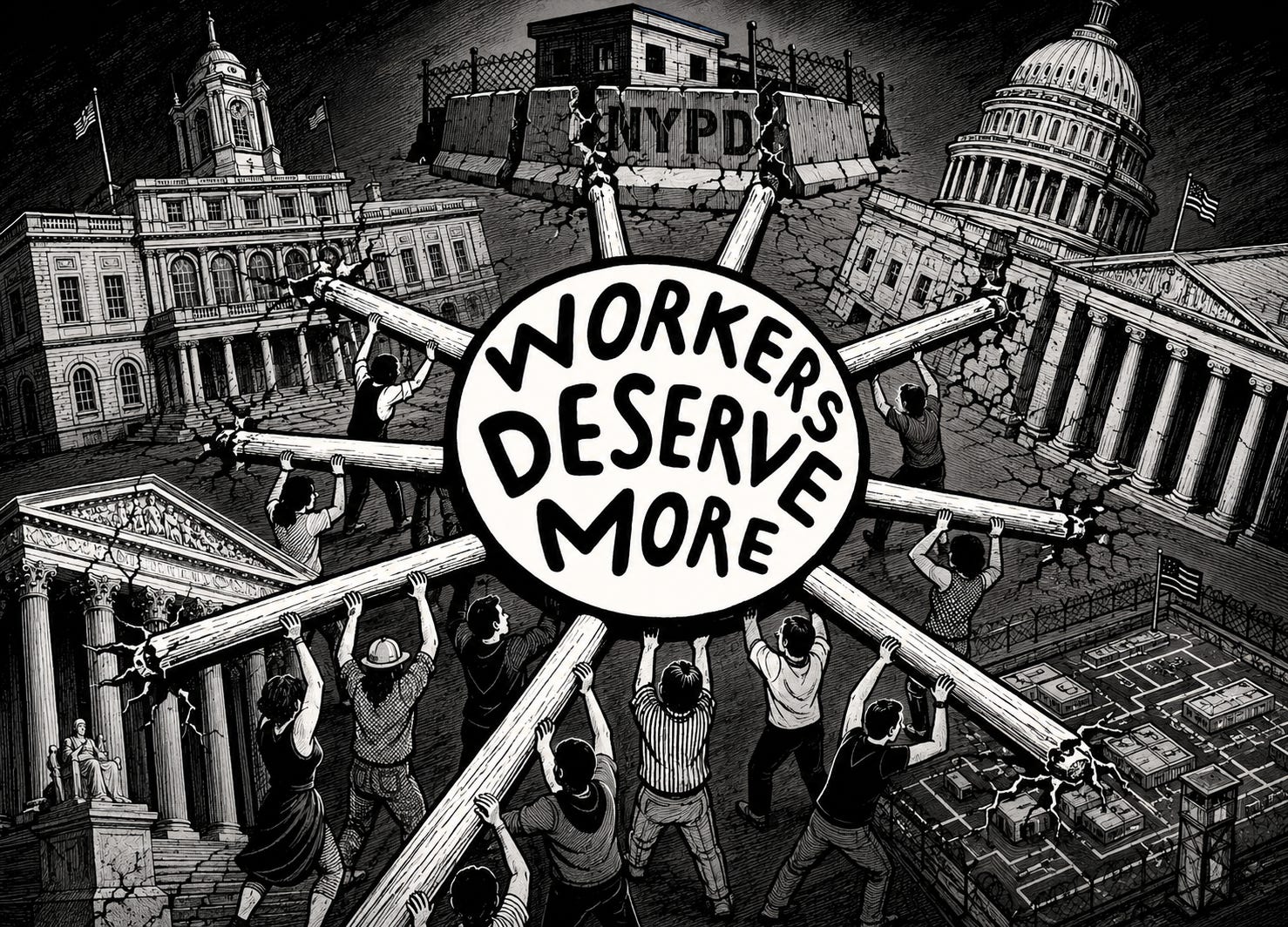
Earlier this month, the DSA’s National Political Committee—its governing board—adopted a platform called “Workers Deserve More!” According to investigative reporting by Stu Smith at City Journal, the document commits the organization to abolishing the U.S. Senate, “replacing the President and Supreme Court with an executive and judiciary chosen by and subordinate to Congress,” eliminating “the carceral forces of the capitalist state,” ending all economic sanctions (including those on Iran, Cuba, and Russia), and granting universal amnesty to all immigrants. The document calls for public ownership of major corporations, defunding the Pentagon, closing overseas military bases, and removing unspecified “restrictions on marriage.”
This isn’t campus Marxism or activist performance art. This is the formal governing document of an organization with over 90,000 members that has successfully placed adherents in state legislatures, city councils, and mayoral offices across the country—including Zohran Mamdani, who became New York City’s mayor in January 2026.


The platform creates an unusual test case: What happens when an organization dedicated to revolutionary transformation suddenly has members responsible for maintaining the institutions it wants to destroy?
The Structure of Radicalization
The DSA operates as a “big tent“—Bernie Sanders social democrats sharing organizational space with self-described Maoists and prison abolitionists. This structure has strategic utility: it provides mainstream credibility through its moderate wing while the militant factions set the ideological trajectory.
But the tent has a ratchet. According to Smith’s reporting, the platform committee that drafted “Workers Deserve More!” spent two months deliberating and delivered it to leadership with a unanimous recommendation to adopt it unchanged. The National Political Committee instead added four amendments—each pushing further left. Two passed unanimously. The others, calling for police abolition and constitutional demolition, barely passed but still made it through.
NPC member Cliff Connolly, from the Marxist Unity Group, acknowledged in the meeting that “this committee was not multi-tendency. There were several tendencies in DSA that were not represented there.” The big tent, in practice, appears to have a missing moderate pole.
The Civilizational Diagnosis
The platform’s coherence depends on a particular reading of American institutions: that they are fundamentally illegitimate structures designed to prevent popular will from challenging entrenched power.
Connolly articulated this clearly in the NPC meeting: “We’re never going to have democracy or socialism in the United States as long as the president and the Supreme Court exist in their current form. The whole point of having the Senate, the president, and the Supreme Court is so that, if popular legislation passes through the House of Representatives, the ruling class has these other levels they can pull to stop it from happening.”
This framework treats constitutional structure not as a system of checks and balances preventing tyranny, but as an obstacle to be eliminated. The separation of powers becomes evidence of anti-democratic design rather than protection against concentrated authority. The Senate’s equal representation of states—a compromise essential to creating a federal union from sovereign entities—becomes proof of systemic illegitimacy because Wyoming has the same senatorial weight as California.
The foreign policy sections follow similar logic. The platform demands an end to all economic sanctions, describing them as “economic warfare” that punishes civilian populations. This framing carefully avoids examining why sanctions exist on regimes like Iran (nuclear weapons development, terrorism sponsorship), Cuba (authoritarian single-party state), or Russia (territorial conquest of neighbors). The entire apparatus of deterrence, alliance maintenance, and pressure on hostile actors gets collapsed into “imperialism.”
The immigration position takes this further: “freedom of movement” translated as universal amnesty treats national borders as inherently oppressive constructs rather than definitional attributes of sovereign states. The DSA platform never addresses whether a nation-state can exist without the ability to determine who enters it, or what happens to the welfare systems they want to expand when eligibility becomes universal.
The Implementation Problem
The analytical framework is revolutionary. The practical reality is that DSA members now run governments.
Sidney Carlson White, a member of the Marxist Unity Group, noted the tension directly during the debate over the police abolition amendment: “We need to articulate our position, especially as we have taken executive power in New York and are in places where we are now responsible for the actions of the police.”
This creates a fascinating institutional dynamic. If the platform represents the DSA’s genuine vision, then every compromise its elected officials make — every day they don’t start dismantling police forces, every month they work within constitutional structures — becomes a betrayal of stated principles. The organization has created conditions where governing competently means ideological failure.
Katie Sims of the Socialist Majority Caucus argued during deliberations that adopting the police abolition language would create contradictions for endorsed candidates “at a moment when the organization was pushing for greater alignment with its elected representatives.” The amendment passed anyway, 16-8.
What Gets Normalized
The most consequential aspect of “Workers Deserve More!” isn’t what it demands—most of the platform has no chance of implementation. It’s what positions the document places within the bounds of serious organizational discourse.
Abolishing the Senate is now an official position of a political organization that holds significant urban power and influences Democratic Party primaries. Eliminating all police forces is formal policy for a group whose members govern major cities. Ending sanctions on authoritarian regimes is a commitment from an organization that shapes foreign policy debates through its congressional allies.
The document also reveals something about how institutional capture proceeds. The DSA didn’t moderate as it gained power—the trajectory went the opposite direction. Success in winning positions didn’t temper the platform; it emboldened the factions pushing for more explicit radicalism. One NPC member described the platform as “what a horizon of power looks like,” suggesting the organization views its current electoral success as the beginning of more fundamental transformation rather than an endpoint.
The Legitimacy Cascade
There’s a pattern visible here that extends beyond one organization. When activist movements transition into governing coalitions, they face a choice: moderate positions to reflect the responsibilities of power, or maintain ideological purity and treat governance as a vehicle for transformation rather than administration.
The DSA is seemingly choosing the latter. The question is whether that choice is sustainable.
According to Smith’s reporting, the DSA’s leadership has scheduled the platform’s full rollout at their Socialists Summit in Chicago this July, where alignment between platform and practice will presumably be addressed. The organization is openly discussing the need for elected officials to bring their positions in line with the national platform..
Whether that’s sustainable remains an open question. But the platform is now public, the commitments are documented, and the organization just eliminated the ambiguity that made its electoral success possible. They’ve written it down, and they’re asking their elected officials to align.
That decision might be the most revealing thing in the entire document.
This isn't political a political platform, this is the blueprint for destroying civilization as we know it.