


The U.S. Conference of Catholic Bishops released a video on March 18 warning Catholics against antisemitic conspiracies and falsehoods. Archbishop Alexander Sample, chairman of the USCCB’s religious liberty commission, did not name any organization directly. He did not need to.
Less than 24 hours later, Catholics for Catholics, a Phoenix-based 501(c)(4) advocacy group, held its third annual “Catholic Prayer for America Gala” in Washington. The event featured a lineup including Candace Owens, Michael Flynn, Carrie Prejean Boller, and Joe Kent, a combination that brought renewed scrutiny to the group’s role in elevating figures accused of trafficking in antisemitic rhetoric or adjacent conspiracy politics under explicitly Catholic branding.
That sequence matters far more than the usual culture-war controversy. It illustrates a deeper institutional problem for the Catholic Church: organizations that present themselves as Catholic can operate outside formal ecclesiastical control, use opaque political funding structures, and platform speakers the bishops would never endorse, while still borrowing the authority and symbolism of the faith for their own purposes.
The Structural Problem
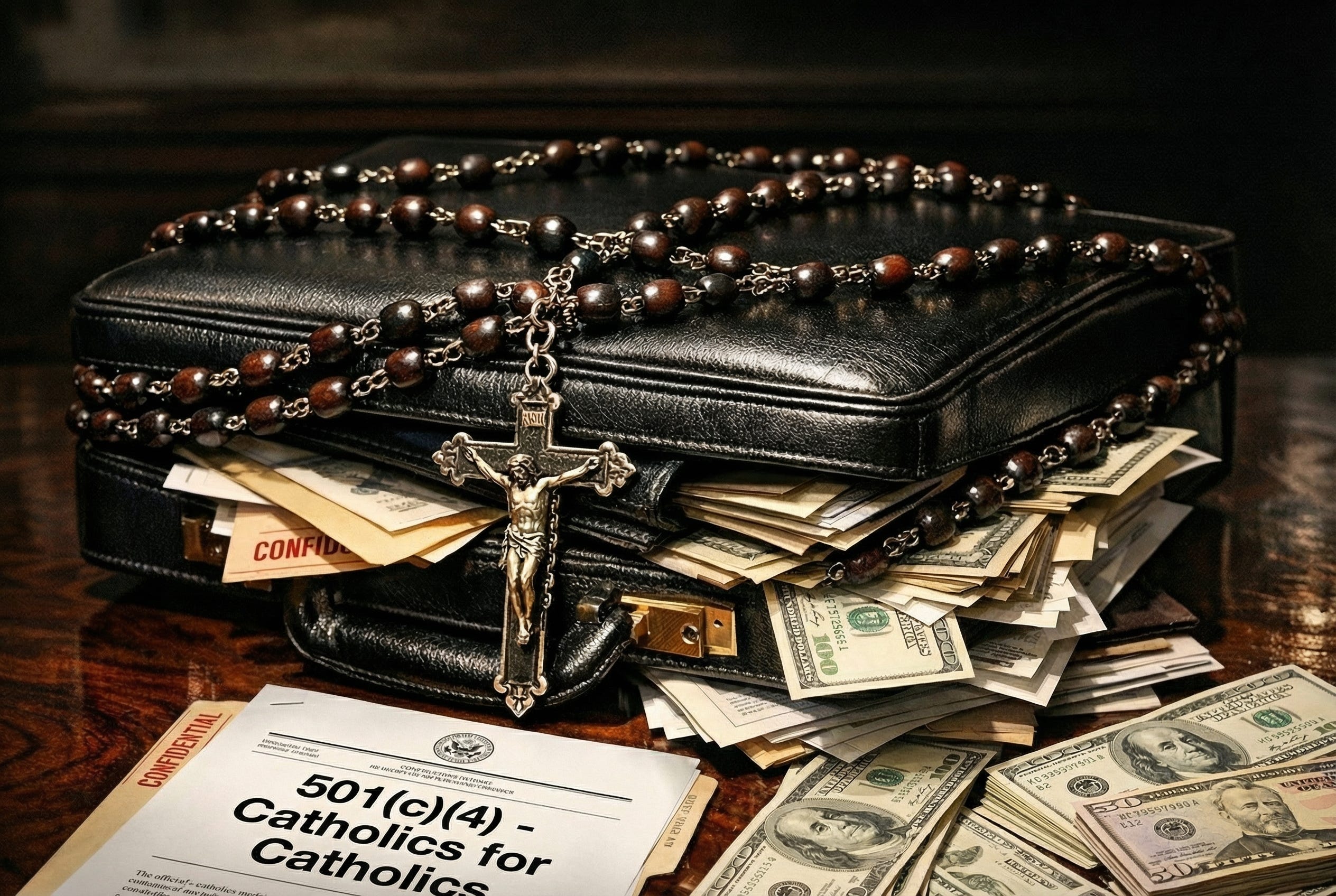
Catholics for Catholics operates as a 501(c)(4) social welfare organization, a designation that allows unlimited political activity and keeps donor identities private. Founded in 2022 and based in Phoenix, the group describes itself as “supporting frontline culture warriors who love God and the USA.” Their website features testimonials from President Trump (”your love of God and Country is evident in everything you do”) and Bishop Joseph Strickland, the Tyler, Texas bishop removed by Pope Francis in 2023.
The 501(c)(4) structure matters because it exists in regulatory space the Catholic hierarchy cannot directly control. Unlike a parish or diocesan organization that operates under clear ecclesiastical authority, Catholics for Catholics can claim Catholic identity while remaining financially opaque and institutionally untethered. The organization doesn’t need diocesan approval for its activities, doesn’t submit to USCCB oversight, and can platform speakers the institutional Church would never endorse—all while wrapping itself in explicitly Catholic branding.
This creates what one longtime observer of Catholic institutional politics called “scandal without remedy”: the Church’s canonical definition of scandal (leading the faithful into sin through public example) applies, but its traditional mechanisms for addressing scandal (episcopal authority, ecclesiastical censure) do not.
The Speaker List as Provocation
The March 20 gala featured Candace Owens, who nine months after converting to Catholicism told interviewer Tristan Tate that Judaism is a “pedophile-centric religion that believes in demons.” Also speaking: former Trump national security advisor Michael Flynn, former beauty pageant contestant Carrie Prejean Boller (removed from the White House Religious Liberty Commission in February after an anti-Zionist tirade at an antisemitism hearing), and Joe Kent, who resigned as director of the National Counterterrorism Center days earlier claiming the U.S. was driven to war by “Israel and its powerful American lobby.”
Dennis Prager, founder of PragerU and Owens’ former employer, wrote her a 15-page letter in September 2024: “Whatever your motives, I cannot think of anyone in public life engendering as much suspicion of Jews, Zionism, and Israel as are you.” Ben Shapiro’s Daily Wire parted ways with Owens in March 2024 after she queried on air whether “a very small ring of specific people” in Hollywood were “using the fact they are Jewish to shield themselves from any criticism.”
The Catholic Speakers Organization—which also represents Bishop Robert Barron and theologian Scott Hahn—added Owens to its roster after her conversion. When Canadian pro-life activist Amanda Achtman, herself Jewish-Catholic, expressed concern about sharing even a virtual platform with Owens, CSO founder Joe Condit declined Achtman’s application. The organization claims all speakers are “rigorously screened and vetted” and “diocesan approved.” The Diocese of Nashville, where Owens resides, confirmed to Catholic World Report it has no record of being contacted by CSO and has issued no letter of recommendation.
The Institutional Response
Archbishop Sample’s video was surgical in its implications without naming targets. “The Jewish community is attacked at a far higher rate than any other religious group in the United States,” he noted. “As Catholics, we are called to walk in the truth and so to reject the conspiracies and lies that lead to harassment and even violence against our Jewish brothers and sisters.”
The next morning, at the National Catholic Prayer Breakfast (a different event), White House Domestic Policy Council director Vince Haley—a Catholic—closed his remarks with similar language: “Hatred toward Jewish people is ugly, despicable, an affront to the Sacred Heart of Jesus, and surely an occasion of terrible grief for our Jewish mother, Mary.”
Neither man mentioned Catholics for Catholics. But Nathan Diament, executive director of public policy for the Union of Orthodox Jewish Congregations, made the connection explicit to EWTN News: “The statement by Archbishop Sample on behalf of the USCCB could not come at a more important time with bad actors weaponizing Catholicism to spread antisemitic views.”
Here’s what makes this fascinating: the institutional Church is now reduced to issuing timed theological reminders because it cannot directly discipline lay organizations operating under 501(c)(4) structures. Sample cited the Council of Trent catechism (1566), which states that Christians bear greater guilt for Christ’s death than first-century Jews, and Nostra Aetate (1965), Vatican II’s declaration that “the Church... decries hatred, persecutions, displays of antisemitism directed against Jews at any time and by anyone.”
This is defensive catechesis—teaching doctrine not to form the faithful but to create distance from those claiming to speak for them.
The Historical Precedent Catholics Aren’t Mentioning
The closest parallel is 1930s Catholic social movements in Europe that merged nationalist politics with selective Catholic identity, operating just outside formal Church structures while claiming to represent authentic Catholicism. Pope Pius XI addressed this in his 1937 encyclical Mit brennender Sorge, which was smuggled into Germany and read from pulpits: “Whoever exalts race, or the people, or the State... and divinizes them to an idolatrous level, distorts and perverts an order of the world planned and created by God.”
The difference is that Pius XI could command every German Catholic pulpit simultaneously. The USCCB cannot command a 501(c)(4)’s donor disclosure, event cancellation, or speaker replacement. It can only clarify doctrine and hope the distinction registers.
What the Church Can’t Say Directly
The institutional Catholic response has been notably careful about how it condemns antisemitism—citing antisemitism’s threat to religious freedom generally rather than naming Catholics for Catholics as a scandal specifically. This is strategic ambiguity born of structural constraint: the USCCB cannot formally discipline a 501(c)(4), but it also cannot afford to be seen as impotent when organizations traffic in what Sample called “conspiracies and lies.”
What Sample and Haley achieved was creating a paper trail. When Catholics for Catholics hosts future events or when Owens speaks at Catholic venues, bishops can now point to explicit, timestamped statements of Church teaching issued the day before a controversial gala. It’s ecclesiastical documentation for future use—not immediate remedy, but evidence for the record.
The question is whether that’s sufficient when the scandal is ongoing, well-funded, and structurally immune to the usual mechanisms of Church discipline. Catholics for Catholics isn’t going anywhere. Neither is its 501(c)(4) status, which guarantees the USCCB will keep issuing carefully worded videos while the organization keeps hosting galas.
The ancient problem of scandal has met the modern problem of tax-exempt political advocacy. The Church has doctrine. It does not, apparently, have jurisdiction.