


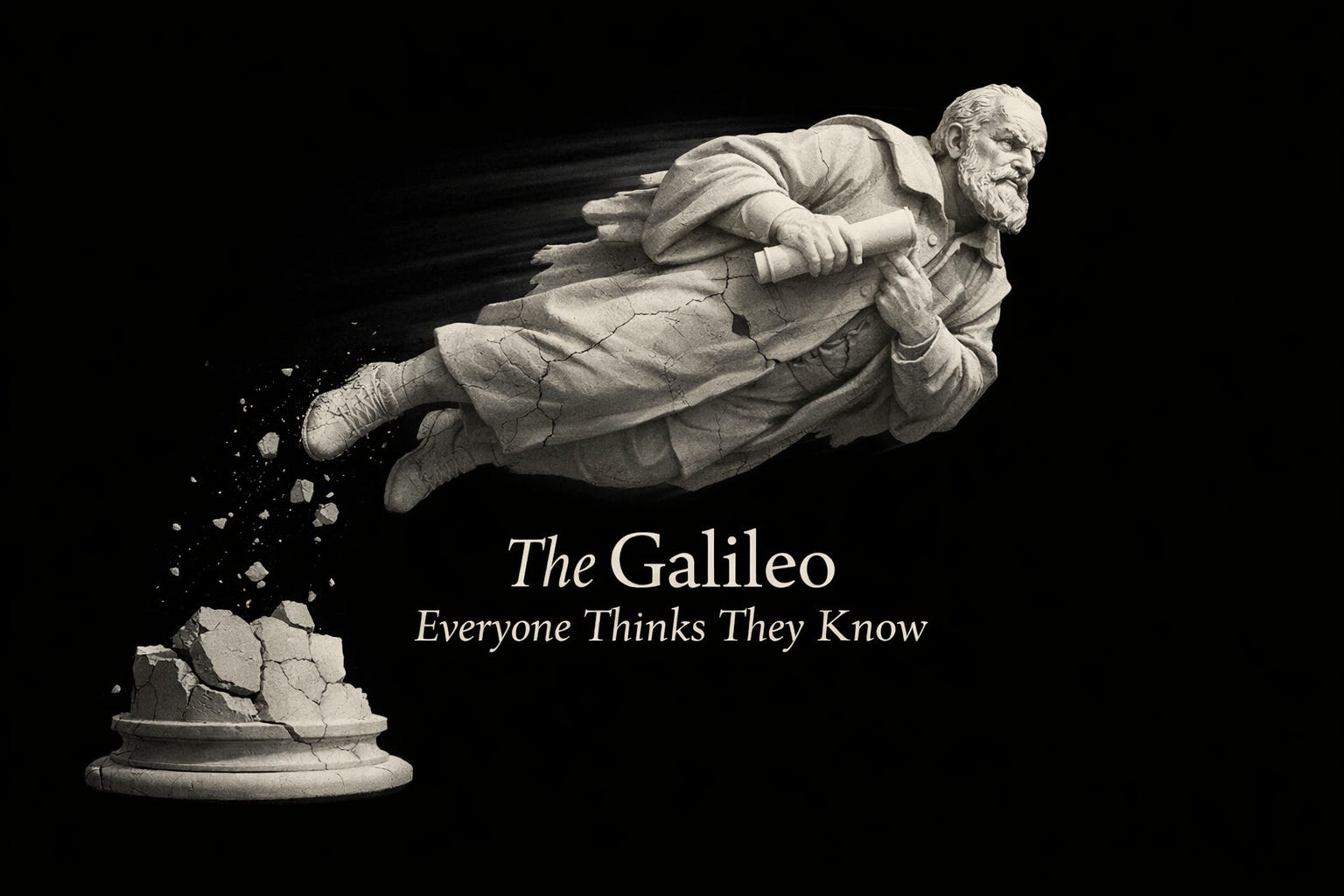
Yesterday marked Galileo’s birthday, and somewhere on the internet, someone deployed him in an argument. They always do. He’s become the perfect projectile—hurl him at your opponent and claim the mantle of persecuted truth-teller. Flat-earthers cite him as proof that consensus can be wrong. New Atheists invoke him as science’s martyr to religious obscurantism. Catholics claim him as a faithful son of the Church who was technically correct all along. Political dissidents of every stripe see themselves in his story.
The strange thing is that almost none of them know what actually happened.
I’ve been trying to understand why the Galileo myth persists with such tenacity, and I think I’ve found the answer: the real story is so much weirder than the myth that our brains reject it. We want heroes and villains, science versus superstition, a clear narrative arc. What we get instead is ecclesiastical politics, philosophy of science disputes, and a man who probably didn’t believe what he was prosecuted for disbelieving.
Let’s start with what didn’t happen. Galileo was not tortured. He was not imprisoned in a dungeon. He spent exactly one day in actual custody before being moved to villa arrest in his comfortable home outside Florence, where he continued his scientific work until his death nine years later. The legendary moment when he muttered “And yet it moves” after renouncing heliocentrism? A romantic invention. If he’d actually said that, the automatic penalty would have been death. Galileo, whatever else he was, wasn’t suicidal.
The trial itself lasted a single day. One day. This supposed 17-year persecution that’s become shorthand for religion crushing science? It was a non-event in 1616—just a warning, no charges—followed by 16 years of silence, then a one-day proceeding in 1633. The sentence was deliberately light: a regimen of penance and house arrest that was commuted almost immediately. For a heresy trial during the Counter-Reformation, this is roughly equivalent to getting a parking ticket.
But here’s where it gets genuinely interesting: Galileo was prosecuted for violating an agreement not to teach heliocentrism as proven fact, and at his trial, he insisted—under oath, with the threat of torture hanging over him—that he didn’t actually believe in heliocentrism. He claimed he’d simply been showing off his rhetorical skills by making the stronger argument for a position he personally rejected.
Was he lying to save his skin? Probably. But we don’t actually know. Henry Kelly, who spent years examining the trial transcripts, notes that “we can only guess at what he really believed.” Galileo in his later years continued to publicly affirm geocentrism. The Church made a point of announcing that he’d always been orthodox. Everyone involved had reasons to obscure the truth.
This is not the tidy morality play we’ve been sold.
The deeper puzzle is why the Church prosecuted him at all. The standard answer—that religion fears science—collapses under scrutiny. Copernicus published his heliocentric theory in 1543, and for 73 years the Church... did nothing. It was taught in Catholic universities. Clergy read it. When the Church finally banned it in 1616, the prohibition was temporary and required only minor edits presenting heliocentrism as hypothetical rather than proven. By 1620 it was allowed again.
The Church’s objection wasn’t that heliocentrism was scientific. The objection was that Galileo was claiming it was proven when the scientific evidence of the era didn’t support that conclusion.
This sounds absurd to us, but it wasn’t absurd then. The heliocentric model contradicted the only comprehensive physics that existed: Aristotle’s. It required believing the Earth hurtled through space at enormous speed without anyone feeling the motion—a genuine conceptual problem before Newton’s laws of motion. Most damningly, no one had observed stellar parallax, the apparent shift in star positions that a moving Earth should produce. Tycho Brahe, the greatest observational astronomer of the 16th century, looked for parallax and couldn’t find it. That’s why he rejected heliocentrism.
The scientific consensus of Galileo’s era treated Copernicus as a useful calculating device, not a description of physical reality. When the Church examined heliocentrism in 1616 and deemed it “foolish and absurd in philosophy,” they were essentially endorsing the scientific mainstream. Historian David Lindberg puts it bluntly: “Those astronomers and natural philosophers who rejected heliocentrism did so not because of blind conservatism or religious intolerance, but because of their commitment to widely held scientific principles and theories.”
So what changed by 1633? Politics and philosophy, not astronomy.
Cardinal Maffeo Barberini—a Galileo fan who’d praised his work—became Pope Urban VIII in 1623. He gave Galileo permission to write about heliocentrism with one condition: treat it as hypothesis, not established fact. The Pope’s reasoning was philosophically sophisticated, anticipating what’s now called the underdetermination thesis in philosophy of science. Any given set of observations could be explained by multiple theories. Tycho Brahe’s geo-heliocentric model accounted for Galileo’s telescope discoveries without requiring a moving Earth. How could Galileo claim certainty?
Galileo proceeded to publish a book that clearly—though not explicitly—argued for heliocentrism as physical truth, while making his opponents sound like idiots. Worse, he put the Pope’s own philosophical argument into the mouth of a character named Simplicio, which in Italian sounds exactly like “simpleton.” Whether this was deliberate mockery or catastrophic misjudgment, the effect was the same: a personal insult to a Pope whose power was already diminished by the Reformation and who was fighting the Thirty Years’ War. The trial of Galileo was launched at the exact moment the war reached crisis point. Coincidence?
The trial focused not on whether heliocentrism was true, but on whether Galileo had violated his agreement with the Church. It was, in essence, a breach of contract case. And because this was the Counter-Reformation, it had a subtext about authority that matters more than the astronomy: who gets to interpret Scripture? Galileo, in his 1613 letter defending heliocentrism, had used standard Augustinian arguments about scriptural accommodation—God spoke in ways ancient peoples could understand, so the Bible shouldn’t be read as a physics textbook.
This was orthodox theology. But Galileo was a layman instructing the Church how to read the Bible, and that looked uncomfortably Protestant. The conflict wasn’t science versus religion. It was Catholic versus Catholic, in an era when that distinction could get you killed.
Here’s what’s genuinely worth understanding about the Galileo affair: it reveals how institutions process disruptive information. The Church had interpretive tools for reconciling Scripture with natural philosophy—the doctrine of accommodation, the distinction between saving appearances and physical truth. It had procedures for updating when evidence became overwhelming. What it didn’t have was a mechanism for handling a charismatic figure who claimed certainty before the evidence warranted it, while simultaneously appearing to challenge institutional authority during an existential crisis.
The Church’s error wasn’t rejecting science. It was demanding certainty about the wrong things—demanding Galileo prove heliocentrism to a standard the evidence couldn’t yet meet, while simultaneously demanding he defer to institutional authority about matters where evidence should have been determinative. The framework was sophisticated; the application was catastrophic.
Three centuries later, in 1992, Pope John Paul II acknowledged the Church had persecuted Galileo unfairly. The books were removed from the Index of Forbidden Works in 1835. Heliocentrism was officially acceptable in Rome by 1822. The gears of institutional error-correction turn slowly, but in the West, they do turn.
The real Galileo story isn’t about religion suppressing science. It’s about what happens when personal politics, institutional anxiety, and premature certainty collide during a civilizational crisis. Which, come to think of it, might be why everyone keeps invoking him.
Do you have links to sources? I'd love to read more
This is probably the most comprehensive review of Galileo and his troubles with the Church as seen from both perspectives that I've ever read in such a concise piece. An absolute must-read for anyone interested in science, history, theology, or current events.