

The Map That Explains Everything
Iran's ballistic missiles can't reach Washington. But draw a circle showing what they can reach, and you'll understand why Operation Epic Fury targeted launch sites as much as nuclear facilities

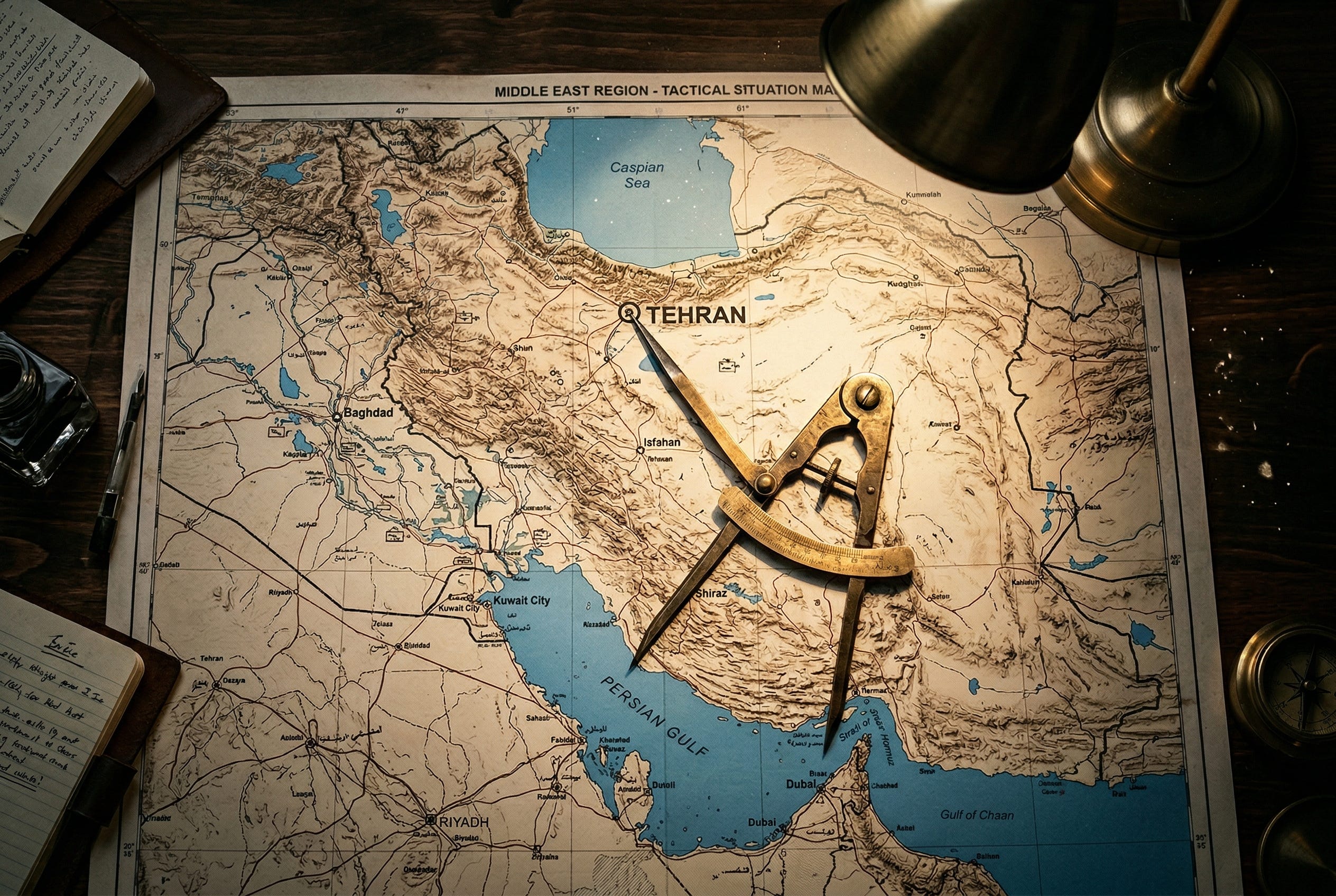
When U.S. and Israeli warplanes began Operation Epic Fury on Saturday morning, they struck nuclear facilities in Tehran and Isfahan. But just as many bombs fell on missile production sites and launch facilities scattered across Iran. To understand why, you need a map and a compass.
The 1,200-Mile Circle
Draw a 1,200-mile radius from Iran’s missile bases. Inside that circle sits almost everything that matters in the Middle East: 40,000 U.S. troops spread across bases in Qatar, Bahrain, Kuwait, the UAE, Jordan, and Iraq. Saudi Arabia’s oil infrastructure at Ras Tanura and Abqaiq. The Strait of Hormuz, through which one-fifth of global oil passes daily. Dubai’s financial district. Every major energy chokepoint between the Mediterranean and the Indian Ocean.
Iran doesn’t need nuclear weapons to hold these targets at risk. It already does, with the largest ballistic missile arsenal in the Middle East, somewhere between 2,000 and 3,000 missiles, depending on whose count you trust. Most are short- and medium-range systems: Shahab-3s, Sejjils, Qadr missiles with ranges between 500 and 1,200 miles. They can’t reach Washington or even Europe. They don’t need to.
America’s Bases in the Crosshairs
Al Udeid Air Base in Qatar sits 615 miles from Iranian launch sites. It houses 10,000 American troops and serves as forward headquarters for U.S. Central Command, which is the nerve center for all American military operations in the region. When Iran retaliated for Epic Fury on Saturday afternoon, one of its first targets was Al Udeid. Qatari missile defenses intercepted the strike, but the message was clear: Iran can reach the bases that launch strikes against it.
Naval Support Activity Bahrain, home to the U.S. Fifth Fleet, sits 500 miles away. Kuwait’s Ali Al Salem Air Base, a staging ground for combat operations: 400 miles. The UAE’s Al Dhafra Air Base, which houses advanced fighter squadrons: 700 miles. Iranian missiles hit targets in at least five countries within hours of Epic Fury’s first wave. Not because Iran’s missile technology is sophisticated—many of these systems are liquid-fueled and take hours to prepare, making them vulnerable to preemptive strikes—but because the geography is unforgiving.
This explains why Operation Epic Fury prioritized missile infrastructure alongside nuclear sites. When Pentagon planners talk about Iran’s “threat radius,” they’re not being abstract. They mean the physical distance Iranian projectiles can travel, overlaid on the map of American commitments. It’s why Gulf states that host U.S. bases now face Iranian retaliation, why Saudi Arabia and the UAE (both of which allowed Epic Fury aircraft to use their airspace) issued statements about defending their territories with “all necessary measures.”
The Targets That Couldn’t Be Hit
The radius also explains decisions about what didn’t get hit. Iran’s Bushehr nuclear reactor, on the southern coast, survived Epic Fury intact. Not because it’s unimportant, but because Russian technicians operate it, and striking the reactor means killing Russians and creating radiological fallout that would drift across the Gulf. Every target inside that 1,200-mile circle matters to someone: American troops, Saudi oil infrastructure, Emirati ports. The reactor sits squarely in the middle of that circle, which makes it effectively untouchable despite being nuclear.
Israel understands this geography intimately. Tel Aviv sits roughly 1,000 miles from Iran’s western launch sites—just within range of Iran’s Shahab-3 and Sejjil-2 missiles. During Iran’s retaliatory strikes on Saturday, Israeli and U.S. missile defenses intercepted dozens of ballistic missiles aimed at Israeli cities. The interception worked, but the attempt demonstrated what Iranian military planners have known for years: they don’t need nuclear warheads to threaten Israel. Conventional explosives on ballistic missiles, launched in sufficient numbers, create their own form of deterrence.
The Geometry of Deterrence
This is why the phrase “Iranian nuclear capability” misses half the strategic picture. Yes, Iran was enriching uranium to 60 percent, a short technical step from weapons-grade material. Yes, dismantling that program was Operation Epic Fury’s stated objective. But the missiles matter just as much, perhaps more. A nuclear Iran with no delivery systems is a regional problem. A non-nuclear Iran with 2,000 ballistic missiles that can hit every U.S. base and oil facility in the Middle East is also a regional problem—just a different one.
The map explains why negotiations collapsed in Geneva three weeks ago, why Epic Fury targeted missile sites as aggressively as enrichment facilities, why Gulf states that allowed overflight are now facing retaliation, and why this conflict won’t end with destroyed centrifuges. Draw that 1,200-mile circle. Everything inside it is connected to everything else by Iranian missile range. That’s not speculation or analysis. That’s geometry.