


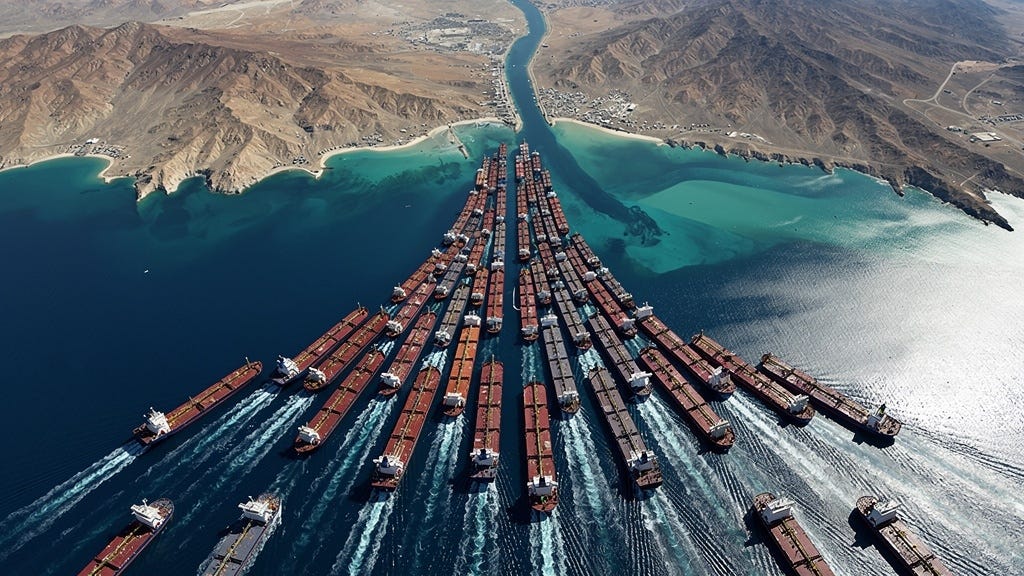
When oil traders watch shipping lanes, they measure risk in nautical miles. The narrowest point of the Strait of Hormuz—21 miles across—sounds manageable until the actual shipping lanes in each direction are just two miles wide, separated by a two-mile buffer zone. That’s 1.2 miles of navigable water carrying 20% of the world’s oil. A single explosive mine floating in the wrong place doesn’t just threaten one tanker; it threatens the entire flow.
Iran demonstrated this leverage last week when the Islamic Revolutionary Guard Corps threatened to “set ablaze” any vessel using the strait. Within hours, hundreds of tankers came to a halt. Oil prices spiked from $69 to $119 per barrel in three days—the fastest surge since the 1970s oil shocks—before Trump’s hints of de-escalation sent them tumbling back to $90. The price spike matters, but the speed matters more: a credible threat to a 1.2-mile corridor can disrupt global energy markets faster than any policy response can contain it.
This is why arguments for reducing Middle Eastern engagement consistently stumble over basic arithmetic. Alternative routes keep appearing in policy briefs as theoretical solutions, yet the numbers reveal why they cannot substitute for an open Hormuz. Saudi Arabia’s East-West Pipeline can carry 5 million barrels per day, and the UAE’s Fujairah pipeline adds another 1.8 million. Against Hormuz’s current 20 million barrels daily—with Saudi Arabia alone exporting 5.5 million barrels through the strait—these alternatives represent supplemental capacity, not replacement infrastructure. Operating both pipelines at maximum capacity wouldn’t cover a single week of normal Hormuz traffic.
The gap between theory and reality widens further under operational scrutiny. The UAE recently upgraded refineries to process more crude domestically, meaning its bypass pipeline now runs near capacity during normal operations. Saudi Arabia increased use of its East-West route last year to circumvent Red Sea disruptions near Bab al-Mandeb. The “slack capacity” that appears in strategic assessments has already been absorbed. Building new pipelines requires 18 months minimum at costs exceeding hundreds of millions—timescales that make them irrelevant to crisis response and barely adequate for long-term hedging.
Storage constraints accelerate the cascade. Qatar’s energy minister warned that if Hormuz remains closed, Gulf producers will reach storage capacity within weeks, forcing oilfield shutdowns. Restarting a major field after shutdown takes weeks or months, not days. The temporary becomes prolonged through mechanical necessity, not political choice. A three-week closure could mean three-month supply disruptions regardless of diplomatic breakthroughs.
This physical reality explains why “letting the region sort itself out” proposals collapse under examination. When 84% of Hormuz oil flows to Asian markets—with China importing 5.4 million barrels daily through the strait—American withdrawal wouldn’t reduce U.S. exposure to price shocks. It would simply transfer control over those shocks to actors with different interests. China’s response illustrates what states do when facing irreplaceable chokepoints they cannot control: build 1.2 billion barrels of strategic stockpiles representing three to four months of buffer capacity. Stockpiling absorbs short-term disruption; it doesn’t eliminate structural vulnerability.
The United States released 172 million barrels from the Strategic Petroleum Reserve last week, dropping reserves to their lowest level since 1982. Even with reduced Gulf imports—the U.S. imported just 0.5 million barrels daily from Persian Gulf producers in 2024, only 2% of consumption—price shocks from Hormuz disruptions hit American consumers as hard as Asian ones. Oil trades globally; regional isolation doesn’t insulate from global price movements. The reserve release demonstrates this constraint: distance from physical dependence doesn’t create distance from economic exposure.
Geography determines the available moves. The Strait of Malacca carries slightly more oil—23.2 million barrels daily—but connects to alternative routes through the Sunda and Lombok straits. Hormuz has no such redundancy. Pipeline capacity exists but cannot scale to need. Some version of naval presence maintaining open shipping lanes isn’t a preference reflecting ideology; it’s a response to the fact that the global economy runs on diesel, jet fuel, and petrochemicals that flow through corridors narrow enough to close with tactical weapons.
The question isn’t whether this dependency is wise—that’s a debate for timescales measured in decades of infrastructure investment. The question is what happens when the only actor positioned to keep those corridors open decides the cost isn’t worth it. The answer arrived last week in the form of $50 price swings across three days.