


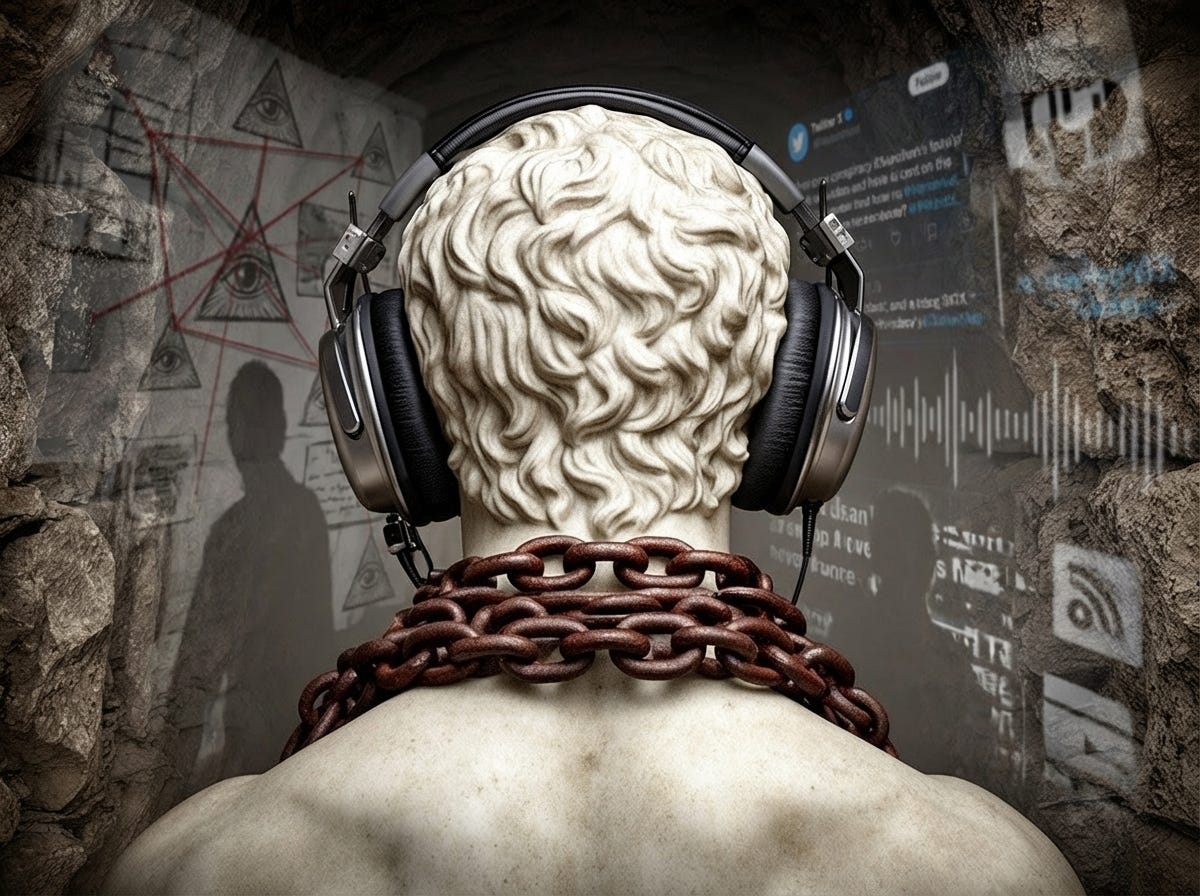
Months after Charlie Kirk’s assassination in September 2025, Candace Owens is still spinning conspiracy theories about who really pulled the trigger. Despite overwhelming evidence pointing to a mentally disturbed individual, heavily linked to the the trans-furry community with a documented grudge, Owens has spent months weaving increasingly elaborate narratives involving Mossad, Israeli influence operations, shadowy cabals, Turning Point USA, and even Charlie’s own wife. When debunkers present facts, she dismisses mainstream outlets as “Mossad fronts.” Anyone questioning her theories gets branded as complicit in the cover-up.
Meanwhile, Tucker Carlson sits across from Joe Kent, the former counterterrorism chief who resigned rather than support the Iran campaign, suggesting on his podcast that maybe Israel orchestrated the whole thing to drag America into war. The implication hangs in the air: what if everything you’ve been told is a lie? Kent doesn’t quite say it. He doesn’t have to. The audience already knows. They’ve been trained to see the patterns.
This is the emerging landscape of what critics call the “conspiracist right,” a strange mirror image of progressive activism that’s taken root in the conservative podcast ecosystem. Candace Owens, Tucker Carlson, and a constellation of post-liberal Catholic influencers and Christian nationalist podcasters aren’t your grandfather’s conservatives. They’re something else entirely: a movement that’s mastered the ancient art Plato warned about 2,400 years ago in his allegory of the cave.
But here’s what most analysis gets wrong. The problem isn’t that these conspiracy theorists are deceiving their audiences. It’s that they’ve built something far more sophisticated than deception- a complete interpretive system that makes escape psychologically nearly impossible.
The Cave Wasn’t About Lies
When Plato described prisoners chained in a cave, watching shadows dance on walls and mistaking them for reality, most readers assume he was talking about deception. Someone outside the cave is manipulating the shadows, right? The prisoners are victims of a hoax.
But read it again. The prisoners aren’t stupid. They’re not gullible. They’ve actually become experts at their reality. They’ve spent years studying the shadows, noting patterns, predicting which shapes will appear next. They’ve developed elaborate theories about shadow behavior. The best among them—the ones who can forecast the shadows most accurately—are honored as wise men, the intellectuals of their world.
Plato’s insight was darker than simple deception: the prisoners’ expertise is their prison. The more skilled they become at shadow-interpretation, the more trapped they are. When someone escapes and returns to tell them about the real world outside—about three-dimensional objects and sunlight- the prisoners don’t just disbelieve him. They think he’s the deluded one. He can’t even predict the shadows anymore! His knowledge has made him incompetent by their standards.
This is the exact mechanism operating in the conspiracist right podcast ecosystem, and recent psychological research explains why it’s so resilient.
Overconfidence and the Conspiracy Mind
A 2023 study from Cornell University found something unexpected about conspiracy theorists: they’re not less intelligent than average, and they’re not more gullible. What distinguishes them is profound overconfidence in their ability to discern truth—and a dramatic overestimation of how many others agree with them.
Sound familiar? These are precisely the cognitive features of Plato’s prisoners. They’re confident they understand their reality because they’ve mastered its internal logic. They assume their interpretive framework is widely shared because, within their cave, it is widely shared.
The American Psychological Association’s research on conspiracy belief adds another dimension: these individuals aren’t driven by stupidity but by a hunger for pattern recognition and meaning-making. They’re often more engaged with current events, not less. They consume more information, not less. They’ve simply organized it all within a totalizing framework that explains everything.
This is the genius and the danger of what figures like Candace Owens and Tucker Carlson have built. They haven’t just created an alternative news source. They’ve constructed a complete hermeneutic: a method of interpretation that processes any new information in a way that reinforces the existing framework.
The Interpretive Prison
Watch how the system operates. When Charlie Kirk was killed, mainstream outlets reported basic facts: the shooter’s identity, his documented ties to the trans-furry community, his previous threats. For most observers, this information points toward a straightforward tragedy and motive.
But in the conspiracist right cave, these same facts become shadows cast by hidden manipulators. The shooter’s identity is “convenient,” exactly who they’d want you to think did it. His mental illness is suspect, possibly drugged or mind-controlled. The quick media narrative is evidence of coordination. The Manhattan Institute’s Josh Appel noted that when Owens was confronted with contradicting evidence, she dismissed The New York Post, traditionally a conservative outlet, as a “Mossad outfit.”
Notice what’s happened: the framework is unfalsifiable. Any evidence against the conspiracy becomes evidence for it, proof of how deep the deception runs. This isn’t a bug in the system; it’s the core feature. Like Plato’s prisoners who’ve mastered shadow-prediction, adherents become more confident the more they engage because the framework successfully processes everything.
James Lindsay, who coined the term, “woke right,” explains the parallel to progressive activism: both movements see the world through the lens of oppressor versus oppressed, both interpret all events through that single conflict, and both treat dissent as proof of enemy influence. The woke-left says doubters suffer from “false consciousness” requiring awakening through Critical Theory. The woke-right says doubters are “controlled opposition” or “regime shills.”
The terminology differs. The structure is identical.
Why Smart People Build Better Prisons
Here’s the disturbing part: the most sophisticated versions of these interpretive frameworks are constructed by genuinely intelligent people. Candace Owens isn’t dumb. Tucker Carlson isn’t unsophisticated. The post-liberal Catholic intellectuals theorizing about the “New Christian Right” are often doctrinally educated.
But intelligence doesn’t protect against cave-building- it makes the caves more elaborate and harder to escape. A study in Nature on echo chambers found that high-engagement, information-seeking individuals are often more vulnerable to complete epistemic closure precisely because they’ve invested more cognitive effort in constructing their framework. They’ve read more, connected more dots, built more impressive edifices of interpretation.
Think of it as intellectual sunk-cost fallacy. When someone’s spent hundreds of hours constructing an intricate understanding of how shadow X always precedes shadow Y, and shadow Y predicts shadow Z, abandoning that framework doesn’t just mean admitting error—it means all that effort was wasted. The expertise becomes worthless.
This is why deplatforming and fact-checking often fail. You’re not just asking people to reconsider a belief; you’re asking them to demolish an entire meaning-making structure and the expertise they’ve built on it. Four years after January 6th, QAnon hasn’t dissipated despite massive deplatforming efforts. It’s fractured and evolved, finding new caves to inhabit, because the interpretive method itself—the pattern-seeking, the unfalsifiable framework—remains intact.
Why the Cave Works
Plato’s cave functioned because it provided prisoners with genuine expertise and social validation. The best shadow-interpreters received honor and authority. Their skills were useful within the cave’s logic. This is crucial: the interpretive framework isn’t just explanatory—it’s functional. It gives adherents a role, a purpose, a community, and a claim to wisdom.
The conspiracist right podcast ecosystem replicates this perfectly. Listen to Candace Owens’s show or Tucker Carlson’s interviews, and you’ll notice the consistent framing: “We’re the ones willing to ask hard questions.” “We’re connecting dots the mainstream media won’t.” “We’re not afraid to speak truth.” This isn’t just ideological positioning—it’s social identity formation.
APA research confirms that conspiracy belief correlates with feelings of social alienation and powerlessness. The interpretive framework restores agency: you’re not powerless, you’re awakened. You see what others miss. Your alienation isn’t marginalization; it’s proof you’ve escaped the Matrix.
Except you haven’t. You’ve just moved from one cave to another—from mainstream consensus to an alternative hermetically sealed chamber—and mistaken the direction of travel for enlightenment.