


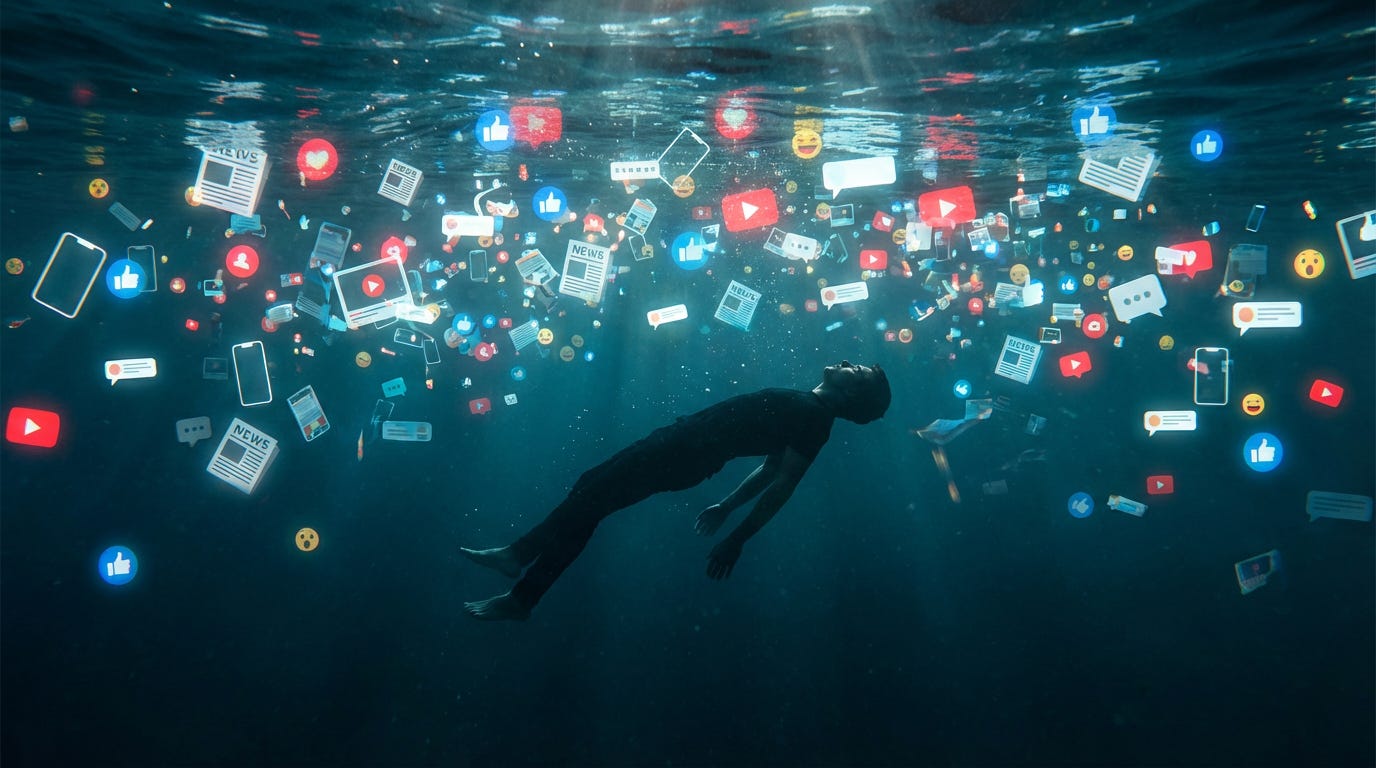
Something shifted in 2025, though you’d be forgiven for missing it. The most significant cultural movement of the year wasn’t on social media, it was the departure from it.
Not the dramatic kind. No manifestos, no announced Digital Sabbaths, no “I’m taking a break for my mental health” Instagram stories. Just… withdrawal. The kind where someone you used to follow posts less frequently, then barely at all, then you realize you haven’t seen their content in months. When you check, their account still exists, technically active, but abandoned in every way that matters.
I’ve been trying to understand why this feels different from previous waves of social media fatigue. The answer, I think, is who’s leaving, and what that signals about where cultural authority actually lives now.
The Numbers Hide What’s Actually Happening
The aggregate figures look stable, global social media users increased by 259 million between October 2024 and October 2025, reaching 5.66 billion identities. But that 4.9% annual growth rate represents a dramatic deceleration from the double-digit surges of the early 2010s. More revealing is what’s happening beneath the surface.
Engagement is collapsing. Average interaction rates on Facebook and X now hover around 0.15%. Instagram’s engagement dropped 24% year-over-year. Even TikTok, the platform that seemed immune to gravity, is plateauing. Roughly half of American adults now rate information on social media as unreliable, down from two-thirds a decade ago, yet they continue scrolling, not because they trust what they see, but because the alternative feels like exile.
That’s the key tension, social media has achieved something more elegant than addiction. It’s made non-participation a form of social illegitimacy, available only to those who can afford its costs. The worker who deletes LinkedIn excludes themselves from professional networks that exist nowhere else. The small business without Instagram watches customers drift toward competitors. The teenager who refuses TikTok can’t parse the vernacular that constitutes their peers’ shared language.
But here’s what the raw user numbers miss, while total adoption remains high, who uses these platforms and how they use them is changing. The American Psychiatric Association found that among 18-34 year olds, a significant proportion deliberately stepped away from social media in 2024, citing mental health. Newsletter platforms reported median time-to-first-dollar for new creators dropping to just 66 days, suggesting real money is flowing toward depth over virality. Substack and Beehiiv aren’t just growing, they’re attracting precisely the knowledge workers and tastemakers who made social media culturally mandatory in the first place.
Status Has Reversed Polarity
Twenty years ago, social media presence signaled cultural relevance. By 2026, absence increasingly signals the opposite, that you have better things to do than perform for algorithms.
This isn’t a moral judgment, it’s an observation about how status markers evolve. The people setting this pattern aren’t retirees or Luddites but precisely the class whose approval once made platforms valuable, writers, academics, professionals whose attention constituted endorsement. When they retreat to newsletters, podcasts, and private Discord servers, they take their cultural authority with them.
What remains is an increasingly bot-mediated wasteland. Research shows tens of thousands of AI-generated accounts flooding major platforms with engagement-optimized slop, vague inspirational quotes, AI-generated images like “Shrimp Jesus,” affiliate marketing disguised as advice. Average interaction rates fall while content volume explodes because what counts as “content” has fundamentally changed. It no longer means human expression, it means anything that generates clicks.
The feed has become a mood-regulation device, not an information source or social space. Scrolling is ambient dissociation, half-conscious scratching of an itch you can’t name. People know it’s fake, they just don’t care enough to stop.
Where the Conversation Moved
The successor to mass social media isn’t another platform, it’s a thousand micro-communities. Group chats. Paywalled newsletters. Discord servers. Federated instances of Mastodon and Bluesky where moderation happens through shared norms rather than algorithmic enforcement.
These spaces share a characteristic, they’re opt-in, not ambient. You choose to be there, and that choice creates accountability absent from algorithmic feeds. A writer with 10,000 devoted newsletter subscribers can earn more and burn out less than someone with a million passive Instagram followers because the relationship isn’t mediated by a black box optimizing for engagement over everything else.
Even major platforms sense the shift. Instagram emphasizes DMs now. X is pushing subscriber-only circles. TikTok experiments with private communities. Behind these moves sits an acknowledgment, the infinite scroll, stuffed with synthetic content, approaches the limit of what humans will tolerate.
What Comes After
Social media isn’t dying because we lack content, we’re drowning in it. It’s dying because the attention economy has exhausted our capacity to care. Novelty became noise. Outrage fatigues. Even virality cannibalizes itself.
The quiet exodus isn’t about rejection. It’s about rediscovery, that meaningful conversation requires shared context, that trust emerges from continuity, that some things worth having don’t scale. The people leaving aren’t giving up connection, they’re looking for it in places where it might actually exist.
The pendulum of quantity vs. quality seems to be swinging back. 20 years ago, you went online if you had something worth sharing, then the algorithms and traffic became all the rage and prioritized quantity over quality. My old online job (this is strictly a hobby as of now) prioritized just that: frequency of posting not so much the quality of the information. More posts = more traffic = more money. With everyone being able to be online now, the focus seems to be shifting back to the quality, which is what I see a lot on Substack.