

Trump and State Department Call Out Persecution of Coptic Christians
A new presidential proclamation and a congressionally mandated State Department report — released the same week — expose the gap between Cairo's polished reform narrative and the five-year hard-labor

On June 1, President Donald Trump issued a Global Coptic Day proclamation calling the violent persecution of Christians “a barbaric evil” and pledging his administration would work to end it “in all its forms.” Days later, the State Department transmitted to Congress its latest report on Egypt’s treatment of its 11-million-strong Coptic Christian community — a document that simultaneously credits Cairo for licensing thousands of churches and confirms that Egyptian courts are still jailing Christians under Islamic blasphemy statutes. The juxtaposition lands at a pivotal moment: just five months ago, Egyptian authorities sentenced 37-year-old Coptic researcher Augustinos Samaan to five years of hard labor for online videos about Islam, and Washington, for the first time in years, is willing to call the underlying pattern by its name.
Two Documents, Two Faces of Egyptian Reality
The State Department report, mandated under Section 7019(e) of the FY24 appropriations act, presents Egypt’s official progress: 3,613 of 3,730 churches that applied for registration have been legalized under the 2016 church construction law, and no sectarian attacks against Christian religious sites were reported in 2025. Egyptian courts in 2025 also executed a police sergeant for killing two Christians and handed down a life sentence to the killer of Coptic priest Arsanious Wadid.
But the same document acknowledges that Christians, roughly ten percent of Egypt’s 111 million people, hold only two of 31 cabinet seats, one of 27 governorships, and 24 of 300 senate seats. No Christian leads any of Egypt’s 27 public universities. Employment discrimination “within the security services, judiciary, and senior civil service remains a significant issue.”
The Blasphemy Machine Still Runs
The report’s most consequential passages document the continued enforcement of Article 98(f) of Egypt’s penal code, a blasphemy provision that minority rights groups have criticized as disproportionately targeting Christians and converts. The State Department confirms two ongoing detentions: Saeed Mansour Rizk Abdel Razek, a Muslim convert to Christianity arrested in July 2025, and Augustinos Samaan, a Coptic author whose YouTube channel, with over a million views, was shut down after he said Islam tolerated child marriage and noted that Muhammad had a child bride.
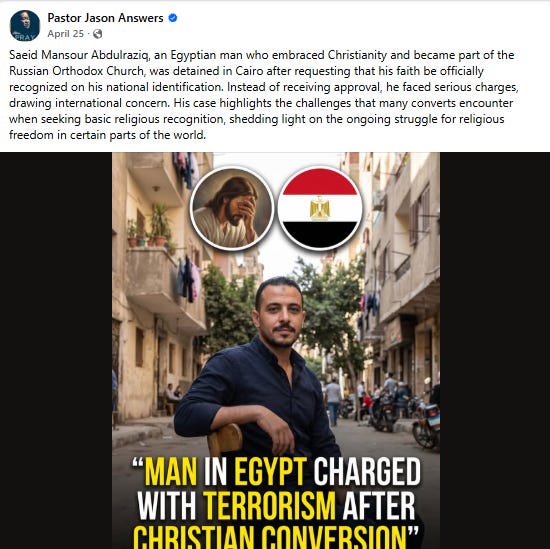
Samaan’s case has since escalated dramatically. On January 3, 2026, an Egyptian court sentenced him to five years of hard labor with immediate enforcement — in a hearing his defense team was never notified about. Coptic Solidarity reports Samaan was tortured under National Security Sector interrogation before his charges were swapped from “joining a terrorist organization” to blasphemy. Egypt’s law also makes it “nearly impossible” for Muslims who convert to Christianity to update their ID cards, locking them out of public education and recognized marriage — a de facto sharia governance of civil status that Washington’s report describes in technical, but unmistakable, terms.


A Presidential Pivot
Trump’s June 1 proclamation explicitly invoked “the 21 Coptic construction workers brutally executed by ISIS terrorists on a Libyan beach just 11 years ago” — the migrant workers who in February 2015 refused to renounce their faith before being beheaded on camera.

The administration is channeling that memory through its new Religious Liberty Commission, established by executive order on May 1, 2025, and explicitly tasked with identifying “opportunities… to further the cause of religious liberty around the world.”
A Wider Pattern Across Africa and the Middle East
Egypt’s case sits within a documented global crisis. Open Doors’ World Watch List 2026 reports that 4,849 Christians were killed for their faith in the past year, roughly 13 every day, with 388 million Christians worldwide exposed to persecution. Approximately 70 percent of those killings occurred in Nigeria, where Islamist groups including Boko Haram, ISWAP and Fulani militants have driven what U.S. lawmakers increasingly call a Christian genocide. Trump redesignated Nigeria as a Country of Particular Concern on October 31, 2025, citing more than 7,000 Nigerian Christians killed in the first seven months of 2025 alone.


In Syria, an Islamic State suicide bomber opened fire and detonated explosives inside the Greek Orthodox Mar Elias Church in Damascus on June 22, 2025, killing 31 worshippers and wounding 54 during Divine Liturgy — the worst attack on Syrian Christians in years, and a signal that the country’s post-Assad transition has not protected its dwindling 300,000-strong Christian remnant. Pakistan’s blasphemy laws continue to ensnare hundreds of Christians annually, while Islamic State affiliates in Mozambique and the Democratic Republic of Congo have escalated attacks on rural Christian villages.
The Strategic Significance
For two decades, U.S. policy toward Egypt — a major non-NATO ally receiving roughly $1.3 billion in annual military aid — has treated Coptic concerns as a quiet bilateral file. The State Department’s willingness to put the Samaan and Razek cases in writing for Congress, alongside Trump’s public framing of Christian persecution as “barbaric evil,” signals that Washington is prepared to elevate the issue.
Whether that translates into conditioned aid, sanctions on individual judges, or pressure to repeal Article 98(f) remains to be seen, but the rhetorical floor has shifted, and Cairo has been put on notice that licensing church buildings will no longer be enough while Christian scholars are being jailed for what they say about Islam.