


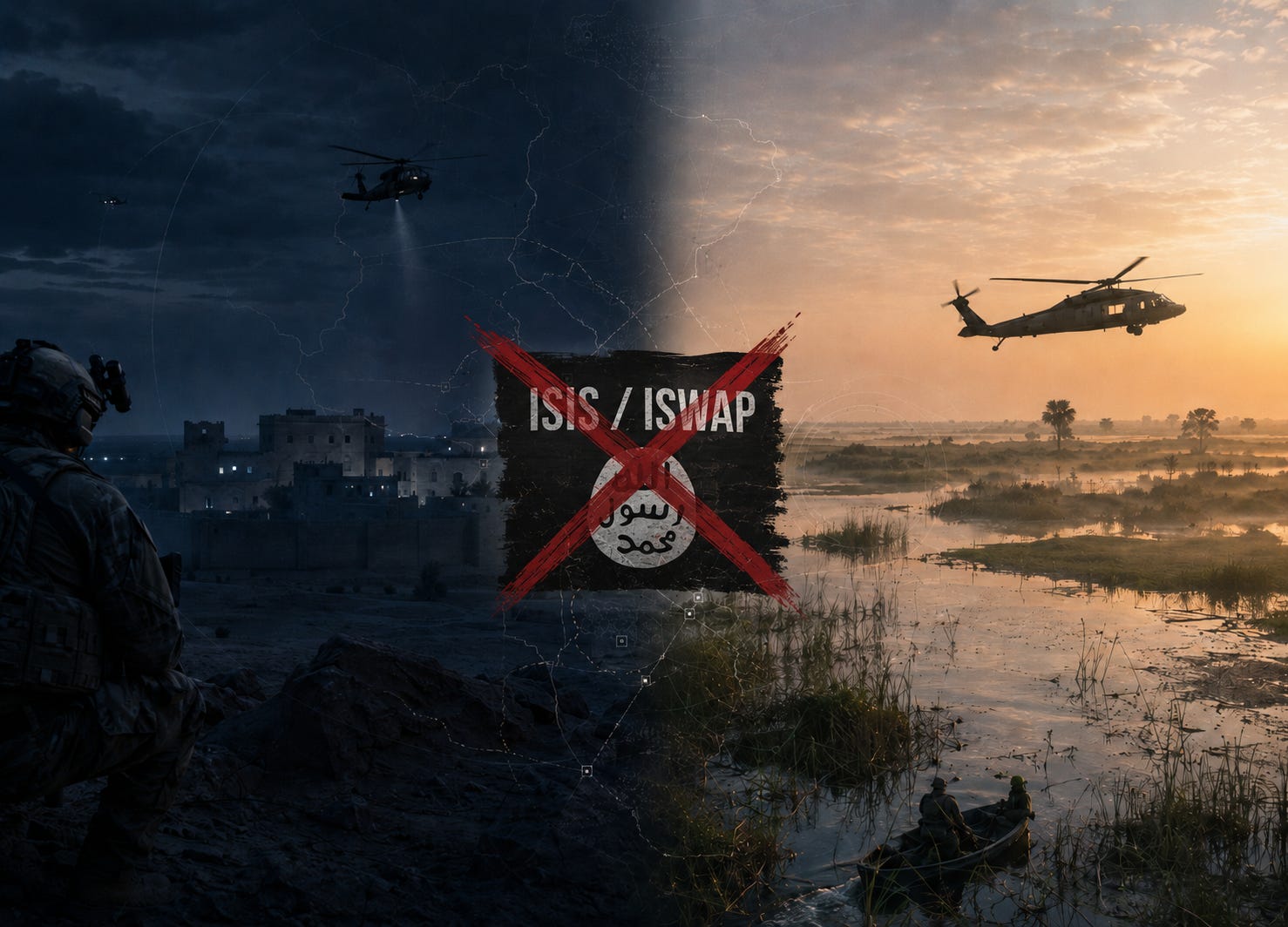
On May 16, 2026, President Donald Trump announced what has become a pattern in his counter-terrorism record: results.
U.S. and Nigerian forces killed Abu Bilal al-Minuki, a senior commander in Islamic State West Africa Province (ISWAP), in a joint operation targeting terrorist infrastructure in Nigeria’s Lake Chad Basin. Nigerian President Bola Tinubu confirmed Minuki’s death alongside “several of his lieutenants,” describing the operation as disrupting a network responsible for kidnappings, attacks on civilians, and the 2018 Dapchi schoolgirls abduction.
It was another data point in Trump’s consistent approach to Islamic terrorism: find them, target them, eliminate them. From Abu Bakr al-Baghdadi to al-Minuki, the administration has demonstrated that jihadist leadership can be hunted down wherever they hide whether in Syrian compounds or African swamplands.
One day after announcing the operation, Defense Secretary Pete Hegseth appeared at Rededicate 250, a gathering on the National Mall that brought together Americans in prayer and reflection on the nation’s 250th anniversary. The juxtaposition wasn’t accidental, it reflected something the administration grasps that previous governments avoided: clarity about what the United States defends, and why it matters.


The ISIS Record: Promises Kept
Trump’s first term delivered what his predecessor couldn’t: the destruction of the ISIS caliphate. In October 2019, U.S. special forces killed ISIS founder Abu Bakr al-Baghdadi in a Syria raid. By early 2020, the territorial “caliphate” that once controlled populations the size of Britain had been dismantled. These weren’t symbolic victories- they were operational defeats that ended ISIS’s ability to govern territory, collect taxes, and project the image of an ascendant movement.
But ISIS, like all jihadist movements, adapted. Following its collapse in Iraq and Syria, the group reconstituted operations in sub-Saharan Africa, where approximately 90 percent of its attacks now occur. Islamic State West Africa Province emerged as one of the continent’s deadliest factions, controlling swaths of the Lake Chad Basin and terrorizing civilian populations across multiple countries.
Trump’s second-term approach recognizes this reality. Rather than declaring victory and withdrawing, the administration has pursued ISIS into Africa, partnering with regional governments, deploying intelligence assets, and conducting precision strikes. The Christmas Day 2025 operation and the May 2026 Minuki killing demonstrate strategic follow-through. When the president says ISIS will be defeated wherever it operates, he means it.
Naming What We Defend
Critics have questioned the administration’s willingness to describe attacks on Christians as attacks on Christians. On Christmas 2025, Trump announced strikes targeting ISIS militants who had been “viciously killing, primarily, innocent Christians.” Hegseth stated plainly: “The killing of innocent Christians in Nigeria (and elsewhere) must end.”


This honesty represents a departure from decades of strategic ambiguity that refused to acknowledge religious dimensions of jihadist violence. ISIS explicitly targets religious minorities — Christians, Yazidis, Shia Muslims — as part of its ideology. Pretending otherwise doesn’t make us more sophisticated; it makes us dishonest.
Are Christians the only victims of ISIS in Nigeria? No. Muslims and tribal groups suffer enormously from jihadist violence as well. But acknowledging that Christians face targeted persecution doesn’t erase Muslim suffering. It simply states a fact that matters to the United States, a nation founded on religious freedom.
When ISIS burns churches, kidnaps Christian schoolgirls, and executes believers for refusing conversion, the United States has both a moral interest and a strategic interest in stopping it. Religious freedom is a cornerstone of Western civilization. Defending it isn’t sectarian warfare, it’s defending the principle that people shouldn’t be murdered for their beliefs.
Moral Clarity, Not Theocracy
The day after announcing the Minuki operation, Hegseth appeared at Rededicate 250, an event organized to mark America’s 250th anniversary through prayer and reflection. The gathering, which brought together religious leaders and citizens, represented something increasingly rare in American public life: an unapologetic articulation of the moral and religious foundations that shaped the nation.
This isn’t theocracy. It’s acknowledgment of inheritance. The American system of ordered liberty, individual rights, and limited government didn’t emerge from nowhere— it grew from specific moral and philosophical soil, much of it Christian. Recognizing that heritage isn’t establishing a state religion. It’s historical honesty.
Hegseth has launched monthly prayer services at the Pentagon, reflecting his understanding that military service involves moral questions that secular bureaucracy can’t answer. Soldiers who risk their lives deserve to know what they’re defending. Telling them it’s merely “international norms” or “rules-based order” is insufficient. They defend something deeper: the civilization that makes freedom possible.
Strategic Seriousness
The Council on Foreign Relations noted that Nigeria operations reflect an “America First approach” focused on protecting U.S. interests. Exactly right. American interests include preventing jihadist networks from establishing safe havens, protecting populations vulnerable to religious persecution, and demonstrating that terrorism has consequences.
Nigerian officials have welcomed U.S. partnership in confronting ISWAP, describing the cooperation as necessary given the scale of the threat. When Trump says the U.S. will work with partners to dismantle terrorist networks, he’s describing coalition-building—not unilateralism.
Some observers worry that acknowledging religious dimensions of the conflict “hands ISIS a propaganda victory.” This is backwards. ISIS already believes it’s fighting a religious war. Our refusal to name that reality doesn’t confuse them—it confuses us. Moral clarity about what we’re defending strengthens resolve. Evasion weakens it.
A Record That Speaks
From the elimination of Baghdadi to the destruction of the caliphate to the ongoing pursuit of ISIS leadership in Africa, Trump has delivered measurable results against Islamic terrorism. The Minuki operation represents the latest in a series of successful strikes that have degraded jihadist networks and protected vulnerable populations.
The administration’s willingness to speak plainly about religious freedom, civilizational defense, and moral purpose doesn’t undermine counter-terrorism—it clarifies it. Americans understand what their military defends because the administration tells them. That honesty, combined with operational effectiveness, is what distinguishes this approach from the strategic drift that preceded it.
ISIS thrives in ambiguity and retreat. Trump offers the opposite: clarity, persistence, and results.