


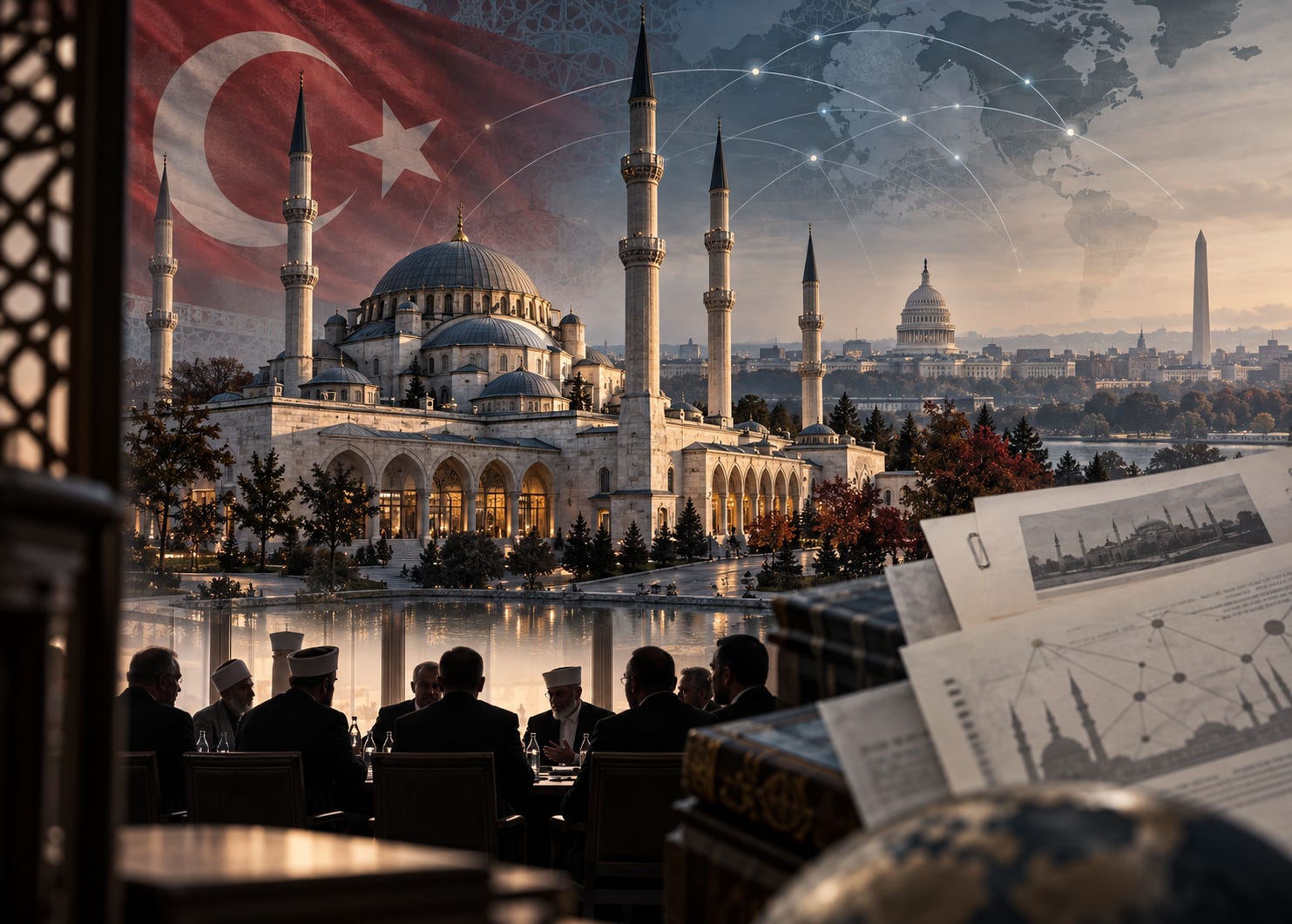
Turkey’s top religious official met with representatives of Islamic organizations and Muslim religious leaders from across the United States over the weekend at a Maryland religious center closely tied to the Turkish government.
Safi Arpağuş, president of Turkey’s Directorate of Religious Affairs, or Diyanet, held a “Religious Leaders Meeting” at the Diyanet Center of America in Lanham, Maryland. Diyanet said the gathering included representatives of Islamic organizations and religious communities from across the country, but did not publicly identify the American participants.
One prominent American Muslim leader was scheduled to be at the same complex almost immediately afterward.
Dr. Zulfiqar Ali Shah, executive director of the Fiqh Council of North America, was advertised for a 7 p.m. Diyanet Center lecture on October 24 titled “Islamic Influences on the Founding Fathers of America.” Diyanet has not said whether Shah also participated in the earlier leaders’ gathering.
Shah previously served as national president of the Islamic Circle of North America, or ICNA. His current biography identifies his leadership of the Fiqh Council. His background is notable because several organizations connected to his current and former roles appear in a controversial 1991 Muslim Brotherhood document later introduced as a government exhibit in the Holy Land Foundation terrorism-financing prosecution.
A 1991 Brotherhood Memorandum
The document, titled “An Explanatory Memorandum on the General Strategic Goal for the Group in North America,” described the Brotherhood’s work in North America as a “Civilization-Jihadist Process” and emphasized building durable institutions as part of a long-term strategy.
An attachment listing what the author called “our organizations and the organizations of our friends” included ICNA, which Shah later led.
It also included the ISNA Fiqh Committee, the institutional predecessor of the modern Fiqh Council of North America. FCNA says in its own history that the committee became the Fiqh Council in 1986, of which he is currently the executive director.
A third organization on the list was the International Institute of Islamic Thought, or IIIT.
Decades later, IIIT developed a formal relationship with FCNA. In 2016, the two organizations signed a memorandum of understanding under which IIIT said it would support FCNA’s work related to its research agenda and provide management and financial support for certain Fiqh Council meetings held at IIIT.
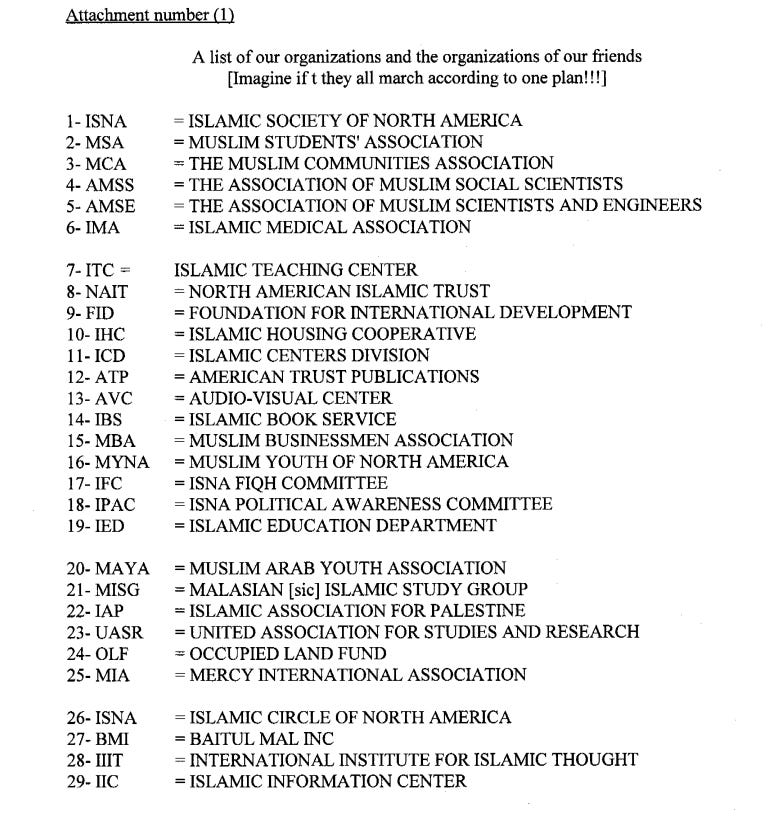
The pattern is notable: ICNA was named directly in the 1991 memorandum; FCNA traces its lineage to another organization named in the document; and IIIT, also listed, later provided documented support to FCNA.
None of that establishes that today’s FCNA, ICNA or their current leaders are controlled by the Muslim Brotherhood. But it explains why Shah’s appearance at the Diyanet Center is relevant to a broader story about American Islamic institutions, historical Brotherhood networks and Turkey’s state religious apparatus.
Other Diyanet Links
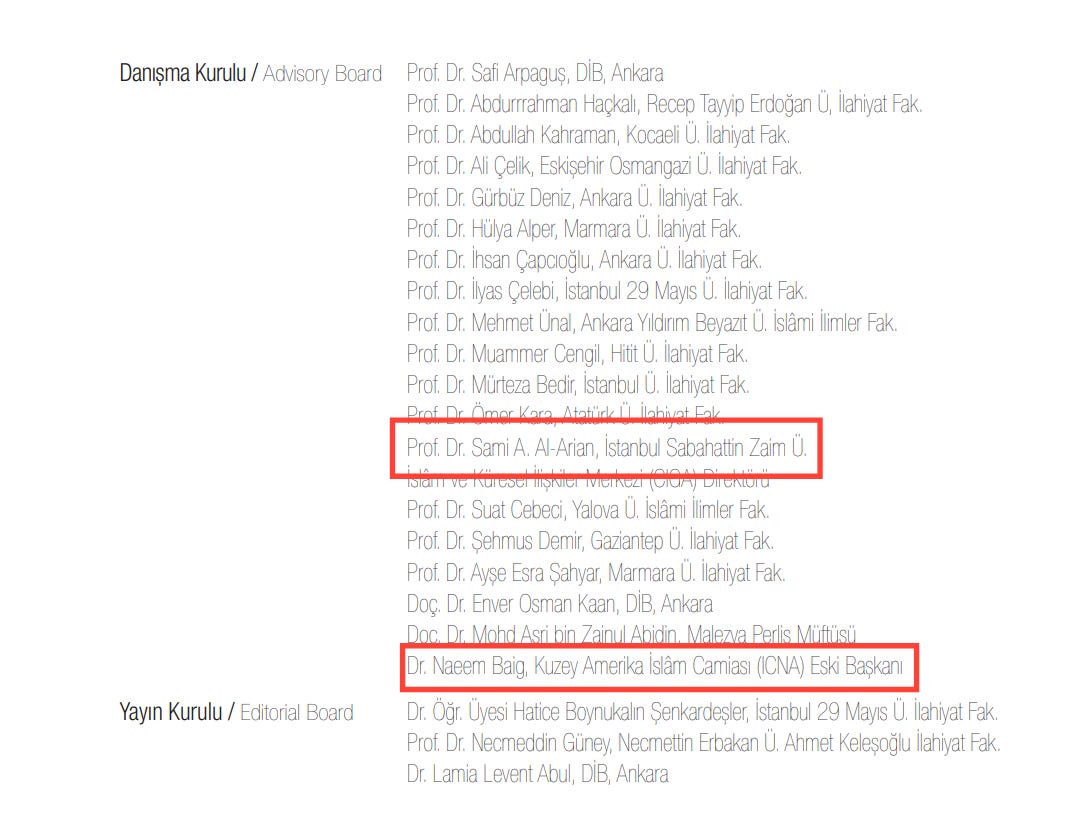
The Maryland gathering is not the only point of contact between Diyanet and figures associated with U.S. Muslim institutions discussed in this article. The advisory board of Diyanet İlmi Dergi, a scholarly journal published by Turkey’s Directorate of Religious Affairs, has included Naeem Baig, a former ICNA president, and Sami Al-Arian, director of the Center for Islam and Global Affairs at Istanbul Sabahattin Zaim University.
Al-Arian pleaded guilty in 2006 to conspiring to provide services to Palestinian Islamic Jihad, a U.S.-designated terrorist organization. According to the Justice Department, he admitted performing services for PIJ after knowing that the organization had been designated and knowing that it used violence to pursue its objectives.
Turkey, Diyanet and the Brotherhood
Those connections take on added significance because Turkey itself has a longstanding relationship with the Muslim Brotherhood.
A 2026 Carnegie Endowment study describes the Brotherhood as the most significant of Turkey’s transnational Islamist relationships. It notes that the ruling Justice and Development Party, or AKP, grew out of Turkey’s Islamist National Outlook movement, which maintained ideological and organizational links with the Brotherhood dating back decades.
Under President Recep Tayyip Erdoğan, those ties deepened. Turkey strongly backed Egypt’s Muslim Brotherhood government under Mohamed Morsi and, after Morsi’s removal in 2013, became a major destination for Brotherhood members, activists and media figures. Istanbul emerged as a hub for Brotherhood-affiliated organizations and television channels.

Turkey has more recently curtailed some of those relationships as Erdoğan sought to repair ties with Egypt and other regional governments. But the historical connection remains significant.
Diyanet operates within that same Turkish state system.
It is Turkey’s centralized religious bureaucracy, responsible for administering mosques, employing religious personnel and preparing sermons. It also maintains an extensive international network used as part of Turkey’s religious and cultural diplomacy. Diyanet’s own institutional materials describe its extensive operations inside Turkey and abroad.
An American Center With Turkish Government Links
The Diyanet Center of America operates through a U.S. tax-exempt religious institution, but its structure overlaps directly with Turkey’s official religious and diplomatic apparatus.
Fatih Kanca, who briefed Arpağuş on Diyanet’s U.S. operations during the visit, serves as Turkey’s Religious Services Counselor in Washington and also holds a leadership role connected to the Diyanet Center. DCA identifies Kanca in its own materials.
Arpağuş’s official itinerary further illustrates that relationship. He visited the Turkish Embassy, met Turkish diplomats and held discussions with religious-services attachés stationed in different U.S. states.
Holding a role at an American nonprofit while serving a foreign government is not, by itself, prohibited under federal tax law. But the overlap raises questions about the extent to which the center operates alongside Turkey’s state religious and diplomatic network.
The October meeting brings those strands together. The head of Turkey’s state religious establishment, under a government with a long history of Muslim Brotherhood ties, met privately with representatives of U.S. Islamic organizations at the Diyanet Center of America.
An hour later, the same center was scheduled to host Zulfiqar Ali Shah, a former ICNA president and senior leader of the Fiqh Council of North America.
ICNA and the institutional predecessor of the Fiqh Council were both named in the 1991 Muslim Brotherhood memorandum. So was IIIT, which decades later entered a formal relationship with FCNA that included documented financial and management support.
Diyanet has publicly identified the Turkish officials involved in Arpağuş’s visit. It has not disclosed which American Muslim leaders joined them.