


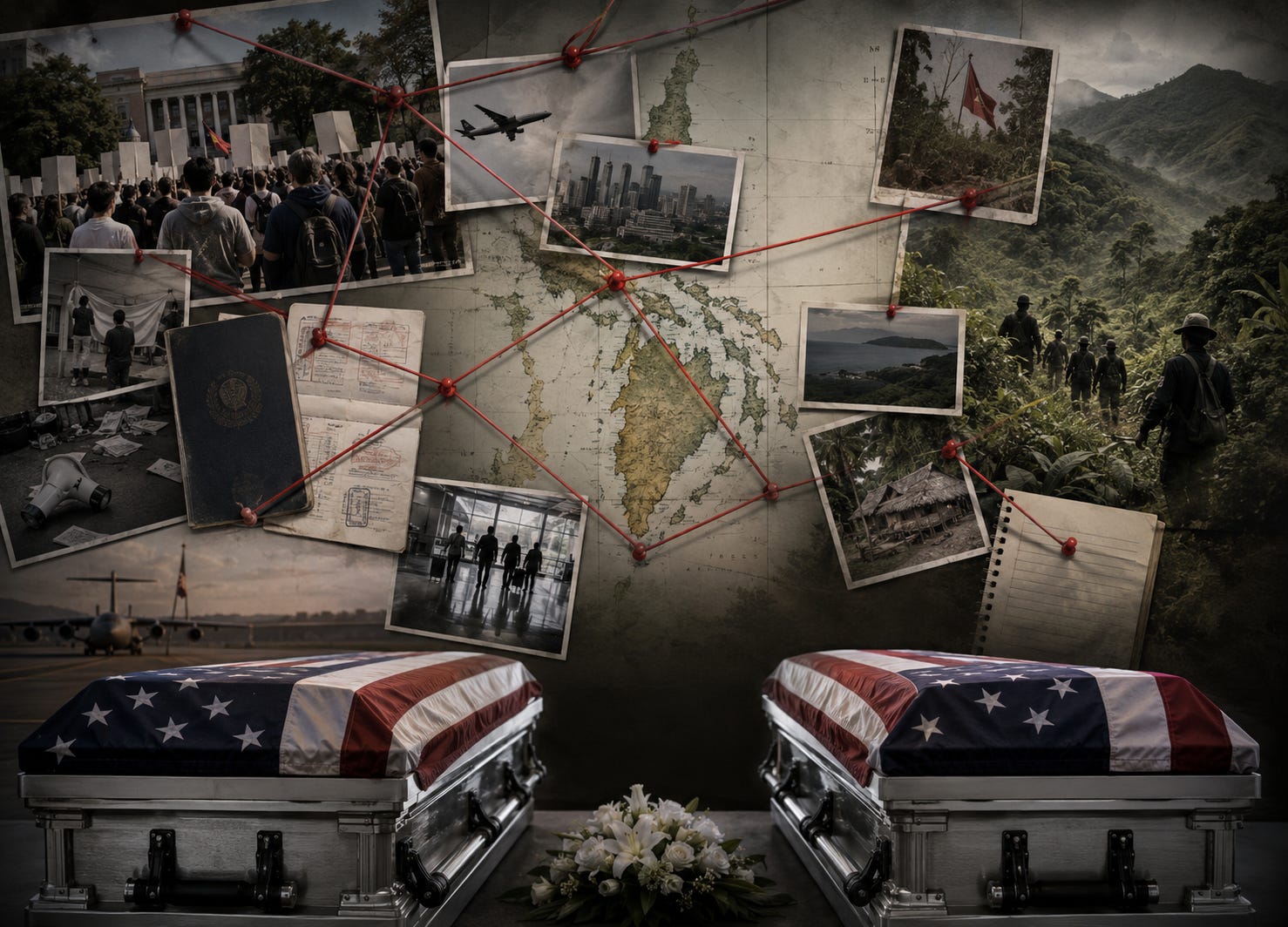
On April 19, 2026, two U.S. citizens — Lyle Prijoles, 40, of the San Francisco Bay Area, and Kai Dana-Rene Sorem, 26, of Steilacoom, Washington — were killed in Barangay Salamanca, in the Negros Occidental town of Toboso, during a twelve-hour series of firefights between the Philippine Army’s 79th Infantry Battalion and the Northern Negros Front of the New People’s Army (NPA).
The NPA and its parent body, the Communist Party of the Philippines (CPP), have been designated Foreign Terrorist Organizations by the U.S. State Department since 2002. Prijoles and Sorem were not tourists who wandered into a war zone. Both had been groomed over years inside a network of diaspora organizations that recruit on American campuses and ferry their cadres into the Philippine countryside on “exposure trips.” The shock is not that two Americans died. It is that the pipeline that placed them in the line of fire of a U.S.-designated terror group operates openly in the United States, unregistered under federal foreign-agent law.

The Toboso encounter
The Philippine Army reports that troops recovered roughly two dozen firearms at the site and killed Roger Fabillar, the Northern Negros Front commander on whom a one-million-peso bounty had stood for four years.
The CPP itself acknowledges ten of the nineteen dead as its own armed revolutionaries; it disputes the status of the rest, including Prijoles and Sorem, whom its U.S. affiliates call “civilians” doing community immersion. The Philippine Commission on Human Rights has opened an investigation, and the forensic pathologist Raquel Fortun has raised procedural questions worth taking seriously. The narrower facts of that morning are properly contested. The wider facts are not.
From SFSU and Central Washington to Negros
Prijoles chaired the San Francisco State University chapter of the League of Filipino Students (LFS) and, in 2012, was elected founding Solidarity Officer of Anakbayan-USA at its founding congress in Chicago. He later served on the U.S. council of the International Coalition for Human Rights in the Philippines.
Sorem’s own organization recounts that she was radicalized in 2020 as a music student at Central Washington University, came to “see a future for her people in the National Democratic movement,” co-founded Anakbayan South Seattle, joined the Anakbayan-USA “Exposure Trip” in 2025, and returned in 2026 to live among “peasant farming communities.” This is not gossip; it is the network’s own promotional language.
A documented front network
The structure these two moved through is not a mystery. A 2025 report by Kyle Shideler at the Center for Security Policy, drawing on CPP defector testimony compiled in the Philippine government study Unmasking the Myth of Communism in the Philippines, documents that Bayan-USA (founded 1994) and its student wing Anakbayan are controlled by the CPP’s National United Front Commission through the Leninist discipline of democratic centralism.
Above them sits the International League of Peoples’ Struggle (ILPS), founded in 2001 by CPP chairman Jose María Sison and overseen by the CPP’s International Department; it claims more than 350 member organizations in 40 countries. A declassified CIA study catalogued the same front structure decades ago. None of these U.S. affiliates is registered under the Foreign Agents Registration Act.
The American blind spot
The Philippine government has now formally warned of “terror-grooming” of overseas Filipinos, and NTF-ELCAC executive director Ernesto Torres Jr. stated that recruitment “has expanded beyond Philippine borders, exposing individuals from the diaspora to the dangers of armed confrontation.” American institutions, by contrast, treat the U.S. nodes of this network as ordinary ethnic advocacy. Faculty at San Francisco State, Cal State Los Angeles, the University of Washington, and Vassar publicly advertise affiliations with Bayan-USA, Anakbayan, or ILPS on their official pages.
A May Day rally by the Georgia Revolutionary Student Union featured an NPA flag and a burning American flag; Center for Security Policy analyst Kyle Shideler observed the obvious — that a comparable display for ISIS or al-Qaeda would have generated immediate federal interest.
What the deaths actually expose
Whether Prijoles and Sorem personally fired rifles on the morning of April 19 will be litigated by the Philippine human-rights commission. What is not in dispute is that they had been formed inside organizations that publicly venerate the founder of a U.S.-designated foreign terrorist organization, that travel back and forth to its operational areas, and that face no scrutiny under American counterintelligence law.
The pipeline did not end at Toboso; the pipeline runs through American classrooms. Two coffins are coming home from Negros. The networks that filled them remain on the syllabus.