

UK Parliament Report: Russia, China, and Iran Are Running an Information War on Western Democracies
A new Foreign Affairs Committee report and the government's May 2026 response expose the networks waging hybrid warfare against democracies — and quietly reveal a Kremlin plot to flip elections

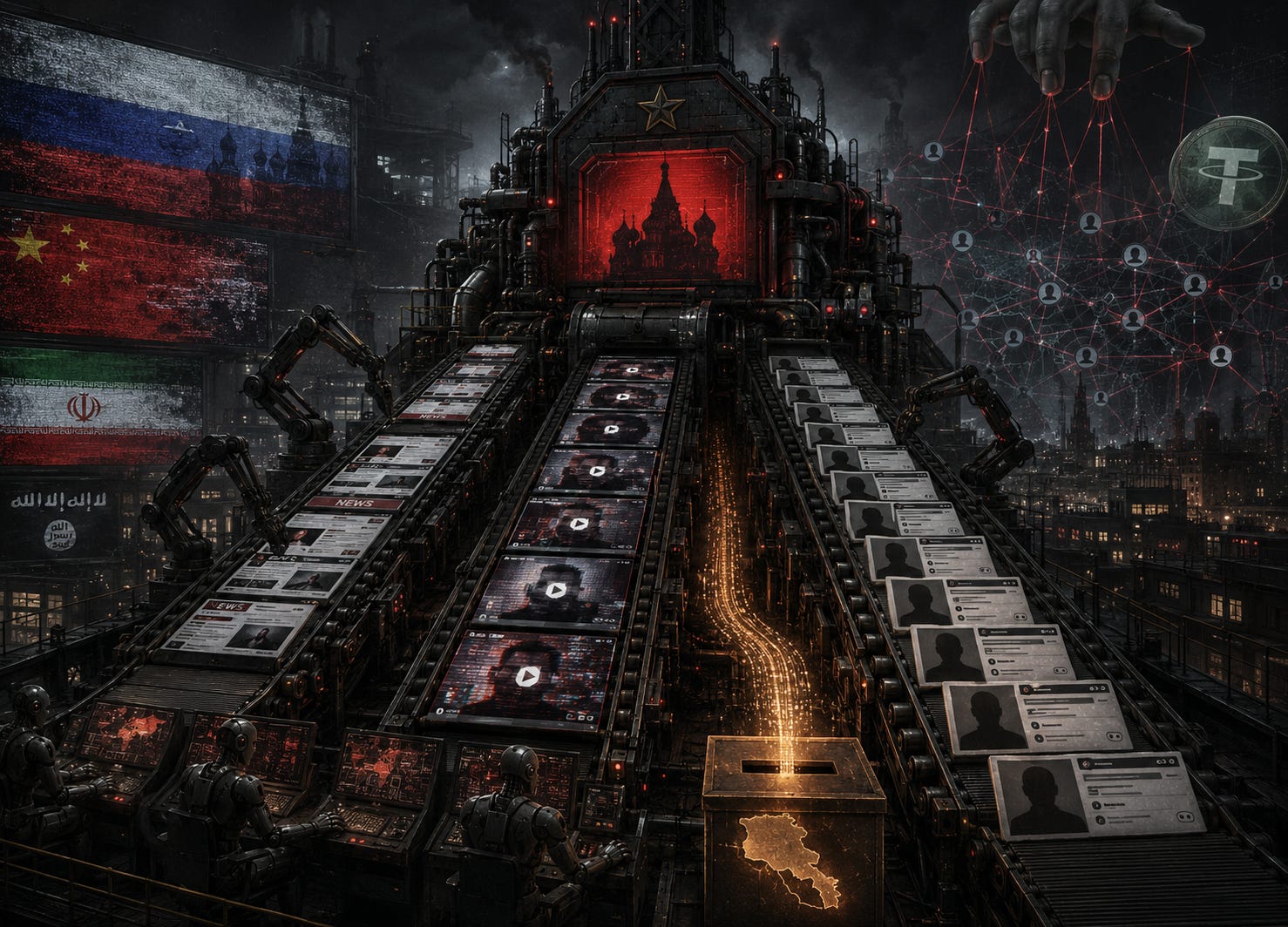
The United Kingdom’s Foreign Affairs Committee has concluded that Russia’s hybrid operations amount to the behavior of “a state at war against the West,” and the British government’s formal response, published on 8 June 2026, confirms the assessment in unusually direct language. Foreign Secretary Yvette Cooper described the threat as “an industrial-scale attack on the UK’s and our allies’ information environment.”
The response also discloses, for the first time, that Kremlin-linked influence firms were used in plans to interfere in Armenian politics and push power toward pro-Russian figures. Together, the two documents map a sprawling architecture of state-backed and non-state information warfare: Russian, Chinese, Iranian, and jihadist. It also lay outs the West’s emerging counter-offensive: 96 sanctions designations in 19 months, a 42 percent boost to BBC World Service funding, and new defense pacts with France, Germany, Poland, and Ukraine.
The Committee’s chair, Dame Emily Thornberry, said she was “shocked to learn just how widespread organised disinformation has become. It is the new warfare and open liberal democracies are sitting ducks.” The original report, released in March 2026, estimated that Russia spends roughly €30 million a week — €1.5 billion a year — on state propaganda alone.
Russia: the Doppelganger machine and the Armenia plot
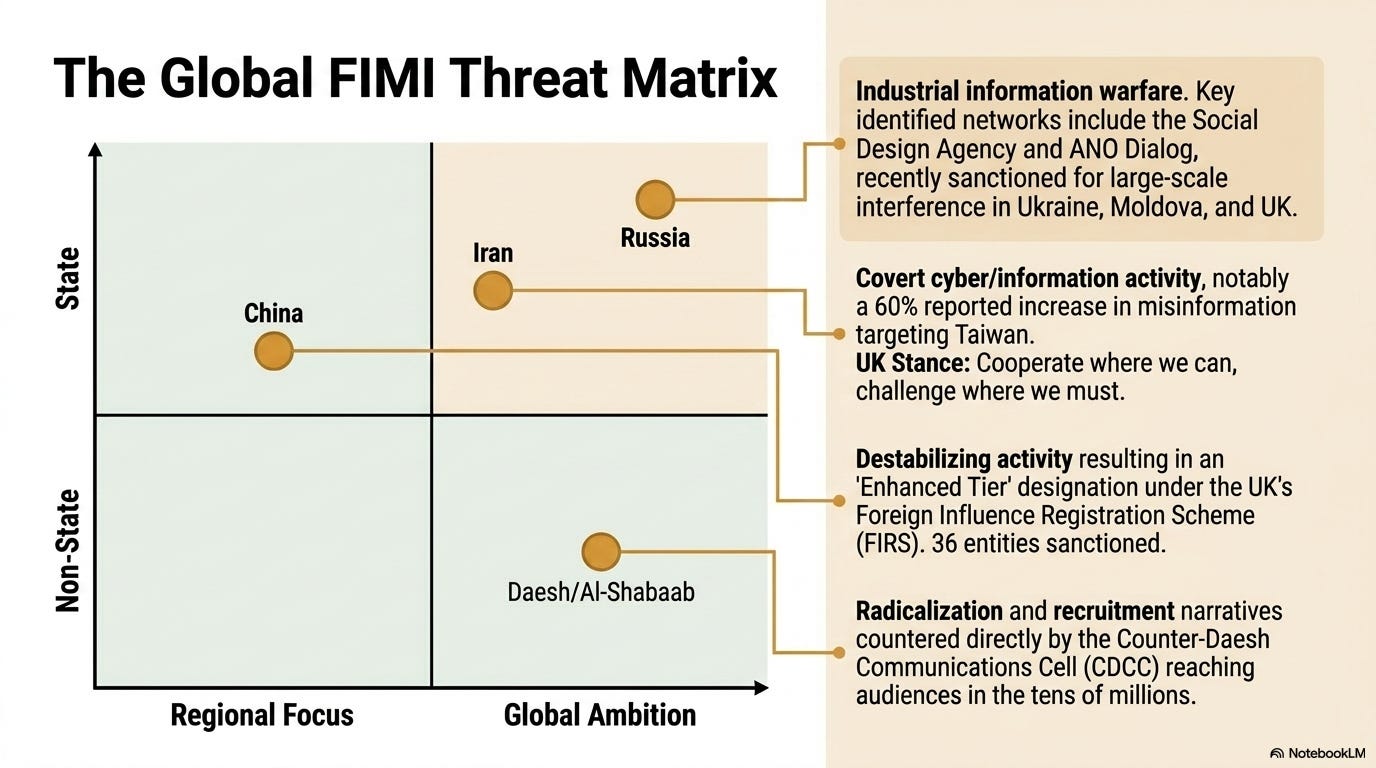
At the center of the Kremlin’s operation is the Social Design Agency, a Moscow PR firm the UK designated in October 2024 as the entity behind the Doppelganger network, which the Committee report says used 228 domains and coordinated inauthentic networks across nine languages to impersonate outlets including Le Monde, The Guardian, Der Spiegel, and Fox News. Cardiff University researchers identified Doppelganger activity amplifying false rumors about the Princess of Wales before her cancer diagnosis was announced.
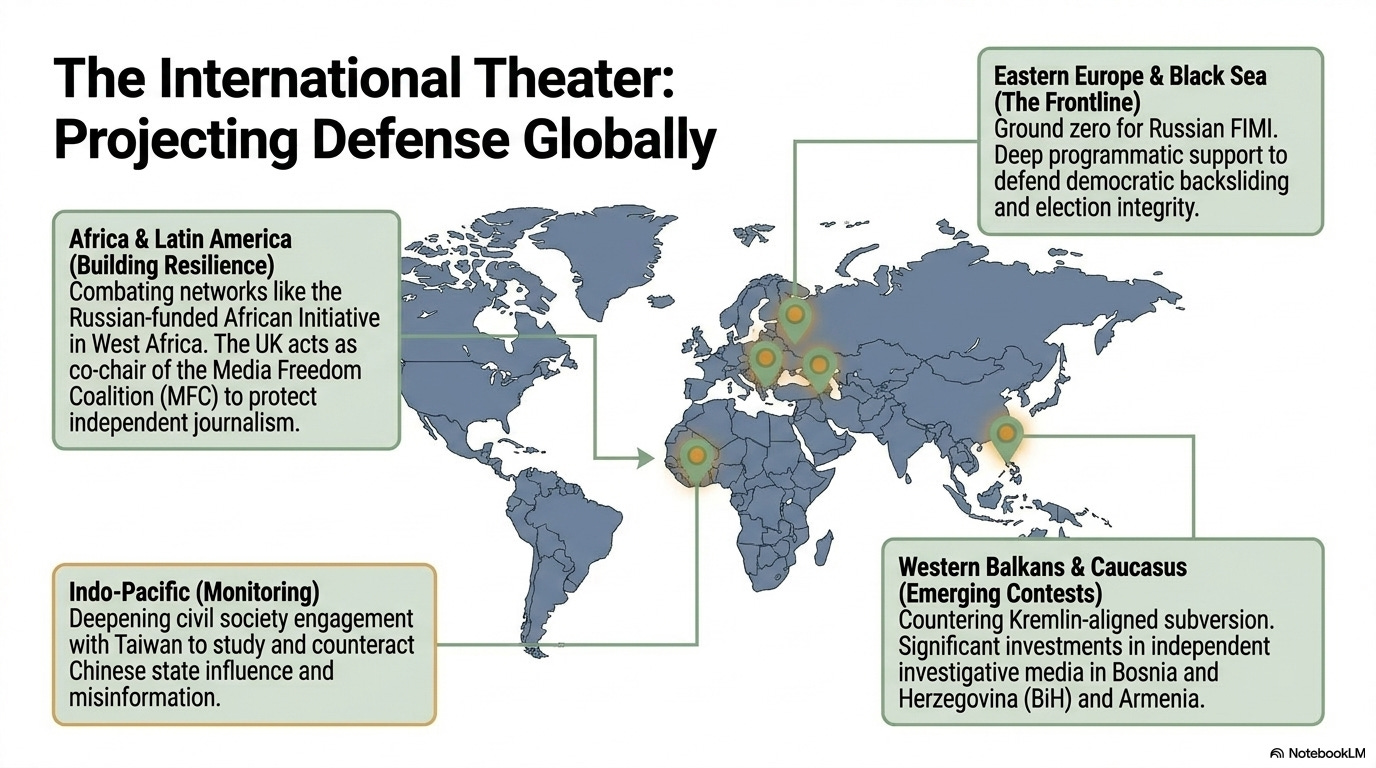
On 11 May 2026, the UK sanctioned a further 56 actors, including 49 SDA employees, and publicly exposed for the first time the SDA’s role in “interfere[ing] in the Armenian elections in favour of pro-Russian figures.” A second Kremlin-funded firm, ANO Dialog, was identified as having “coordinated with Russian intelligence on interference plans aimed at Armenian domestic politics.”
The broader Russian ecosystem the UK has sanctioned since October 2024 includes Rybar LLC, a Rostec-funded outlet that the BBC documented is producing war-themed comic books to sell Russia’s invasion of Ukraine to children; Storm-1516, an AI-driven network that EU researchers say fabricates videos targeting European politicians; and the Centre for Geopolitical Expertise, founded by Aleksandr Dugin.
In Moldova, the UK sanctioned Evrazia, a network run by fugitive oligarch Ilan Shor, after Moldovan police found that roughly 130,000 citizens received a total of $15 million in bribes to vote against EU accession in 2024. London later sanctioned entities tied to the A7 network and its ruble-backed A7A5 cryptocurrency, which UK officials said was linked to sanctions evasion and information-interference activity.
In February 2026, the UK sanctioned the Georgian channels Imedi TV and POSTV for amplifying Kremlin narratives, and in July 2025 it designated African Initiative, a Russian intelligence-staffed “content mill” pushing health conspiracies across West Africa.
China: the “Three Warfares” and the Taiwan surge
China’s operations follow the People’s Liberation Army’s doctrine of “Three Warfares” — public opinion, psychological, and legal — supported by a global coordinated influence network that researchers call Spamouflage, or Dragonbridge, which harasses regime critics across X, Facebook, TikTok, and YouTube.
The UK government acknowledged Taiwan’s National Security Bureau finding that Chinese misinformation aimed at the island rose 60 percent in a single year. The Foreign Secretary told Parliament that London “will not sacrifice our national security for economic growth” and pointed to a new Counter-Political Interference and Espionage Action Plan unveiled in March.
Iran: “Enhanced Tier” and Endless Mayfly
Iran is designated in the “Enhanced Tier” of the UK’s Foreign Influence Registration Scheme — the highest threat category — and London has sanctioned 36 Iranian individuals and entities for malign activity. Tehran’s signature operation, which the University of Toronto’s Citizen Lab named “Endless Mayfly,” fabricates news articles impersonating legitimate outlets and feeds them to real journalists in an attempt to launder Iranian narratives into Western media.
Microsoft’s Threat Analysis Center reported that Iranian government-connected actors used cyber-enabled influence campaigns around the 2024 U.S. presidential election, including hack-and-leak activity, covert personas, and AI-enabled content.
The government acknowledged that the Islamic Revolutionary Guard Corps and affiliated entities continue to drive Iran’s information operations, with the FCDO Iran Unit’s “deep experience in Iranian tactics, techniques and procedures” central to the UK’s response. Freedom House documented that Iran was among three states responsible for 11 incidents of physical transnational repression on UK soil between 2014 and 2024 — paired with online harassment, deepfake intimidation, and threats against the families of UK-based dissidents.
Non-state actors: Daesh, al-Shabaab, and the comms war
The Committee’s inquiry also examined non-state actors, finding that jihadist organizations remain prolific disinformation producers even after losing territory. The UN warned earlier this year that the threat from Daesh has “increased steadily” since its last report, with the group expanding its use of artificial intelligence and encrypted platforms to recruit. Researchers at the Combating Terrorism Center at West Point have catalogued 93 unofficial Islamic State outlets operating across mainstream platforms and encrypted messaging apps.
Al-Shabaab’s online operation has evolved in parallel. The Institute for Strategic Dialogue previously documented al-Shabaab and Islamic State propaganda ecosystems on Facebook, while Somali officials have warned that misinformation and disinformation threaten national cohesion and can incite violence.
The Western counter-offensive
The government committed £148 million a year for the next three years to the BBC World Service, a 42 percent increase. London is also building out a defense-and-security architecture aimed squarely at hybrid threats: the UK–EU Security and Defence Partnership, the Lancaster House Declaration with France, the Kensington Treaty with Germany, a forthcoming UK–Poland treaty, and the UK–Ukraine 100 Year Partnership, whose Article 7 covers foreign information manipulation.
The blunt message from London is that the information war is no longer a future risk. As Thornberry put it: “If Russia is already conducting information warfare against the West, the UK must be ready to defend itself.”
Unfortunately, democracies make very easy targets for informational warfare. The irony is that, should Western governments step in to steer the narrative, they'll become the very authoritarians they themselves despise.