


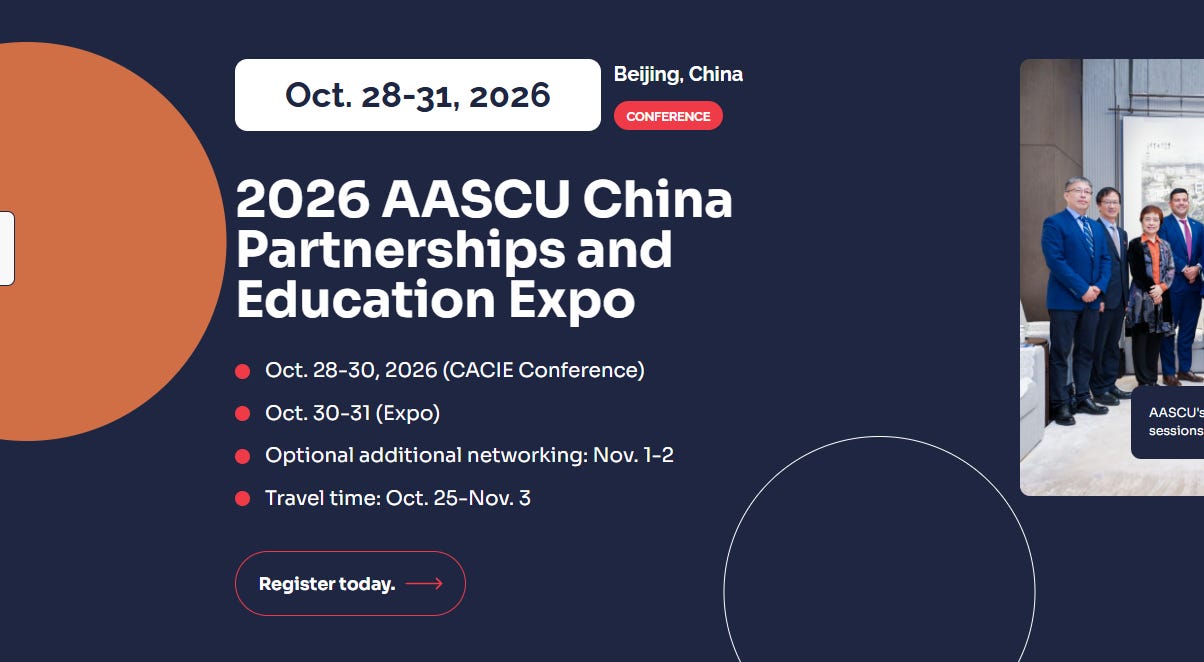
An association representing the sector of more than 500 American regional public colleges, universities and systems is preparing to bring university leaders to China for meetings explicitly designed to build new partnerships, weeks after the Pentagon ordered U.S. schools to review ties with foreign institutions it says pose national-security risks.
The American Association of State Colleges and Universities, or AASCU, will hold its 2026 China Partnerships and Education Expo from October 28 to 31 in Beijing. The program is aimed at presidents, provosts, deans and senior international officials and includes a U.S. Embassy policy briefing, a China-U.S. university presidents forum and an afternoon devoted to “B2B partnership building and networking with Chinese universities.”
After the Beijing conference, AASCU members can travel to Harbin in Heilongjiang Province for invitation-only one-on-one meetings intended to “build partnerships and explore collaboration opportunities” with additional Chinese universities. AASCU has not publicly identified the Chinese institutions taking part.
Washington Tightens Scrutiny
The trip comes amid a sharper federal focus on university relationships with Chinese institutions. On August 17, the Pentagon ordered 30 U.S. universities to audit academic, financial and research collaborations involving foreign entities identified under Section 1286 of the 2019 National Defense Authorization Act, as well as organizations associated with rebranded Confucius Institutes.

Section 1286 is a research-security mechanism aimed at protecting Pentagon-funded research from unwanted foreign influence and technology transfer. The department says the list identifies foreign entities and talent programs confirmed to be engaging in activities that threaten U.S. national-security interests. Beginning in fiscal 2026, Pentagon funds cannot be used for fundamental research involving collaboration with an entity on the most recent list.
The restrictions do not amount to a blanket ban on student exchanges or every form of academic contact. They do, however, restrict Pentagon-funded fundamental research with listed institutions and require researchers to disclose relevant affiliations.
AASCU’s existing China network already intersects with that list.
The association jointly administers the Sino-U.S. CHEPD 1+2+1 Program with the China Center for International Educational Exchanges. AASCU says the network includes 43 American institutions and 160 Chinese partners, has enrolled 7,500 students and has generated approximately $450 million in tuition, fees, room and board for U.S. campuses. It also advertises “teaching and research opportunities for faculty members” and requires participating American institutions to be able to host Chinese visiting scholars.
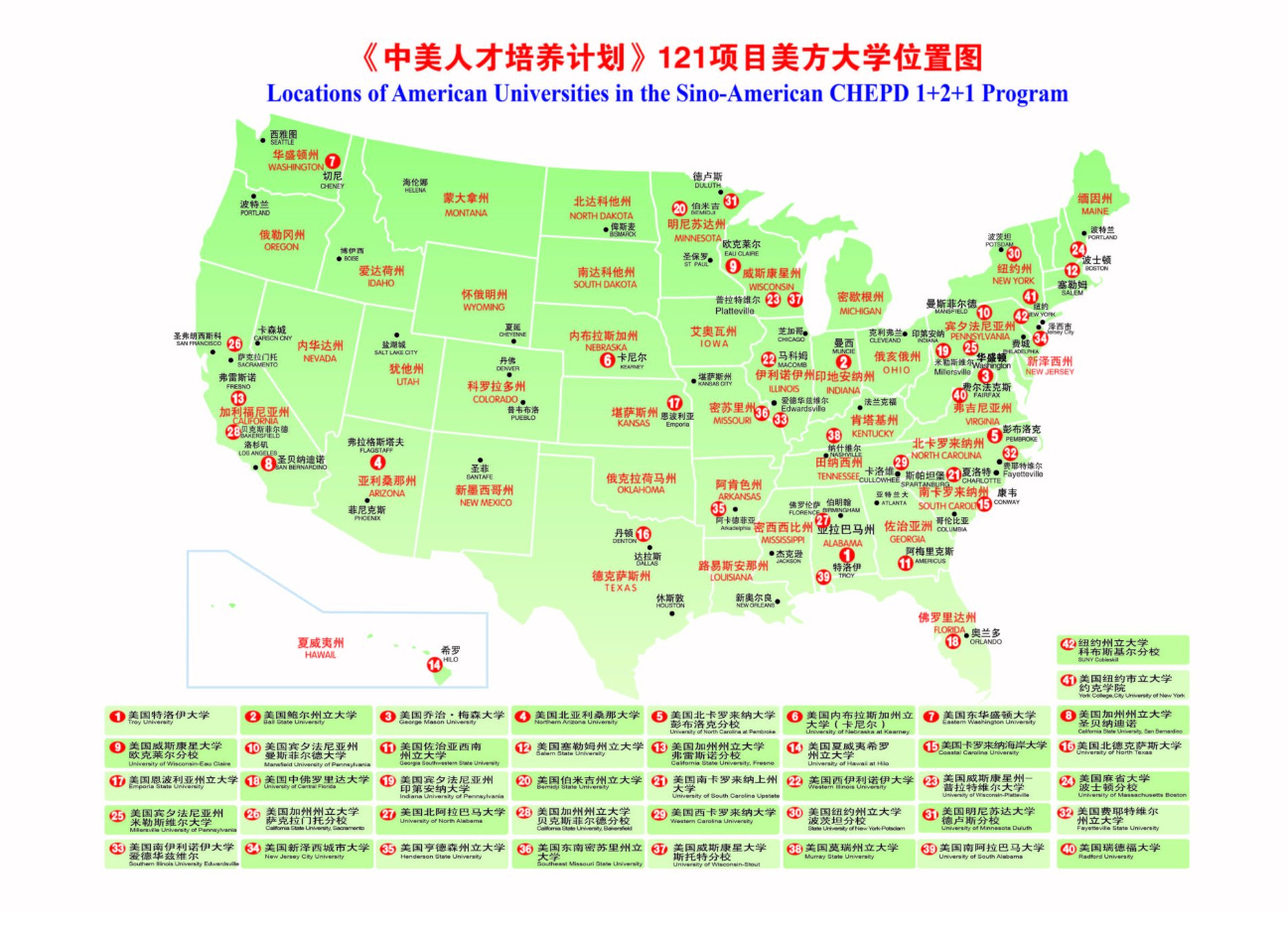
One Chinese participant is Chongqing University, which remains on the Pentagon’s current Section 1286 list. On March 17, Chongqing University opened applications for its 2026 1+2+1 dual-degree and related exchange programs and told students that all participating American universities were available to applicants.
The timeline is significant. Chongqing was actively recruiting students into the AASCU-linked program in March. The Pentagon published its updated Section 1286 list in July with Chongqing still included. The following month, it ordered 30 American universities to review collaborations involving listed foreign entities and assess exposure involving sensitive or export-controlled research.
Undisclosed Meetings in Harbin
The Harbin leg raises a separate question.
AASCU has not disclosed which Heilongjiang universities its delegation will meet. Harbin, however, is home to two universities on the current Section 1286 list: Harbin Institute of Technology and Harbin Engineering University.
Both are also on the Commerce Department’s Entity List, a separate export-control regime that imposes licensing requirements on transactions involving covered U.S.-origin goods, software and technology. The current Commerce listing subjects exports of items covered by the Export Administration Regulations to both universities to a license requirement and a presumption of denial.
Commerce added the universities in 2020 for much more specific reasons. It said Harbin Engineering University had acquired or attempted to acquire U.S.-origin items in support of People’s Liberation Army programs. Harbin Institute of Technology, Commerce said, had done the same and had sought to use U.S. technology for Chinese missile programs.
There is no public evidence that either university is participating in AASCU’s November meetings. But AASCU already has an established partnership-building footprint in Harbin.
In June 2025, a delegation including AASCU representatives and leaders from Millersville University, the University of Wisconsin-Stout, the University of North Carolina at Pembroke and Salem State University visited Northeast Agricultural University in Harbin. According to the Chinese university, discussions included expanding cooperation into faculty and student exchanges, joint research projects and jointly established laboratories and research centers.
A Larger Debate Over University Partnerships
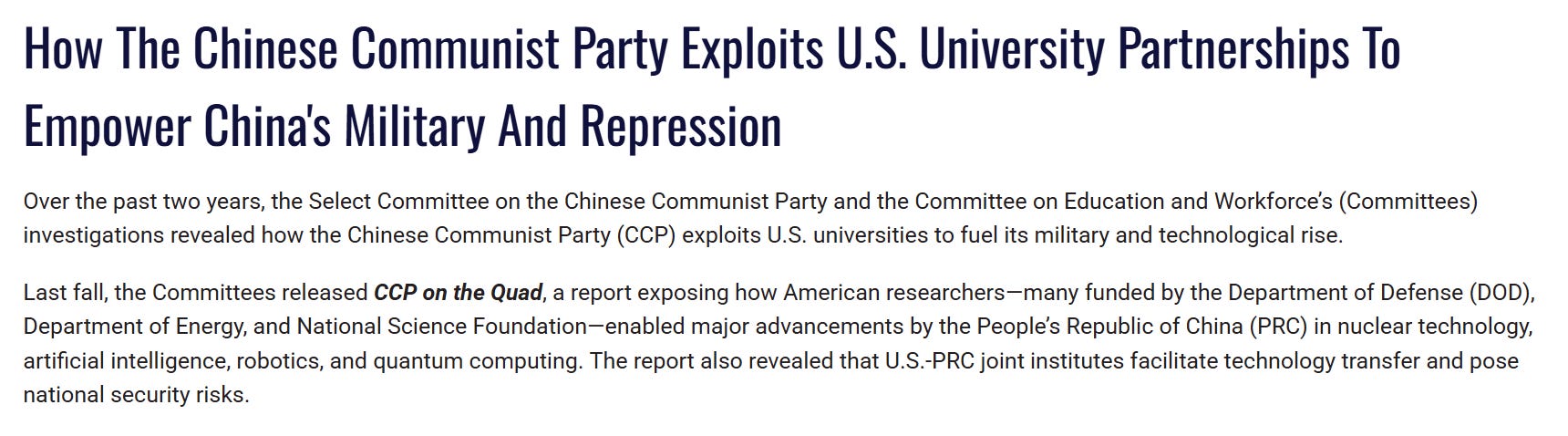
The trip follows broader congressional scrutiny of U.S.-China academic ties. A September 2025 report from the House Select Committee on the Chinese Communist Party and House Education and Workforce Committee said their investigation uncovered dozens of previously unreported academic collaborations they considered national-security risks, particularly joint institutes and other arrangements linking American universities with Chinese institutions. Those conclusions were made by the committees and have been disputed more broadly by higher-education groups that argue legitimate academic exchange should not automatically be treated as a security threat.
AASCU’s October itinerary puts the competing priorities side by side. American university officials will receive a U.S. Embassy policy update in Beijing and then move directly into meetings intended to create and sustain new educational partnerships in China. Less than a week later, some will be in Harbin for a second round of university matchmaking whose Chinese participants have not been publicly identified.
The unanswered question is how AASCU is applying Washington’s new research-security restrictions as it works to expand those relationships.
I'm sure the American university bigwigs will get a carefully curated tour all while being chaperoned by CCP government minders.