


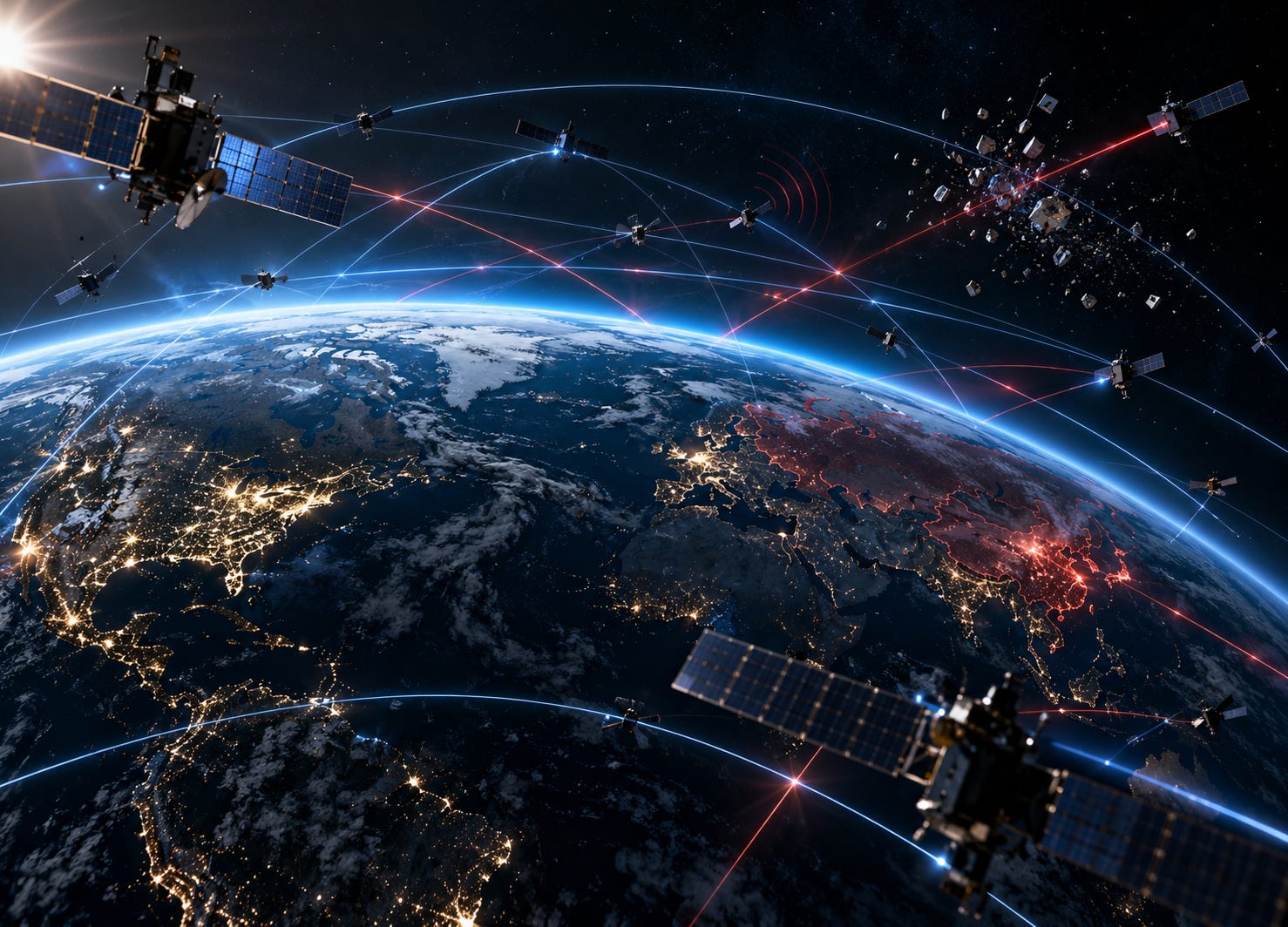
The battlefield is extending far beyond Earth.
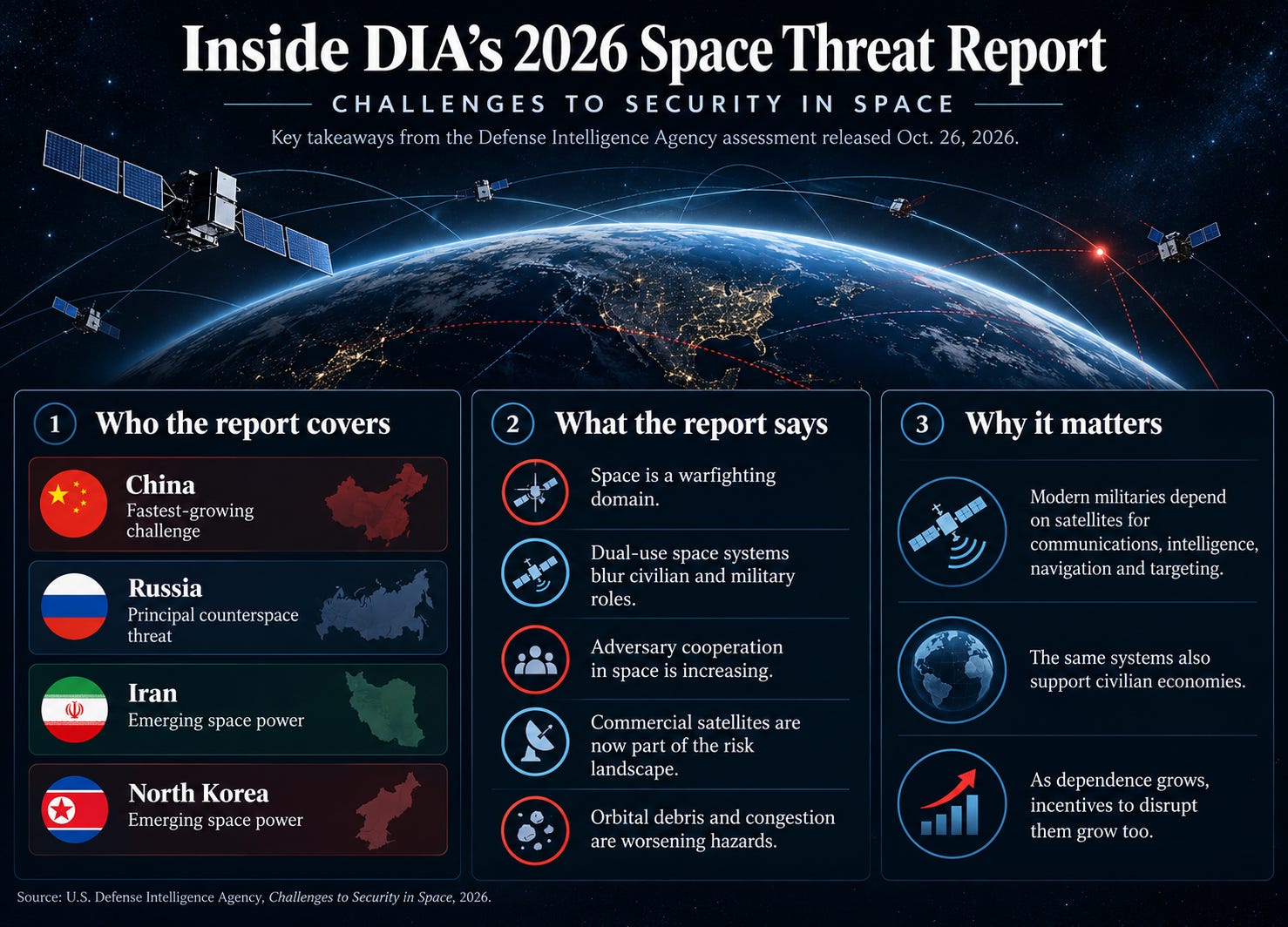
A new U.S. intelligence assessment warns that China and Russia are expanding capabilities designed to disrupt, disable or destroy satellites, while Iran and North Korea are developing increasingly significant space programs of their own.
The Defense Intelligence Agency released the third edition of its Challenges to Security in Space report on October 26. The unclassified assessment, with information current through July 2026, examines the strategies and capabilities of China and Russia, the emerging space programs of Iran and North Korea, growing cooperation among U.S. adversaries, dual-use technologies and hazards such as orbital debris.
The report reflects a broader shift in how major powers view space. Satellites are no longer simply communications, navigation or scientific infrastructure. They increasingly form part of the machinery of modern warfare.
China’s Rapid Expansion
China represents the fastest-growing space challenge documented in the report. According to DIA, Beijing now operates more than 510 intelligence, surveillance and reconnaissance satellites, including government and commercial spacecraft. China’s ISR fleet has more than tripled since 2018.
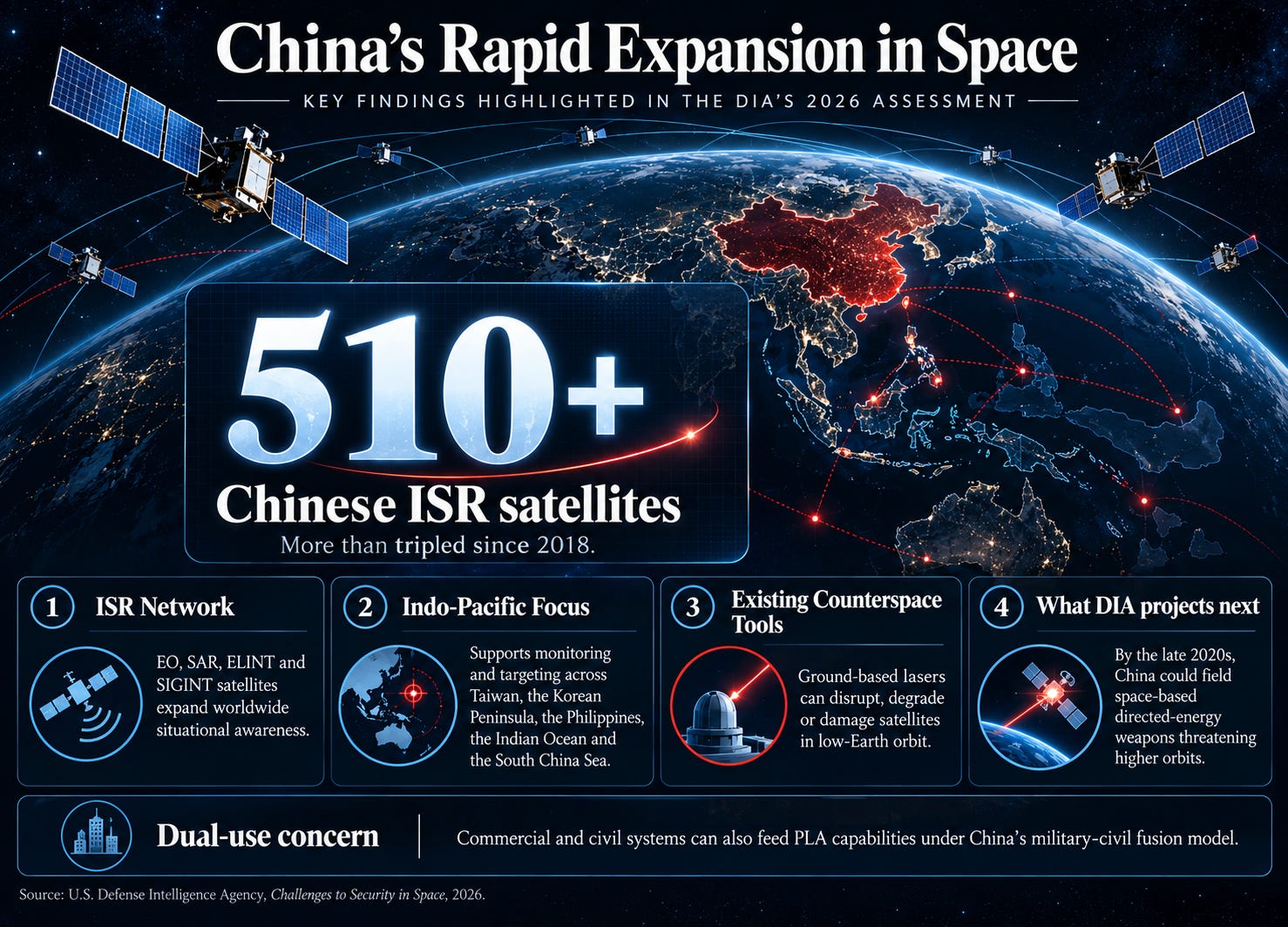
The network includes electro-optical imaging satellites, synthetic-aperture radar systems and spacecraft collecting electronic and signals intelligence. Together, DIA says, they give China greater worldwide situational awareness and help enable long-range strikes by allowing the People’s Liberation Army to locate and track potential targets.
The Indo-Pacific is particularly important. Chinese satellites can support monitoring of activity around Taiwan, the Korean Peninsula, the Philippines, South China Sea and Indian Ocean. The report also describes an expanding Chinese counterspace arsenal.
DIA says China already possesses ground-based laser systems capable of disrupting, degrading or damaging satellites in low-Earth orbit. By the late 2020s, the agency assesses that Beijing could field more powerful ground systems as well as space-based directed-energy weapons capable of threatening satellites in higher orbits.
That is an intelligence projection, not an assertion that China currently has operational laser weapons stationed in space. China is also developing spacecraft capable of maneuvering around other satellites and investing heavily in reusable launch systems. The 130-page DIA report includes a satellite image of China’s secretive reusable spaceplane, part of Beijing’s broader effort to develop spacecraft that can remain in orbit, maneuver and return for additional missions.
The Civilian-Military Divide Is Disappearing
China’s expansion also illustrates one of the report’s broader themes: the increasing difficulty of separating commercial space activity from military capability. Commercial satellites can provide imagery, communications and other services useful to armed forces, while technologies developed for civilian purposes can have military applications.
China integrates commercial and civilian space capabilities into a broader national strategy, giving the PLA access to resources extending beyond spacecraft formally operated by the military. The same problem increasingly affects the United States and its allies.
Western militaries now depend heavily on privately operated communications, imagery and navigation services. The war in Ukraine has demonstrated how quickly commercial satellite systems can become critical battlefield infrastructure. That also makes them potential targets.
Russia’s Counterspace Arsenal
Russia remains the other principal counterspace power identified by DIA. Moscow possesses electronic warfare systems capable of interfering with satellite communications and navigation and continues to develop weapons intended to threaten spacecraft in orbit.
The report also discusses U.S. concerns about Russia’s pursuit of a potentially nuclear anti-satellite capability. Such a system would be fundamentally different from destroying one spacecraft with a conventional missile. A nuclear detonation in space could affect numerous satellites across a broad area and potentially disrupt systems belonging to countries not directly involved in a conflict.
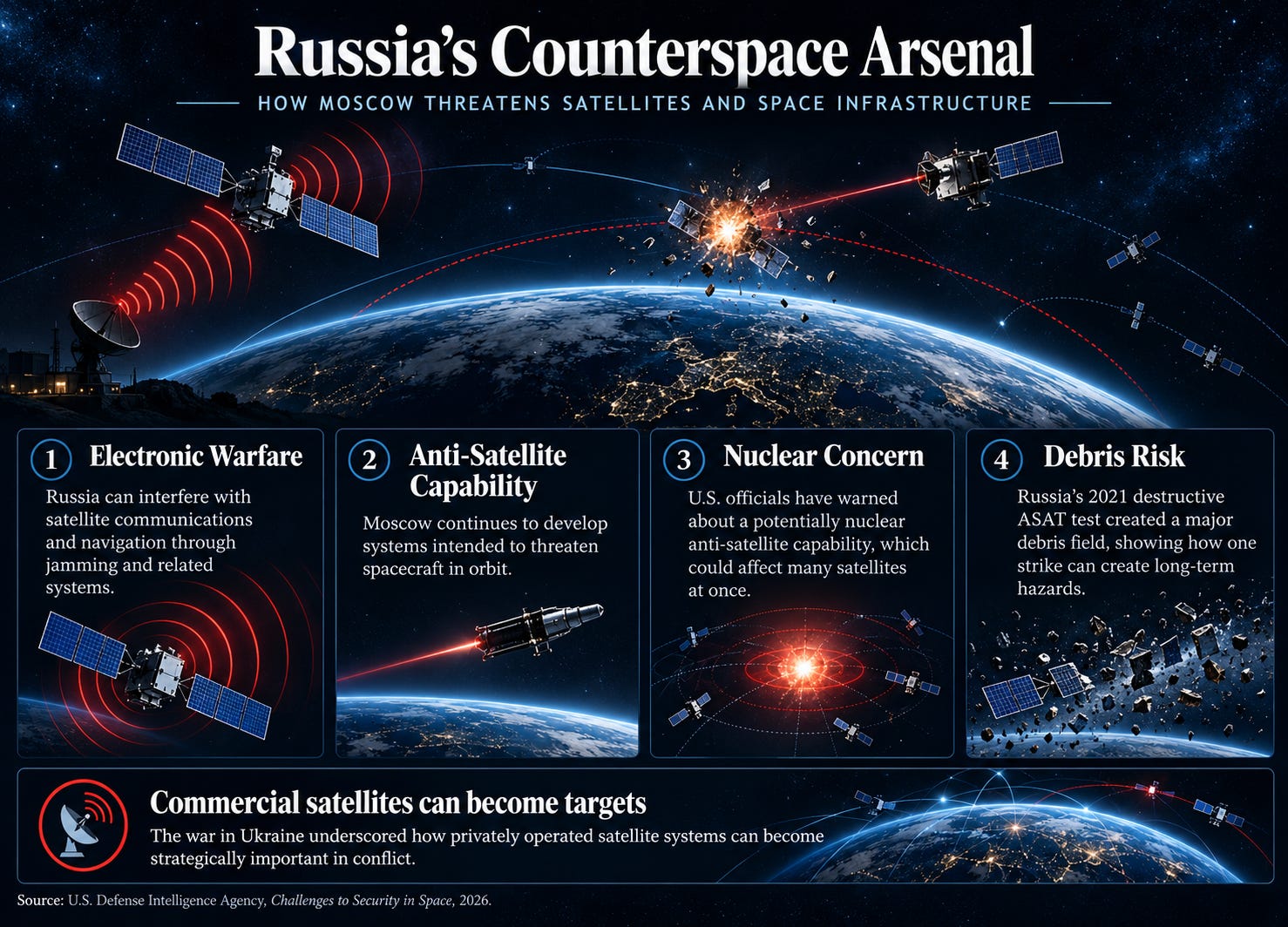
Russia has already demonstrated the consequences of destructive anti-satellite warfare. In 2021, Moscow destroyed one of its own satellites during an anti-satellite missile test, producing a large debris field. China’s 2007 destructive test similarly created thousands of pieces of orbital debris.
Those fragments can remain in orbit for years, threatening military, commercial and scientific spacecraft long after the original test or conflict ends.
Iran and North Korea Expand Their Programs
DIA also identifies Iran and North Korea as emerging space powers, although their capabilities remain well behind those of China and Russia. Iran has continued expanding satellite-launch and military-space capabilities, while North Korea has pursued reconnaissance satellites and launch technologies despite repeated technical setbacks.
Their significance extends beyond their individual programs. The report highlights growing space cooperation among U.S. strategic adversaries, including technology transfers, satellite services and other forms of assistance. Space is becoming another arena in which relationships among China, Russia, Iran and North Korea can translate into military advantages.
A More Dangerous Orbit
The threat described by DIA is not limited to deliberate attacks.
Earth orbit is becoming increasingly crowded as governments and commercial companies deploy enormous satellite constellations. At the same time, previous launches, accidents and anti-satellite tests have left large amounts of debris circling the planet.
The combination of congestion and military competition makes operations in space increasingly complicated. A satellite destroyed during a conflict can create fragments that threaten spacecraft belonging to neutral countries and commercial companies for years afterward.
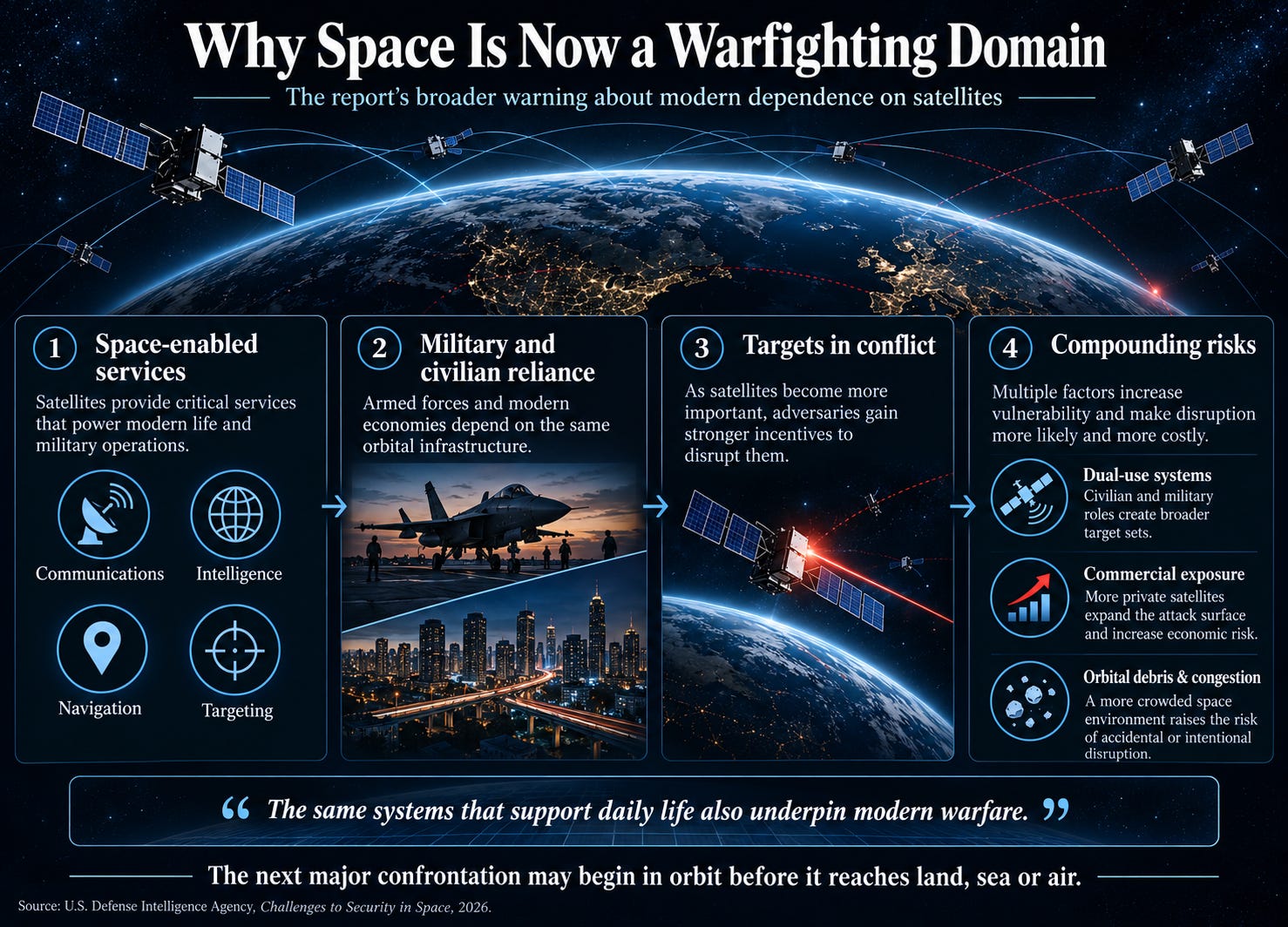
The report’s central warning is therefore larger than any single Chinese laser, Russian missile or Iranian satellite launch. Modern militaries depend on space for communications, intelligence, missile warning, navigation and targeting. Civilian economies depend on many of the same systems.
As that dependence grows, so does the incentive for an adversary to interfere with them. The next major confrontation between advanced military powers may therefore begin long before opposing forces meet on land, at sea or in the air. It could begin hundreds or thousands of miles above them.
An unbroken lesson throughout history is this: passivity invites aggression. This is probably the reason that the USA recently announced that it has orbital weapons.