


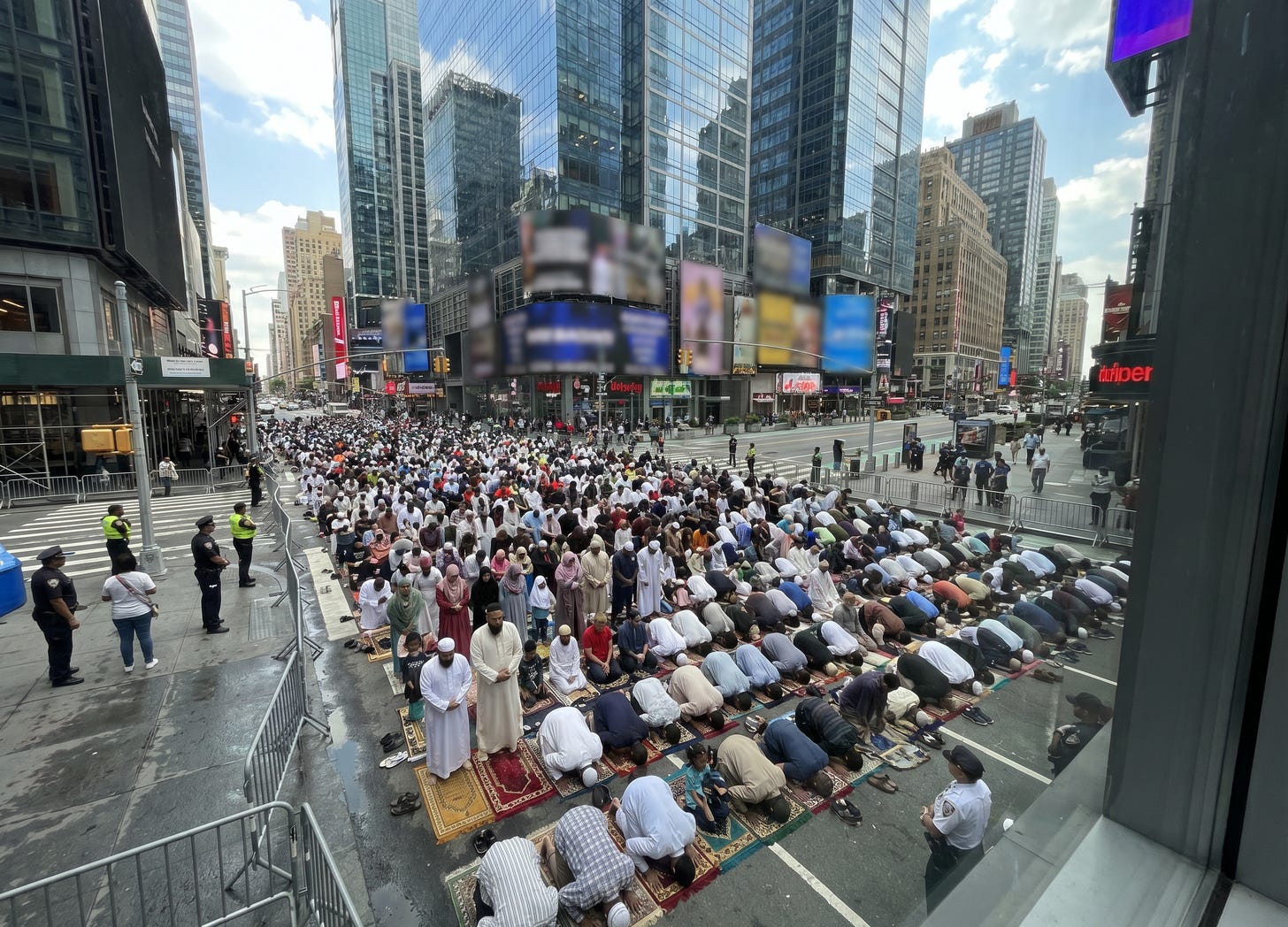
A viral clip of streamer Sneako declaring New York an “Islamic State” and saying “Islam will be in every household” spread this week because it sounded absurd and theatrical. Taken literally, the claim is false: New York remains a secular city governed by constitutional law, and Muslim New Yorkers are still a minority. But the clip resonated because it exaggerated something real. Over the last decade, Muslim identity, Islamic institutions, and progressive politics have become far more visible and politically consequential in New York than at any point in the post-9/11 era.
The transformation is not simply demographic. It is organizational, ideological, and institutional—and it has been bankrolled and organized by networks with documented ties to extremist movements.

Following the money and the ideology
Zohran Mamdani’s mayoral campaign drew its largest institutional backing from groups linked to organizations federal lawmakers have described as having “deep ties to terrorist organizations.” The New York Post reported that the Unity and Justice Fund PAC—which shares addresses and personnel with CAIR Action—gave Mamdani’s campaign $120,000, making it one of his biggest single donors.
CAIR, the Council on American-Islamic Relations, was named as an unindicted co-conspirator in the 2008 Holy Land Foundation terrorism financing trial, where prosecutors presented evidence showing the group received “seed money” from Hamas and transferred funds for “consulting services” to a Hamas-linked charity.
Radical activist Linda Sarsour, described as a mentor to Mamdani, stated at CAIR’s 2025 Leadership Conference: “PACs that have supported Zohran, or a particular PAC that has supported Zohran is probably over 80% of Muslim-American donors in this country.”
This is not incidental. Muslim political organizing in New York has moved from the margins to the center—and it has done so with institutional backing from groups that U.S. authorities and lawmakers have repeatedly flagged for extremist ties.


The ideological package deal
Mamdani’s campaign drew heavily from the Democratic Socialists of America, an organization that justifies terrorism as resistance. On October 7, 2023—the day Hamas murdered 1,200 Israelis—DSA’s national organization issued a statement expressing “steadfast solidarity with Palestine” without condemning or even naming Hamas. DSA’s NYC chapter promoted a rally the next day where protesters chanted “Globalize the Intifada.”
The Guardian reported that DSA’s stances on foreign conflicts have become a defining part of its appeal to younger voters. The New York Post reported that Democratic leaders privately acknowledged ideological purity tests—not just economic populism—drove recent socialist primary victories.
The concern is not Muslim civic participation. The concern is that Muslim political ascent has been funded and organized by groups with documented extremist ties, amplified by mosques hosting calls for religious violence, and entangled with far-left movements that justify terrorism and treat dissent as bigotry.

A city that hasn’t reckoned with what it elected
That shift in New York affects school calendars, coalition politics, nonprofit funding, policing priorities, foreign-policy posturing, campus culture, and the unwritten rules governing what can be said, questioned, or criticized in public life. And it has happened faster than the city’s institutions—or its citizens—have had time to reckon with.
The Sneako clip went viral because it converted a genuine civic transformation into a meme. The real story is more serious. New York’s Muslim political ascent is a fact. The question is whether New Yorkers understand who funded it, what ideology drove it, and what comes next.