


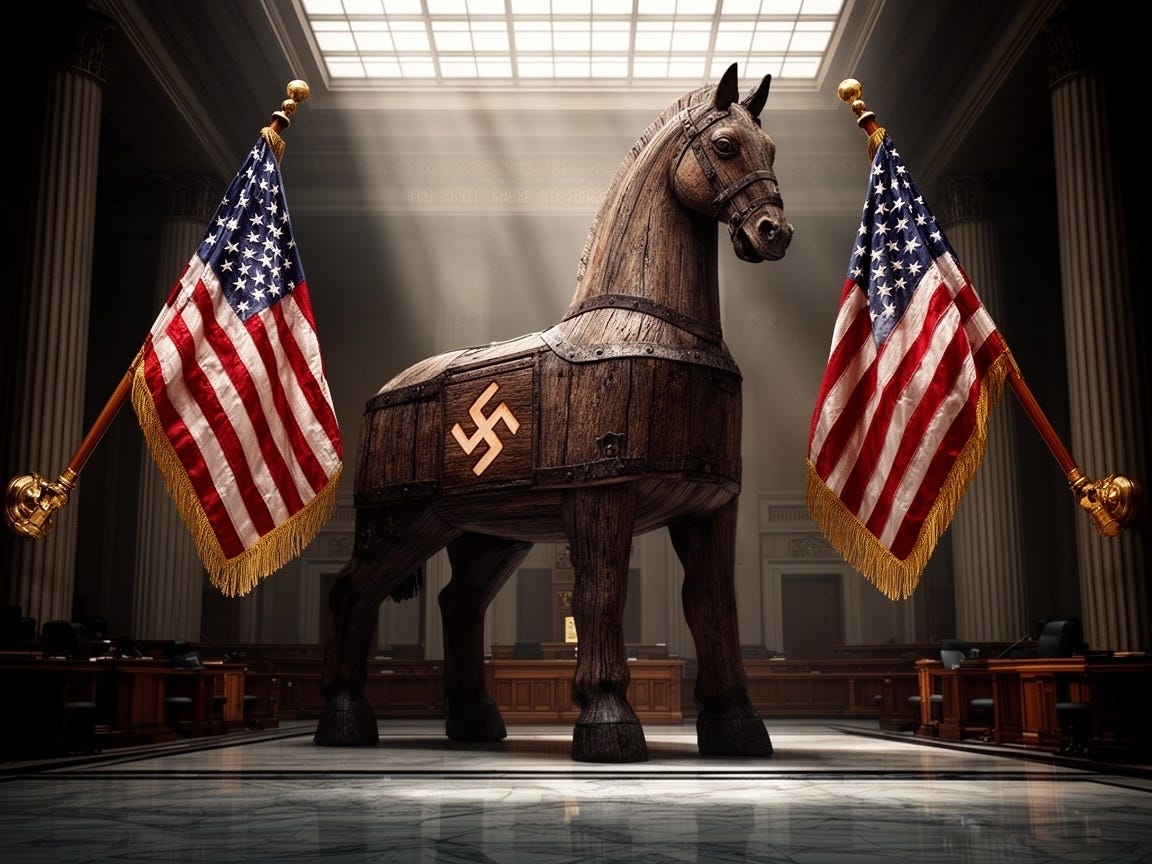
In 1938, congressional investigators discovered something alarming: a well-connected American publicist named George Sylvester Viereck had been ghostwriting speeches for U.S. senators. The speeches praised Nazi Germany’s policies, downplayed its aggression, and urged American neutrality. Then Viereck would have those same senators insert the speeches into the Congressional Record—making them official government documents that could be mailed across the country under congressional franking privileges, free of charge.
The Nazi government was paying for it all.
Senator Ernest Lundeen of Minnesota was among Viereck’s most cooperative partners, delivering Viereck-penned speeches on the Senate floor and distributing Nazi propaganda materials to constituents. By the time investigators exposed the scheme, German agents had turned American democratic infrastructure into a distribution network for foreign influence operations. The propaganda looked homegrown, carried senatorial letterhead, and cost the Reich nothing to mail.
Congress responded with the Foreign Agents Registration Act, signed into law by President Franklin Roosevelt on June 8, 1938. The law didn’t ban Nazi propagandists or criminalize their speech. Instead, it required one thing: disclosure. Anyone acting on behalf of a foreign government to influence American policy or opinion had to register with the State Department and make their relationships public. The theory was elegant—transparency as antidote. When foreign influence becomes visible, democratic immune systems can respond.
Eighty-six years later, FARA remains the primary legal framework governing foreign influence in American politics, though the threats it addresses have evolved beyond recognition. What began as an anti-Nazi propaganda statute became an anti-Communist subversion law, then a foreign lobbying disclosure regime, and now a tool for managing influence operations from China, Russia, and Iran in the age of social media and computational propaganda. The law’s longevity reveals something important about how democracies develop antibodies to foreign interference: they build institutional memory through legal frameworks that adapt without abandoning core principles.
The Exposure Campaign
The story actually begins in 1934, when Representative Samuel Dickstein convinced Congress to create a special committee investigating Nazi propaganda activities in the United States. What the McCormack-Dickstein Committee uncovered was more sophisticated than crude pamphlets. The Nazis had hired Ivy Lee and Carl Byoir- two of America’s most prominent public relations pioneers—to shape American perceptions of the Third Reich. Lee, who had built his reputation managing image problems for robber barons and unpopular industries, took payments funneled through a Swiss-based German dye cartel to advise Nazi officials on what to say for American consumption.
The committee documented extensive networks: German-American Bund camps where children learned Nazi ideology, German diplomats distributing propaganda through seamen on merchant vessels, American isolationist groups receiving funding and talking points from Berlin. By 1938, investigators had established that foreign governments were systematically manipulating American political discourse through paid agents who presented themselves as independent American voices.
The original FARA reflected this discovery. It required agents of foreign principals to register within 30 days, disclose their compensation and contracts, submit propaganda materials to the government, and label all distributed materials with clear disclaimers identifying the foreign source. The law explicitly avoided censorship- propaganda could still be disseminated, but Americans would know where it came from. As one congressional report explained, the goal was “the spotlight of pitiless publicity” rather than prohibition.
This choice mattered constitutionally and strategically. Censorship would have violated First Amendment protections and conjured memories of World War I civil liberties abuses that still haunted the public. But transparency could work with democratic culture rather than against it. Knowing that a particular isolationist pamphlet came from Berlin, or that a particular speaker was being paid by Tokyo, allowed Americans to weigh information accordingly. The law trusted citizens to make informed judgments once they had the relevant facts.
Evolution Through Threat Perception
FARA’s subsequent amendments track how each generation reinterpreted foreign influence threats. The 1942 amendments, passed after Pearl Harbor, expanded enforcement dramatically. Administration shifted from the State Department to the Justice Department, definitions broadened to capture more types of agents, and requirements for propaganda labeling became more stringent. By war’s end, federal prosecutors had charged dozens of individuals with FARA violations and secured 23 convictions- including Viereck himself, who served prison time for failing to register as a Nazi agent.
Then the threat changed. After World War II, Nazi propaganda ceased to be the concern. For two decades, FARA went largely dormant—the Justice Department prosecuted roughly nine cases through the early 1960s. The law remained on the books, but enforcement dwindled.
The 1966 amendments represented the most significant conceptual shift. During debates over the Sugar Act, foreign governments had mounted aggressive lobbying campaigns around sugar import quotas. The Senate Foreign Relations Committee investigated what it called “an increasing number of incidents involving attempts by foreign governments, or their agents, to influence the conduct of American foreign policy by techniques outside normal diplomatic channels.” The resulting legislation refocused FARA from propaganda and subversion toward advocacy and lobbying. As Senator Fulbright explained during floor debate, “the trench coat has been replaced by the gray flannel suit.”
This reorientation proved prescient. Modern foreign influence operations rarely involve crude propaganda or ideological subversion. Instead, they work through professional lobbyists, public relations firms, think tank funding, and sophisticated information campaigns designed to look like organic American political activity. The 1966 amendments acknowledged this evolution and adapted accordingly.
The Dormant Deterrent
Here’s what makes FARA’s enforcement history genuinely interesting: the law is almost never prosecuted, yet thousands of people register voluntarily every year. Between 1966 and 2016, only seven FARA cases were brought criminally. The law functions primarily through its existence rather than through prosecution. This represents sophisticated institutional design- establishing clear boundaries and ensuring visibility without requiring constant criminal enforcement.
The deterrent works because FARA violations carry serious penalties (up to five years in prison and $10,000 in fines for willful violations) and because registration failure creates legal liability that compounds over time. A continuing offense that began months or years ago becomes difficult to quietly fix once discovered. More importantly, registration itself isn’t particularly burdensome for legitimate advocacy: it requires disclosing relationships, compensation, and activities every six months. The friction falls heaviest on those trying to hide foreign connections.
Recent years have seen enforcement revival. The Paul Manafort prosecutions in 2017-2018 signaled renewed Justice Department interest, with cases involving Chinese influence operations, Russian propaganda networks, and other foreign lobbying schemes following. This uptick doesn’t represent a legal change—it reflects shifting threat perceptions. When democracies begin recognizing new patterns of foreign interference, dormant laws reactivate.
Why Transparency Persists
The through-line across 86 years is consistent: democratic societies handle foreign influence through disclosure rather than prohibition. This isn’t weakness or naivety- it’s recognition that prohibition creates constitutional conflicts, drives influence operations underground, and often backfires by making forbidden ideas more attractive. Transparency allows democratic systems to function as designed, with citizens equipped to evaluate information sources.
The law’s original architects understood something that remains true: foreign influence operations become dangerous when they’re invisible. Once exposed, they lose much of their power. A think tank study carries different weight when readers know it’s funded by a foreign government. A senator’s speech reads differently when constituents learn it was ghostwritten by a foreign agent. An isolationist movement appears less organic when German payments to its organizers become public.
Democratic immune systems, it turns out, work remarkably well when they have accurate information about pathogens in the environment. That’s what FARA provides—not prohibition, not censorship, but the transparency required for informed democratic judgment. The framework has proven adaptable precisely because it doesn’t try to ban foreign influence, only to make it visible. Each generation can apply that principle to its own threats: Nazi propagandists in 1938, Soviet subversion in 1942, foreign lobbyists in 1966, computational propaganda campaigns today.
The recent enforcement uptick suggests we’re in another moment of reinterpretation, recognizing new patterns of foreign interference that require renewed attention to old principles. The institutional antibody remains the same. Only the pathogens have evolved.