


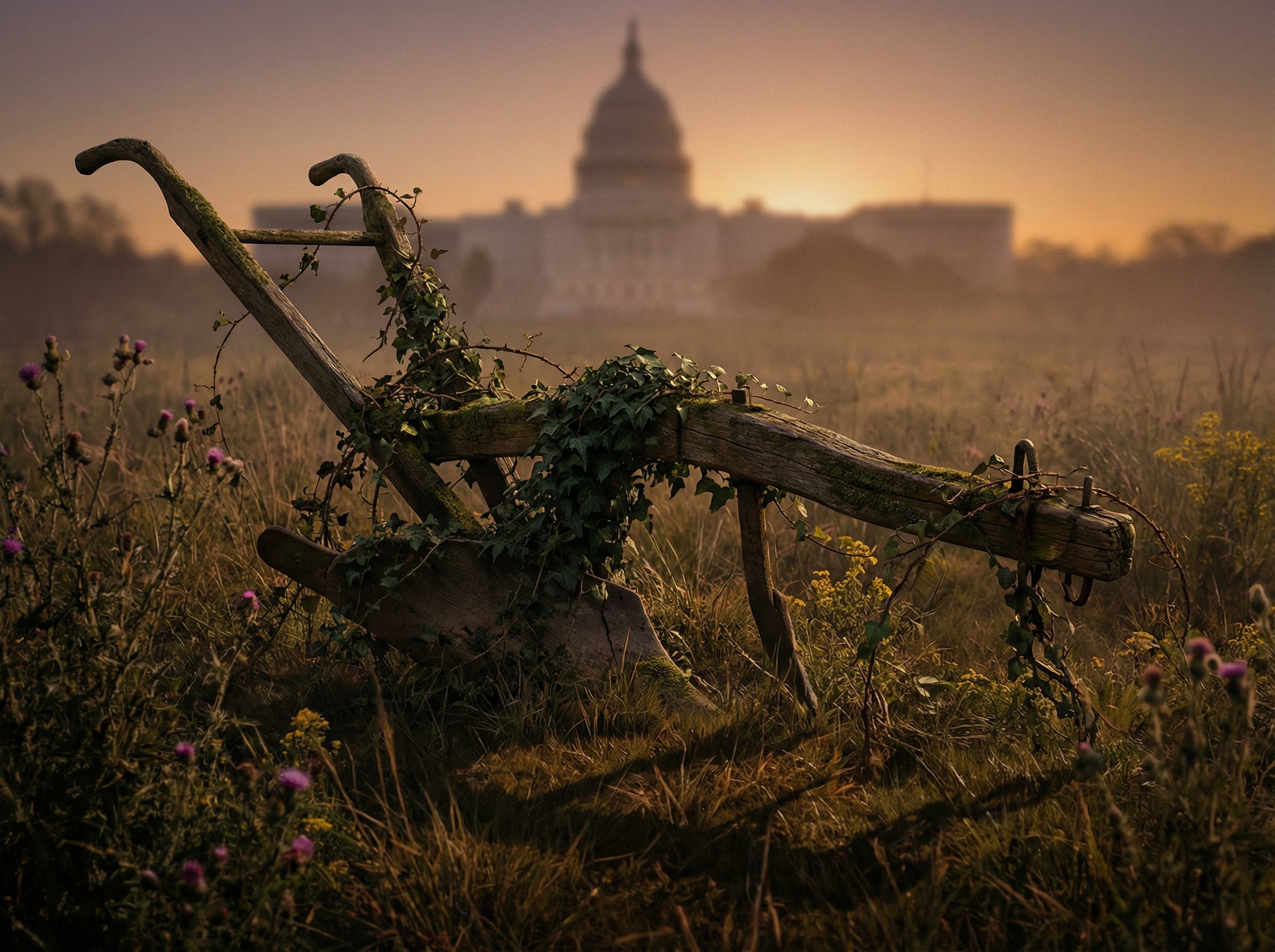
Every February, Americans observe Presidents’ Day without quite remembering why. We celebrate leaders whose names we struggle to recall, commemorating an office that has drifted so far from its origins that the Founders themselves might not recognize it. The real story isn’t about the holiday’s confusion. It’s about a transformation so gradual that we barely noticed the Roman farmer becoming an emperor.
George Washington had a problem in 1783. He’d just won a war against monarchy, and everyone expected him to become one. His officers were restless, unpaid, and openly discussing a military coup. Foreign diplomats assumed he’d crown himself. King George III himself reportedly said that if Washington returned to his farm, “he will be the greatest man in the world.”
Washington did return to his farm. He modeled himself explicitly on Lucius Quinctius Cincinnatus, the Roman general who left his plow to save Rome, then returned to his plow fifteen days later after resigning his dictatorship. When Washington resigned his military commission in Annapolis that December, he wasn’t just declining power—he was performing what historian Garry Wills called “the greatest act of his life.” The message was unmistakable: American presidents would be temporary servants, not permanent rulers.
The image obsessed the Revolutionary generation. Jean-Antoine Houdon’s famous statue in Richmond’s Capitol shows Washington in civilian dress, standing before his plow. The Society of the Cincinnati—military officers who’d served in the Revolution—took the Roman general’s name, adopting the Latin motto “He gave up everything to serve the republic.” Philip Freneau wrote that Washington, like Cincinnatus, “Beturn’d, and sought his sylvan shade.” The metaphor wasn’t decorative; it was load-bearing. It answered the question that haunted every revolutionary movement: what happens after you win?
The Constitution’s Article II reflects this anxiety. It’s remarkably brief—shorter than the section on Congress—and deliberately vague about presidential powers. The Framers had revolted against monarchical authority; nobody wanted George III in Philadelphia instead of London. They imposed short terms, required re-election, created impeachment. They built a presidency for Cincinnatus: powerful enough to act, constrained enough to return home.
But here’s what the Framers couldn’t anticipate: America wouldn’t stay a nation of four million people on the Atlantic seaboard with an explicitly isolationist foreign policy. George Washington’s Farewell Address laid it out clearly—avoid entangling alliances, stay out of European wars, remain commercially engaged but politically detached. By 1945, that advice was archaeological. The United States had become the world’s greatest power, and after the Cold War, its only superpower.
When a country’s role transforms from continental farm republic to global hegemon, the presidency transforms with it. Abraham Lincoln discovered this during the Civil War. He called up 75,000 troops without congressional authorization. He suspended habeas corpus. He authorized military trials of civilians. Constitutional scholars call these actions “dubious.” Lincoln called them necessary, and the public agreed—during wartime, you want the commander-in-chief to win, not to worry about constitutional niceties.
Eighty years later, Franklin Roosevelt pushed further. Through the War Powers Acts, he reorganized vast swaths of the executive branch. He censored mail. He accessed confidential census data that led to Japanese internment. Then, during the Great Depression, his New Deal programs didn’t just improve consumer confidence—they fundamentally expanded presidential authority to regulate the economy. The administrative state mushroomed: the Federal Communications Commission, the Securities and Exchange Commission, agencies upon agencies, all ultimately answerable to the president.
FDR also shattered the most important unwritten rule Washington had established. Every president since 1789 had observed the two-term limit, not because the Constitution required it, but because Washington had set the precedent. Roosevelt ran for a third term in 1940, then a fourth in 1944. The norm held for 150 years until it didn’t. Two years after FDR’s death, Congress passed what became the 22nd Amendment, writing Washington’s norm into constitutional text, but only after it had been thoroughly broken.
The pattern repeats: crisis opens space for presidential expansion, and what begins as emergency authority becomes normalized baseline. After September 11, 2001, President Bush claimed powers that would have stunned the Framers—indefinite detention of enemy combatants at Guantanamo, vastly expanded domestic surveillance, authorized torture. These powers didn’t disappear when Bush left office. Subsequent presidents inherited and maintained them.
Today’s presidency bears almost no resemblance to the office Washington occupied. Modern presidents command a military of 1.3 million active personnel across 750 overseas bases. They oversee a federal bureaucracy of four million employees. They issue executive orders that reshape entire industries. They declare national emergencies that unlock 137 statutory powers Congress has defined—powers that allow taking control of industrial plants, restricting commerce, seizing property, and mobilizing production. The National Emergencies Act of 1976 was supposed to limit these authorities; instead, it catalogued how vast they’d become.
The growth was inevitable. The world changed. A nation of farmers needed someone who could briefly leave their plow; a nuclear superpower needs someone who can answer the phone at 3 a.m. to authorize a counterstrike. The question isn’t whether presidents have more power than Washington did—of course they do. The question is whether we’ve maintained any meaningful version of the Cincinnatus principle: that presidents serve temporarily, constrain themselves voluntarily, and ultimately go home.
What made Cincinnatus remarkable wasn’t that he wielded power well, but that he relinquished it willingly. He didn’t wait to be voted out or term-limited out. He left because staying would have corrupted the republic he’d saved. When Washington performed the same act, he established that American presidents were fundamentally different from European monarchs, not because the office was weaker, but because the occupant recognized it as borrowed, not owned.
That recognition has frayed. Not because any single president became a tyrant, but because the presidency itself became something the Framers couldn’t have imagined and didn’t design for.
And so we still take Presidents’ Day off work, vaguely honoring men who once walked away from power. But the office we’re celebrating isn’t the one they would recognize. Somewhere between the plow and the empire, Cincinnatus stopped coming home.
The Founding Fathers clearly viewed service to the nation for what it should be: a sacrifice, not as a road to riches and/or fame. The same cannot be said for most of today's politicians, who largely serve themselves, lining their pockets the whole way.