

White House Science Chief Unveils Blueprint to Overhaul U.S. Research System
A White House blueprint argues that America can reclaim scientific leadership by reforming stagnant institutions, protecting its research system, and reconnecting discovery with domestic manufacturing

On July 21, Michael Kratsios, director of the White House Office of Science and Technology Policy, released a 123-page-blueprint arguing that American scientific institutions, largely unchange
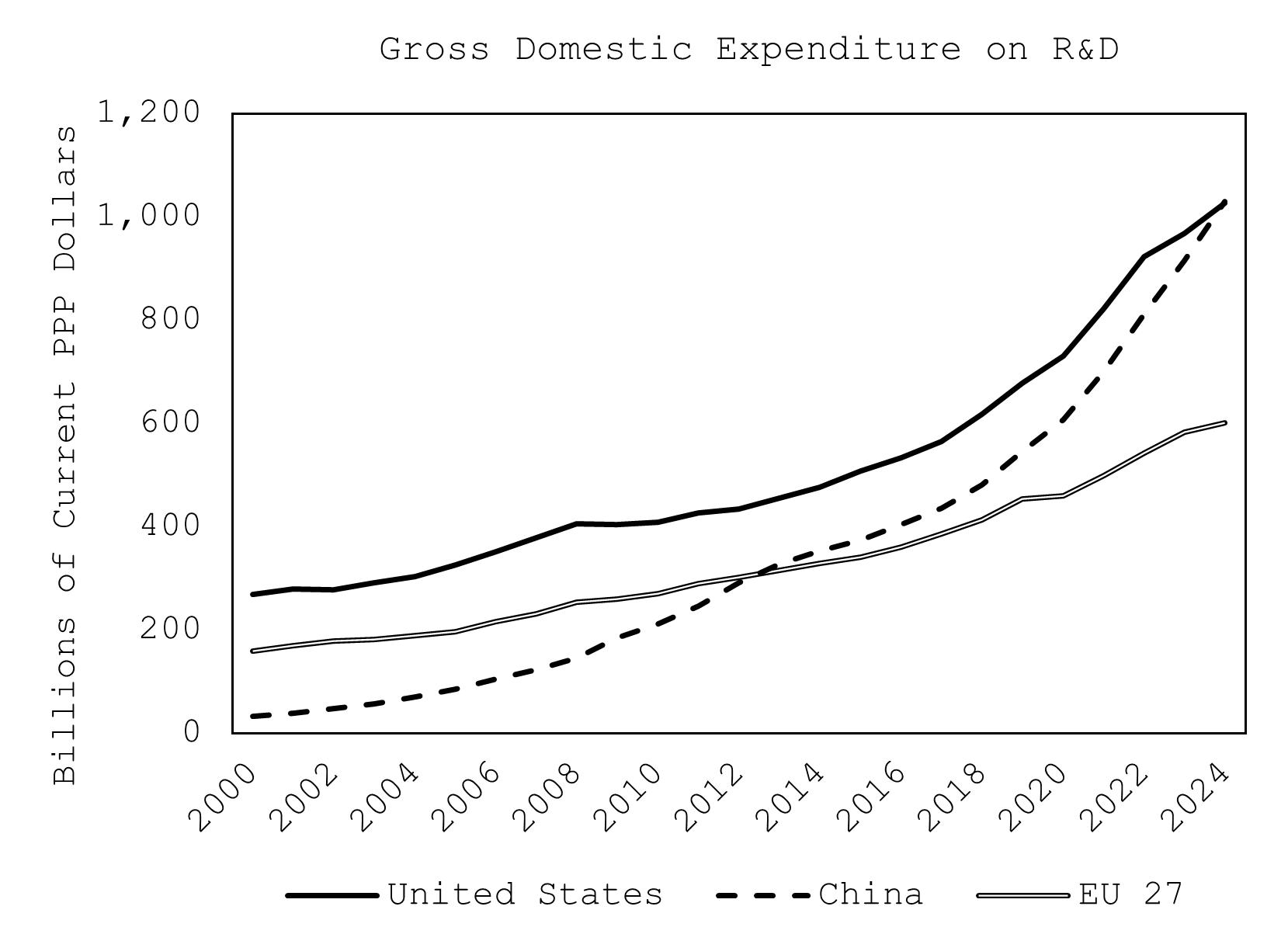
d since 1945, are losing ground to competitors who’ve learned to exploit the asymmetries between open and closed research systems. The report’s central claim: U.S. productivity is declining even as China reaches R&D spending parity, and the fix requires reconnecting discovery with domestic manufacturing.
The diagnosis is stark. Pharmaceutical R&D efficiency has fallen 80-fold since 1950 in inflation-adjusted terms. The number of researchers needed to double semiconductor transistor density has risen 18-fold since the 1970s. Drug approvals have flatlined despite surging NIH budgets. Researchers now spend nearly half their time on paperwork rather than science. Universities extract 40 percent overhead rates to fund administrative expansion while the average age of first-time NIH investigators has climbed from 36 to 42, delaying independence for young scientists.


The China Problem
The report frames these failures against a geopolitical backdrop that didn’t exist during the Cold War. China has reached R&D spending parity with the United States on a purchasing-power basis and takes an “all-of-society approach” to capturing strategic technologies, tightly integrating government directives with private sector execution. Beijing treats scientific capacity as “a central pillar of global competition, elevating decision-making to the highest level.”
More consequential is what the report calls a “deep asymmetry”: competitors use America’s open education system as “an entry point into our innovation base” while maintaining closed domestic programs that restrict reciprocal access. About half of U.S. doctoral graduates in computer science and mathematics are temporary visa holders—meaning taxpayer-funded training may ultimately benefit rival nations. The report notes that foreign governments exploit U.S. universities to harvest data and recruit talent back to build their own technological enterprises.
The response includes a proposed ban on using federal funds for “bilateral or multilateral collaborations” with “covered foreign countries” without specific national-interest exceptions. A separate OMB rule, published in May and now under review, would codify these restrictions across all federal research agencies
Discovery Without Manufacturing
But the report’s most pointed critique targets something closer to home: the severing of science from industrial capacity. “Discovery without domestic manufacturing leaves America paying the research bill while rivals develop the process improvements and capture the economic, strategic, and knowledge returns,” it argues. The U.S. invented flat-panel displays and lithium-ion batteries; both technologies scaled abroad because manufacturing had already moved offshore.
The report rejects the “linear model” that assumed basic research in academia would naturally flow to applied development and then industry. Instead, it describes an “iterative loop” where manufacturing constraints expose new scientific questions. When production moves overseas, American scientists lose access to the practical problems that inspire new research, while foreign rivals gain the process knowledge—encoded in the hands of workers—that sustains long-term technological leadership.
To rebuild this connection, the report calls for integrating “hands-on training” into STEM curricula, creating national fellowships for skilled craftspeople, and establishing practitioner-in-residence programs that embed machinists and technicians alongside Ph.D. researchers. It envisions expanding regional innovation hubs that keep discovery and production geographically close, modeled on historical clusters like Detroit for automotive engineering.
AI as Force Multiplier
The report’s centerpiece is the “Genesis Mission,” a national AI initiative launched by executive order last November that aims to integrate supercomputers, AI models, and datasets across Department of Energy national laboratories to “double the productivity and impact of U.S. science within a decade.” The vision: AI-driven autonomous laboratories that collapse drug discovery timelines “by orders of magnitude” and AI verification systems that automatically audit published papers for reproducibility.


But the report acknowledges a constraint: “Even the most capable AI models will be slowed down in the bottleneck of institutions and systems built for the last century.” The implication is that institutional reform and AI deployment are inseparable—you can’t have one without the other.
The Peer Review Question
To break institutional gridlock, the report recommends “golden ticket” mechanisms where single reviewers can champion unconventional proposals, fast grants with 48-hour decisions, and scaling “X-Labs”—agile teams tackling specific bottlenecks without university overhead. It calls for empowering individual program managers to make bold bets without committee consensus, modeled on DARPA’s approach during the Cold War.
The parallel regulatory effort goes further. The proposed OMB rule instructs senior appointees that they “must not ministerially ratify or routinely defer to the recommendations of others”—meaning peer review becomes advisory rather than binding. All discretionary research awards must “demonstrably advance the President’s policy priorities.” Applicants must commit to “Gold Standard Science,” a term Kratsios defined in May 2025 as research free from “political biases” including diversity initiatives.
The public comment period drew nearly 500,000 submissions; of the roughly 51,000 comments analyzed so far, about 94 percent were in opposition. But legal experts are divided on the rule’s prospects: several have flagged First Amendment and administrative-law vulnerabilities, while others note that formal notice-and-comment rulemaking is procedurally harder to unwind than an executive order alone.

The Framework: Stewardship as Civilizational Requirement
The deepest argument in the Kratsios report is this: a republic cannot sustain the conditions of ordered liberty if it does not ensure that the knowledge its citizens produce, the institutions it builds, and the talent it develops first serve the citizens themselves.
This is not protectionism. It is stewardship—the recognition that a civilization is a trust extending across generations. Those who inherit it have an obligation to preserve and strengthen it, not to allow its foundations to erode through institutional indifference.
The Return to National Mission
The Kratsios report's invocation of the Manhattan Project and Apollo Program makes a single claim: American civilization achieves its greatest scientific breakthroughs when discovery, manufacture, and national purpose are unified under a clear mission. That coherence has been lost. The question now is whether the nation can recover it—whether it can pursue technological dominance, manufacturing restoration, and scientific renewal with the same unified will that once took Americans to the moon. If it cannot, American scientific leadership will remain a hollow achievement: discoveries made at home, returns captured elsewhere, talent trained for foreign powers.