


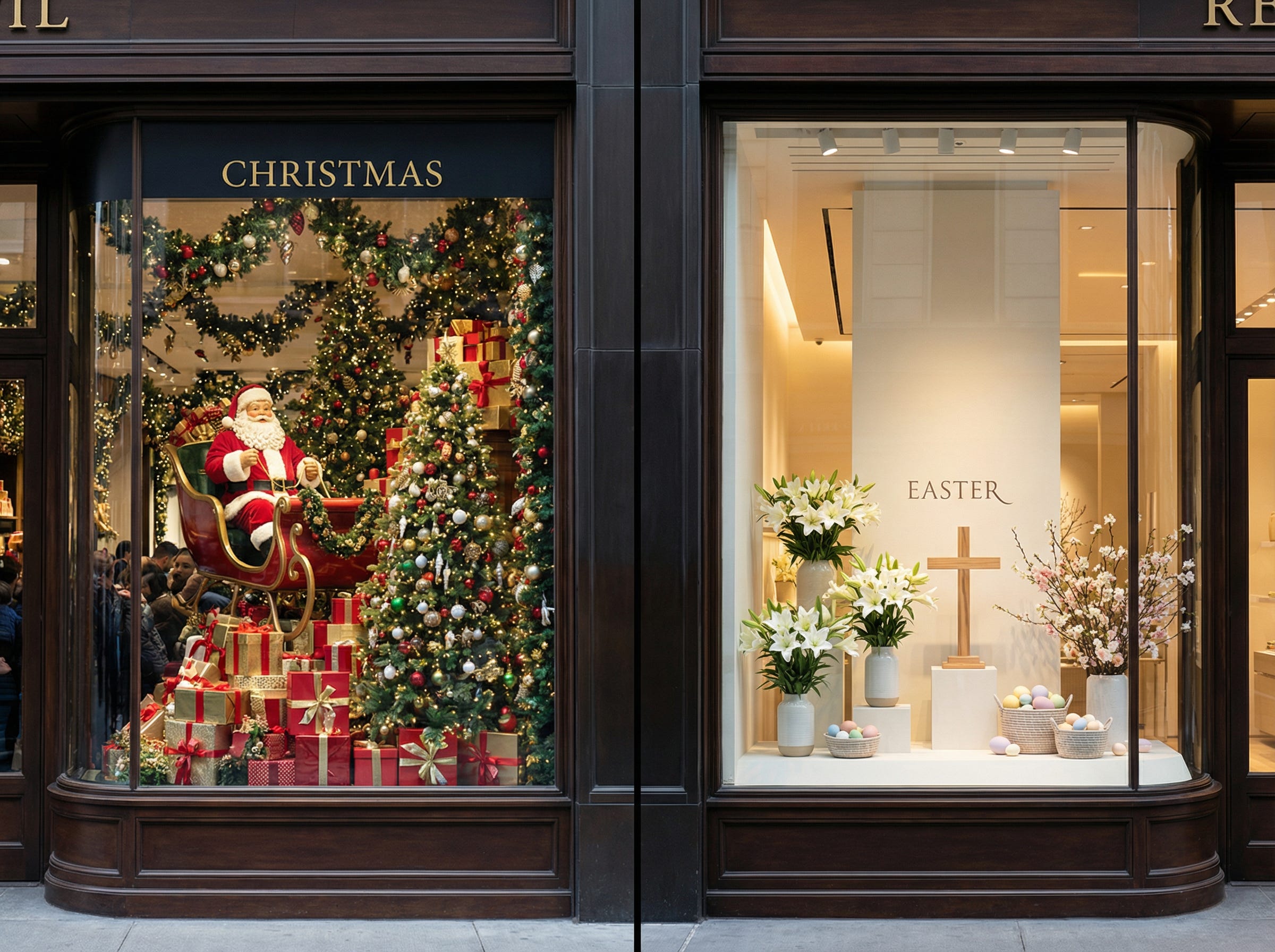
This morning, millions of Americans will attend church for Easter Sunday. Church attendance today will be two to three times higher than an average Sunday, filling sanctuaries from coast to coast. Many dioceses are reporting record-breaking conversions at this year’s Easter Vigil. Newark saw 1,701 people join the Catholic Church, a 30% jump from last year. Oklahoma City recorded a 57% increase. Philadelphia’s cathedral overflowed with new catechumens.
Yet if you walked through most of America yesterday, you wouldn’t have known Easter was approaching. No Easter movies dominated streaming services. No Easter music filled retail spaces. No multi-week cultural buildup. Americans will spend an estimated $24.9 billion on Easter this year, which sounds substantial until you realize Christmas retail spending surpassed $1 trillion for the first time in 2025. That’s a 40-to-1 ratio.
For Christianity’s most theologically significant holiday, Easter commands almost zero secular cultural real estate compared to Christmas. The contrast raises an interesting question about what happens when holidays follow different paths.
When Both Holidays Were Suspect
The divergence wasn’t inevitable. Christmas and Easter held roughly equal cultural weight for much of Christian history. But America’s early Puritan settlers objected to both holidays with equal suspicion. They saw feast days as dangerous times when social codes could be violated. Cotton Mather lamented how “the feast of Christ’s nativity is spent in reveling, dicing, carding, masking, and in all licentious liberty.”
Easter faced similar objections. For Puritans and similar Protestant groups, religious holidays smacked of Catholic ritual. The solution was treating all days as equally sacred rather than elevating specific feast days.
So what changed? In the 19th century, Christmas got reinvented as a domestic, family-centered celebration. Easter didn’t.
The Victorian Reinvention
The Christmas we recognize today is largely a Victorian creation. As historian Stephen Nissenbaum documented, the holiday was transformed into a bourgeois celebration centered on childhood and family. Popular writers created the modern template through what amounted to a cultural marketing campaign. Washington Irving’s 1822 Bracebridge Hall referenced “ancient” Christmas traditions that were actually Irving’s inventions. Clement Clarke Moore’s “The Night Before Christmas” appeared the same year. Charles Dickens’s A Christmas Carol followed in 1843.
These works reimagined Christmas as respectable and family-friendly. The holiday became accessible to people with varying levels of religious commitment. You didn’t need to believe in the virgin birth to enjoy a story about gift-giving and childhood wonder. The Nativity scene translated easily into celebrations of family. Nearly everything we associate with Christmas today comes from this 19th-century cultural renovation.
Easter received no such transformation. While it acquired some family-friendly additions like Easter eggs and bunnies, no equivalent cultural movement emerged. Historical analysis shows that at the dawn of the 19th century, English books referenced Christmas and Easter roughly equally. By the 1860s, Easter references had dropped to half that of Christmas. By 2000, Christmas was referenced almost four times as often.
Why Easter Resisted
The divergence reflects structural differences between the holidays. Christmas celebrates a birth, which translates smoothly into broader celebration. The story requires minimal theological commitment. Whether you believe in the virgin birth or not, you can appreciate that a person named Jesus was probably born, and births are worth celebrating. The imagery of mothers and infants works perfectly for a child-centered holiday.
Easter is about an adult man who was executed, then rose from the dead. The supernatural elements sit front and center. You either believe a man conquered death or you don’t. There’s less comfortable middle ground for casual participation.
The mechanics reinforce this. Easter is a moveable feast, varying within a 35-day range depending on lunar calculations. Retailers struggle to build sustained campaigns when the target date shifts annually. Christmas sits fixed on December 25, allowing multi-week buildups and predictable planning.
Gift-giving creates another difference. Christmas became synonymous with presents, which drove commercial investment. Easter has no equivalent gift-giving tradition. Without that engine, retailers had less incentive to invest in Easter’s cultural expansion.
The Paradox of Preservation
Here’s what’s interesting about Easter’s commercial failure. By resisting secularization, the holiday may have preserved something valuable. Father Dennis Gill, who oversees conversion programs for the Archdiocese of Philadelphia, told the National Catholic Register that recent converts show unusual commitment. “I have noticed over the last several years that there is a greater commitment to conversion, a greater commitment to the Church, when they arrive.”
The record conversion numbers suggest Easter retains serious appeal precisely because it hasn’t been culturally diluted. While surveys show more people leaving the Catholic Church than entering overall, the conversion data reveals something else happening. “While we may see a decrease in cultural Catholicism, we see an increase in people becoming Catholics by personal choice,” said Father Juan Ochoa of the Archdiocese of Los Angeles, which expects a 54% increase in converts this Easter.
Easter’s cultural invisibility creates a different dynamic. If you’re celebrating Easter, you’re probably doing so intentionally. The broader culture isn’t pulling you along. There are no Easter bonuses at work, no monthlong marketing blitz making participation feel expected. The holiday exists for those who seek it out.
Edward Trendowski, director of the Office of Faith Formation for the Diocese of Providence, described unusual spiritual openness among people coming to the Church. “People seem to be more spiritually open,” he observed. “We know deep down that there’s something more. People are looking for something deeper.”
Multiple dioceses report that new converts skew younger, often in their twenties and thirties. Barbara Ferreris, director of faith formation at Sacred Heart Catholic Church in Tampa, explained the pattern simply. “They have the career. They have the home, the car. They’re searching for more.”
These aren’t people who grew up with Easter as ambient cultural background. They’re coming to it deliberately, often after trying what secular culture offers and finding it insufficient.
Different Paths, Different Outcomes
Christmas demonstrates what happens when a religious holiday gets thoroughly adapted for broad cultural participation. The culture embraced it, retailers invested in it, and it became a massive shared experience that accommodates everyone from devout believers to casual celebrants.
Easter shows what happens when a holiday remains primarily religious. The culture largely ignores it, which means the holiday stays weird, supernatural, and unavoidably theological. You can’t celebrate Easter casually the way you can Christmas. The resurrection is either true or it isn’t.
This makes Easter a different kind of test. The people filling churches this morning made deliberate choices. The converts joining the Church at Easter Vigils yesterday chose something the broader culture neither validates nor particularly notices.
As Americans return to work tomorrow, most won’t notice Easter has passed. The culture will move on without Easter parties or Easter retail analysis. But for those who marked today deliberately, that cultural indifference might be precisely the point. The holiday that never got commercialized retained the strangeness that makes religious claims compelling in the first place.
Both paths have value. Christmas reaches millions through cultural accessibility. Easter reaches fewer but demands more. The contrast reveals less about which approach is better than about what different holidays can accomplish when they take different routes through American culture.
No doubt Christmas is the runaway winner with commercialization but, as a lifetime retail worker, I would put Easter in the #3 spot after Halloween. It was a bit of a shock to me to see just how commercialized it was as Easter was a pretty low-key event growing up.