


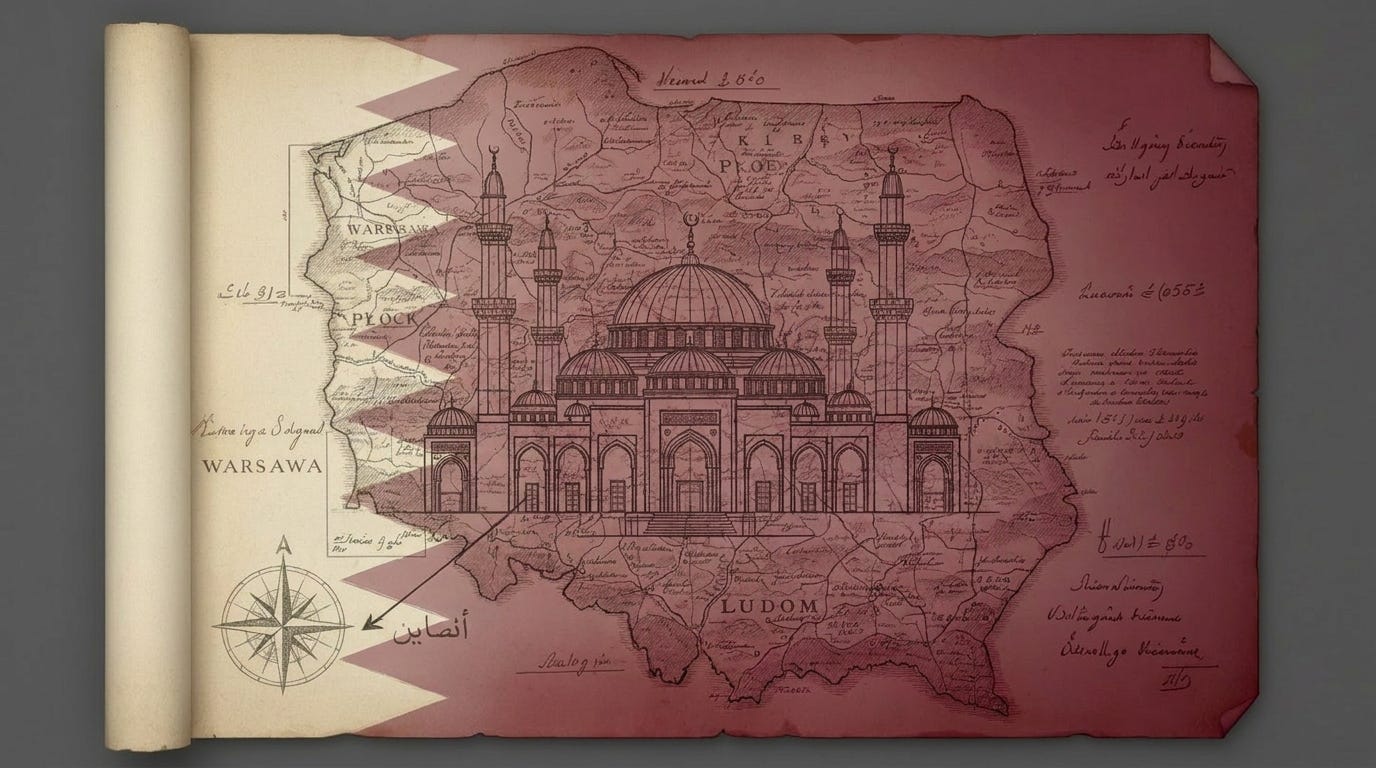
Qatar Charity, the Doha-funded NGO at the center of two leaked European document troves, has channeled roughly €2 million into at least six Islamic projects in Poland — including the flagship Warsaw mosque run by the Muslim League in the Republic of Poland (Liga Muzułmańska), an organization Wikipedia describes as a “branch of a worldwide Muslim Brotherhood organization.”
The disclosure, amplified this week by Visegrád 24 and grounded in the 2020 ICSR study and the Qatar Papers investigation by French journalists Christian Chesnot and Georges Malbrunot, lands as Strasbourg’s Qatar-supported “mega-mosque” rises beside the European Parliament. The shock is not the size of the Polish sums but the strategy behind them: Doha is pre-positioning Brotherhood-linked infrastructure inside a Catholic, historically homogeneous country before its Muslim population grows large enough to defend itself politically. Poland, in other words, is being treated as the next European frontier, not the last European holdout.
A Documented European Pattern
The Chesnot–Malbrunot investigation, drawing on leaked Qatar Charity ledgers, identified roughly 140 mosque, school, and Islamic-centre projects bankrolled across Europe. The follow-on report by the International Centre for the Study of Radicalization (ICSR) at King’s College London counted at least 138 such projects, “many related to Muslim Brotherhood associated organizations.” The two French journalists argue that the goal is “to strengthen Islamic identity and help spread and entrench political Islam in Muslim communities throughout Europe.” Qatar Charity formally denies any Brotherhood affiliation.


The Polish Node: Liga Muzułmańska
The principal Qatari counterparty in Poland is the Muslim League, a body distinct from the centuries-old Lipka Tatar community that has historically represented Polish Sunni Islam. The League was founded in 2004 by Arab-immigrant doctors and led by the Kuwait-trained pediatrician Samir Ismail. Rzeczpospolita reported in 2009 that Ismail sat on a committee of the Federation of Islamic Organizations in Europe (FIOE) — the federation a U.S.-based research foundation characterised as a “cover-up” that “unites the members of Muslim Brotherhood in Europe.”
The same investigation documented that Ismail’s named FIOE colleague, Walid Abu Shewarib, was simultaneously under inquiry by the Munich prosecutor’s office for “supporting the organizations listed on the EU list of terroristic organizations” via the Belgian branch of the al-Aqsa foundation. Polish authorities, Rzeczpospolita established, did not actually verify the foreign sources financing the Warsaw mosque — the Interior Ministry “does not possess or gather any data” on them.
Strasbourg as the Template
The pattern Doha is exporting eastward is most visible in Strasbourg. The Eyyub Sultan Mosque — a 2,500-capacity complex administered by the Turkish-nationalist Milli Görüş confederation — has been under construction since 2017 at a cost Wikipedia puts at €25 million.
Reporting by the Middle East Forum notes that the project drew a €2.5 million subsidy from Strasbourg’s Green-led city council alongside contributions from Qatar, Morocco, Kuwait and Saudi Arabia — even as the same council dimmed the cathedral’s lights to “save energy.” Then–Interior Minister Gérald Darmanin publicly opposed the subsidy.
Why Poland, Why Now
Qatar’s Polish outlay is modest because Poland’s Muslim population still is. But Doha appears to be following the European script in advance: cultivate a Brotherhood-aligned national federation, fund a flagship cultural centre, secure a foothold in education and youth programming, then scale as demographics shift.
Poland issued more than 94,000 work permits in 2024 to citizens of six Muslim-majority countries — a meaningful inflection for a society that until recently had almost no immigrant Muslim presence outside the Tatar community. The infrastructure is being laid before the population arrives.
The Faultline
The danger to Polish civic life is not the existence of mosques, nor the presence of practicing Muslims. It is the slow capture of religious representation by a foreign-funded, ideologically distinct stratum that bypasses the established Tatar community and answers — financially and institutionally — to networks documented by French, German and British investigators.
Strasbourg’s cathedral did not go dark by accident; the city’s Green council made a choice, one subsidy and one switch at a time. Poland, for now, still has the option to refuse the same trade. Whether it does will depend on whether Warsaw treats foreign religious financing as the strategic question it is — or, as in 2009, simply admits it has no idea who is paying.
Another key consideration is that many European countries have a negative fertility rate among the native-born and this alone could be key to future demographics.