


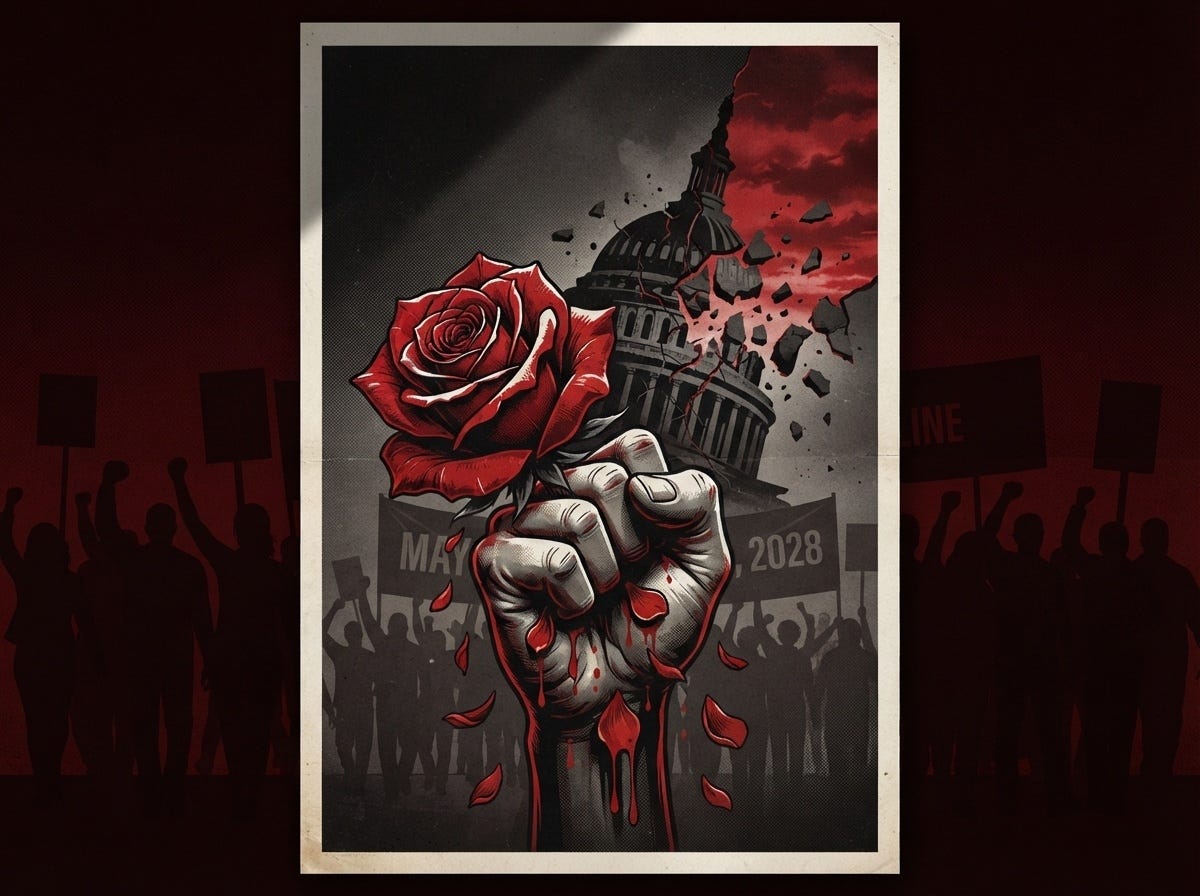
At the Young Democratic Socialists of America convention in Chicago July 31 through August 2, delegates elected two Bread & Roses–backed organizers — Mae Bracelin and James Hernández — as YDSA co-chairs, seating them with full votes on DSA's 27-member National Political Committee, its governing board. The elections, and Bracelin's on-camera statements, were first surfaced by investigative journalist Stu Smith.

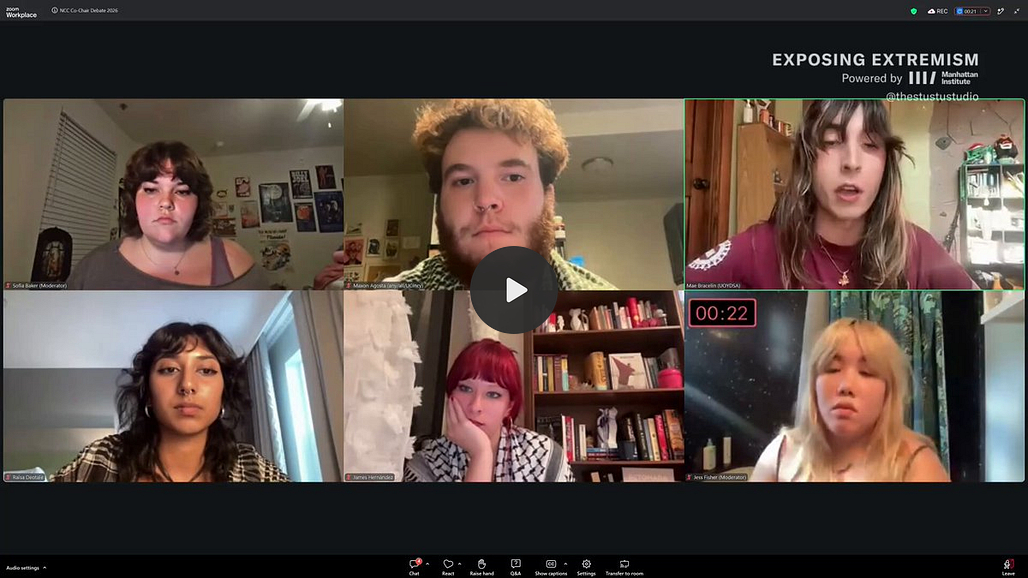
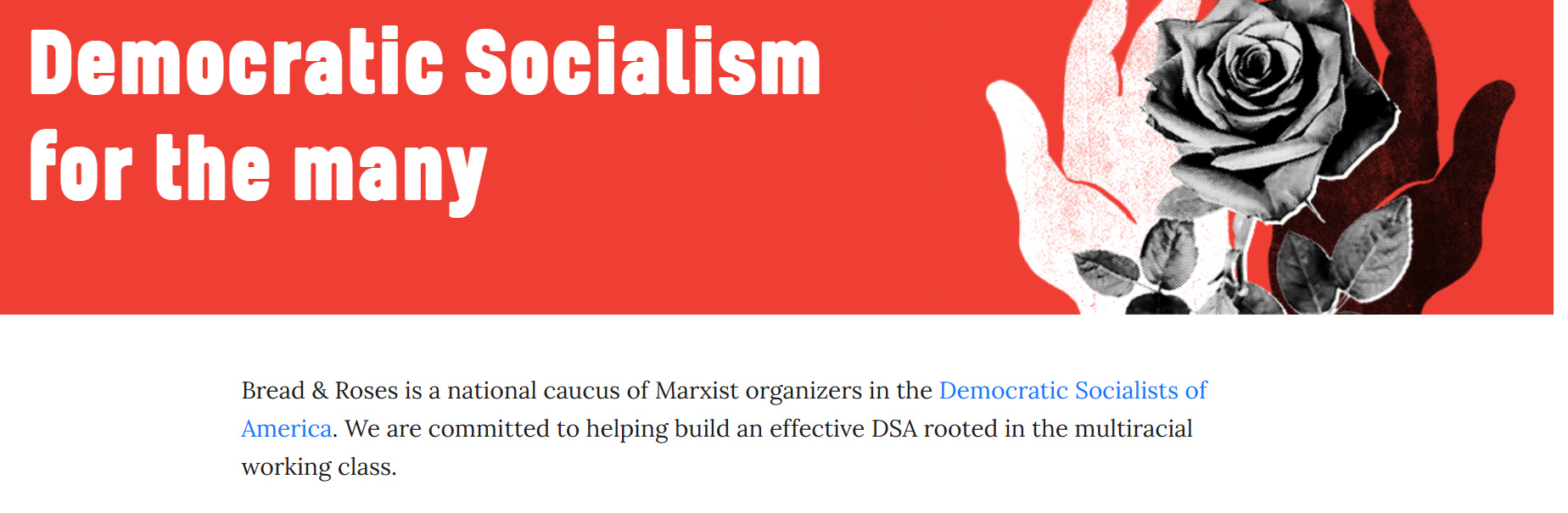
They ran on the Bread & Roses slate, whose platform commits to building the coordinated May Day 2028 general strike now backed by the UAW and to breaking the labor movement's dependence on — and eventually supplanting — the Democratic Party. Their caucus describes itself on its own website as "a national caucus of Marxist organizers" and calls in its platform for an electoral strategy "completely independent from the Democratic Party apparatus."
Earlier this year, DSA's National Political Committee voted to adopt a platform calling to abolish the U.S. Senate, replace the President and Supreme Court, and defund the police — the same governing body Bracelin and Hernández now sit on.
The May Day 2028 Plan Is Real
The coordinated general strike in May 2028 is not aspirational rhetoric, it already includes an auto union and teacher’s union, according to the DSA. The United Auto Workers(UAW) President Shawn Fain has confirmed the union “aligned our contracts to expire at midnight on April 30, 2028” and is “fully preparing to strike on May Day 2028.” The American Federation of Teachers, representing 1.8 million workers, voted at its 2024 convention to join the effort. The UAW has launched a dedicated campaign, may1.uaw.org, asking every union in the country to align contract expirations to the same date.
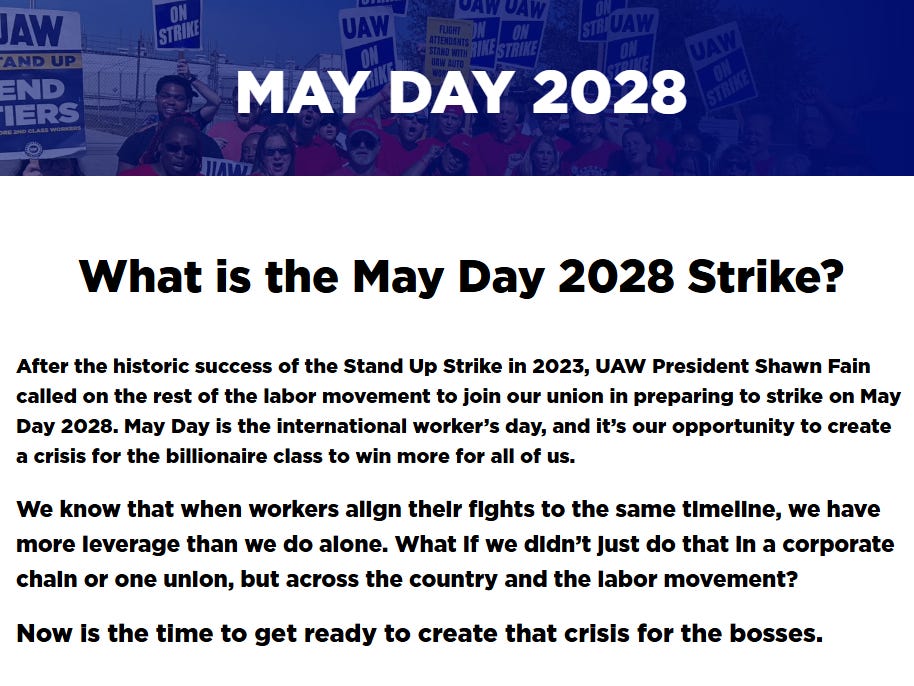
A strategy paper authored by a YDSA National Coordinating Committee member — the youth wing's elected leadership body — and published on the group’s website frames the goal explicitly: use the strike to build “an independent working-class party capable of supplanting the Democratic Party.”
The Salting Pipeline
YDSA has also passed R13-1, which directs the organization to “encourage students to get jobs in one of the RFS’s three strategic industries — teaching, nursing and logistics — to build lifelong organizers.” The resolution formally links YDSA to DSA’s Workers Organizing Workers committee, which the document notes “largely focuses on recruiting for salting at Amazon.” Salting, as described by DSA members themselves, means “getting jobs” at “targeted unorganized workplaces” specifically “with the intent of forming a union.”
At YDSA’s March 2026 organizing conference, Jacobin reported, more than 65 percent of the 400 attendees signed pledges to “industrialize” into strategic sectors after graduation. Bracelin herself was featured at the conference, describing the University of Oregon student worker strike as the prototype.
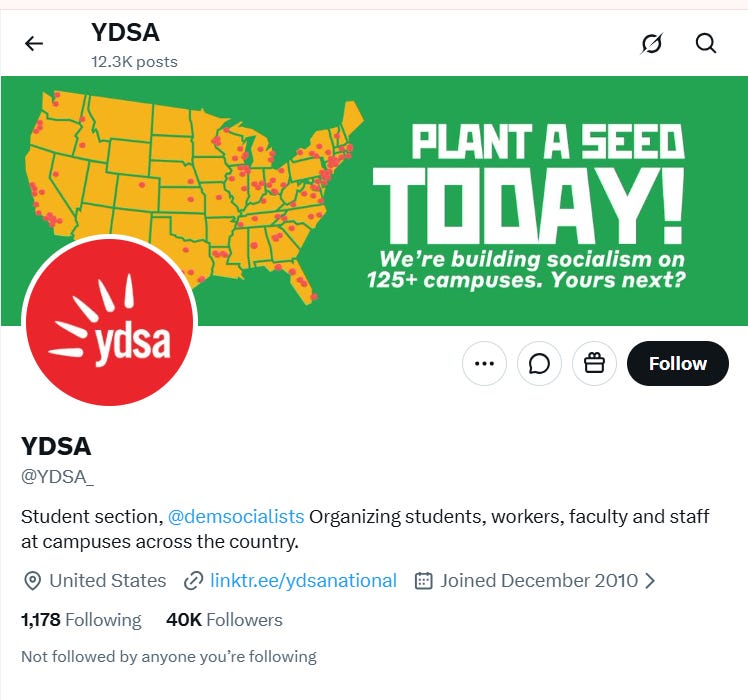
The Bracelin Playbook
Bracelin, the former president of University of Oregon Student Workers (UAW Local 8121), has said on camera that her union "did a lot of militancy, did a lot of direct action, broke a lot of rules and we won." The Nation documented how striking workers disrupted a summit with the dean of students, set up a campus lawn encampment, and staged a sit-in in which 54 workers remained in Johnson Hall after it closed. Bracelin personally interrupted the dean at the podium with a megaphone.


The same UO YDSA chapter that built Local 8121 also co-founded University of Oregon Students for Justice in Palestine after October 7, 2023. In a candid essay in The Call, a chapter organizer described “bloc recruiting” the campus Muslim Student Association into SJP and using the union apparatus to advance “BDS demands in bargaining.” Bracelin, then UO YDSA vice president, demanded “an immediate end to Israeli military aid” at a rally days after the Hamas attack.
She has since folded the two movements together explicitly. “As a strike leader, I was proud to have SJP picketing on our picket line,” she said in her co-chair campaign video, “and I got so much shit for that but it was the right thing to do.”
Where the Caucus Stands
The Bread & Roses platform, published on the caucus’s own website under Where We Stand, is unusually direct about its goals. The document self-identifies Bread & Roses as “a Marxist caucus within the Democratic Socialists of America” and calls DSA a “pre-party organization.” It commits the caucus to “an oppositional electoral strategy that remains completely independent from the Democratic Party apparatus,” rejecting “the idea that socialists can capture the Democratic Party” and pledging instead to “break unions and social movements from their current dependence” on it.
On the transition itself, it warns:
”A party can even help foment a crisis, through helping to build powerful movements from below — millions of people acting on their own behalf in strikes, workplace takeovers, student occupations, and mass demonstrations — and by electing a socialist government. Such mobilizations and such a government would together be able to create a rupture with the capitalist system. And since no ruling class has ever peacefully ceded power, in a transitional period a socialist government backed by popular mobilizations will have to do everything necessary to defend the mandate they have won to carry out a program of redistribution, expropriation, and democratic reform of state institutions.”
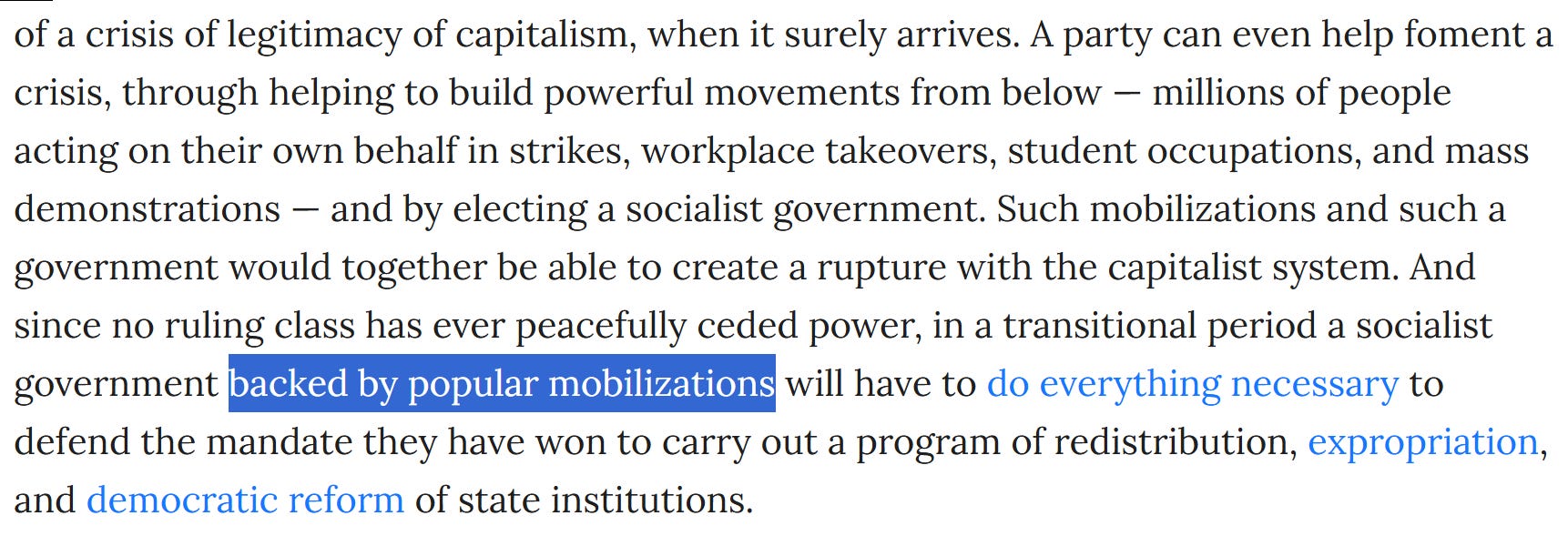
Bracelin and Hernández were elected on that platform.
A Caucus Consolidates
The Bread & Roses caucus now holds four seats on DSA’s 27-member National Political Committee, tied for the largest bloc, according to NPC records. Its self-description is a “national caucus of Marxist organizers” fighting for a “militant, left-wing” labor movement and “an independent class politics.” With Bracelin and Hernández added, the caucus now controls both YDSA co-chair seats and the pipeline that produces DSA’s next generation of organizers.
Hernández has spelled out the international dimension. “We need a long-term strategy,” he told Jacobin. “One horizon we discussed is May Day 2028, organizing youth internationally around coordinated anti-fascist action. That means building real rank-and-file relationships across borders.” He has also argued YDSA’s mission is to “dismantle U.S. imperialism and capitalism.”
What Comes Next
The infrastructure is now openly documented: aligned union contracts expiring at midnight on April 30, 2028; a rank-and-file pipeline funneling YDSA graduates into Amazon, K-12 schools, hospitals and logistics; a fused pro-Palestine and labor operation modeled at the University of Oregon; and a governing board on which the caucus building all of it now holds a plurality. The organizers themselves are not hiding it. They are publishing the resolutions, giving the interviews, and — as Bracelin put it in her own words — organizing to break rules and win.
Twenty-one months remain.
Germans in the 1920s dismissed Mein Kampf as the writings of a lunatic, that didn't work out so well. We Americans cannot afford to laugh at these proposals, either. The similarities between the rise of Hitler and the DSA are positively eerie.