



Secretary of War Pete Hegseth announced October 23 that the Pentagon had designated Confucius Institutes, Chinese government-backed language and cultural centers, a national security threat. He said successor organizations had appeared on American campuses under different names after earlier restrictions.
Hegseth described “80 new propaganda cells” at 30 universities and said the department had dismantled them over the preceding two months. The announcement brings renewed attention to how Chinese educational programs have adapted as Washington tightened restrictions on university partnerships.
The department’s published audit results document a broader campaign against foreign relationships considered research-security risks. Separately, organizational records show how some former Confucius Institute programs continued through nonprofits and other educational partners.


Audits Across American Universities
The Pentagon ordered 30 academic institutions on August 17 to review their academic, financial, and research collaborations with foreign entities of concern. The review covered institutions on its Section 1286 restricted list and organizations associated with rebranded Confucius Institutes.
Universities were directed to assess whether sensitive or export-controlled research was exposed, implement mitigation measures, and report their findings by August 31. The department said the effort was intended to protect taxpayer-funded research from unauthorized technology transfers, intellectual-property theft, and foreign exploitation.
In an October 19 release, the department said all 30 universities had addressed the identified relationships with listed foreign entities. It reported more than 80 termination-related actions, including precautionary terminations involving organizations not specifically on the restricted list.
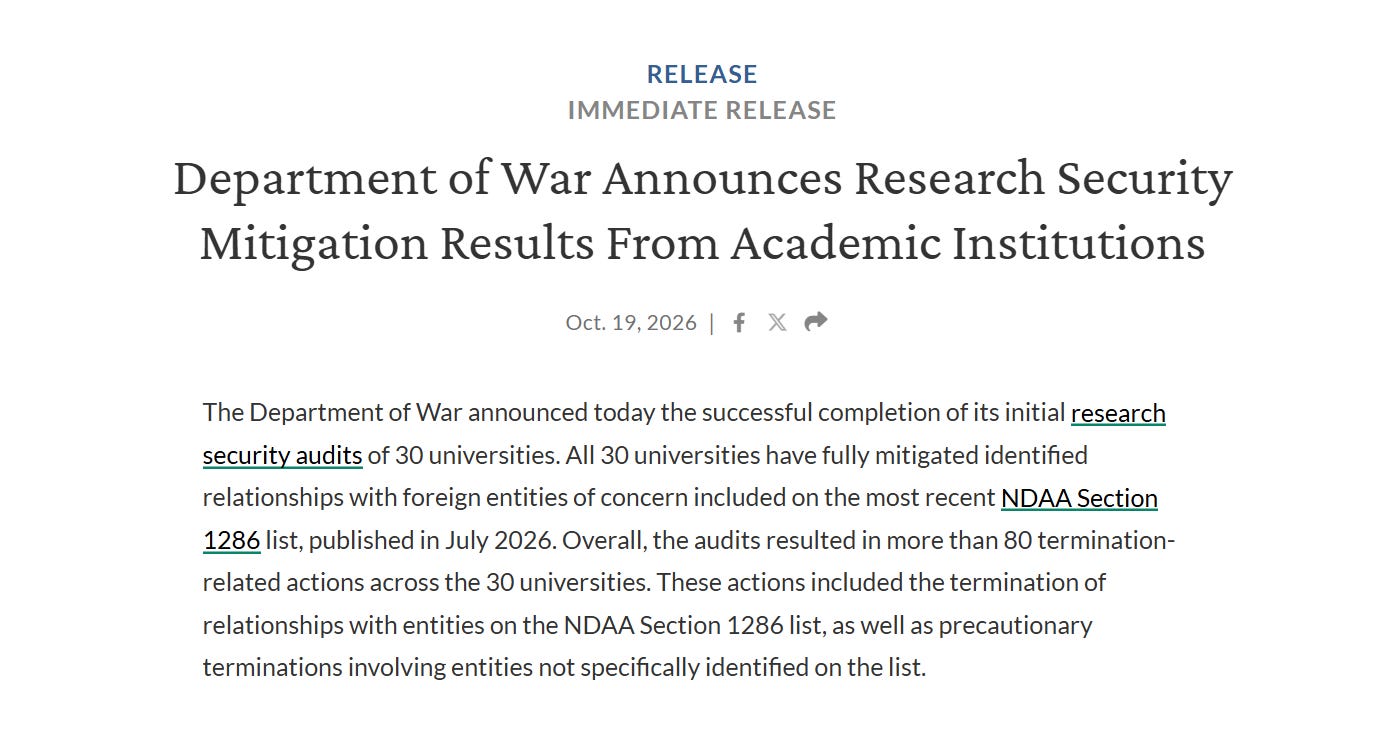
The release did not identify all those actions as Confucius Institute closures. It praised Oklahoma State, Penn State, UNC Chapel Hill, the University of South Carolina, USC, UT Austin, and Virginia Tech for taking steps beyond minimum compliance.
According to DefenseScoop, which obtained the full list from a U.S. official, the audited institutions also included Harvard, MIT, UC Berkeley, Cornell, Georgetown, Johns Hopkins, and NYU.
Funding Restrictions Tighten
A key federal enforcement tool is access to defense funding. An existing law, Section 1062 of the fiscal 2021 National Defense Authorization Act, as amended, prohibits Pentagon funding to higher-education institutions hosting Confucius Institutes, apart from educational assistance paid directly to students.
Congress expanded the definition in 2023 to include programs receiving funding or support from the Chinese International Education Foundation or the Chinese Education Ministry’s Center for Language Exchange Cooperation. It also covers cultural institutes funded by the Chinese government. Changing a program’s name therefore does not, by itself, remove it from the restriction.
A further deadline passed this month. The authority to issue waivers expired October 1, 2026, and previously issued waivers no longer apply. The Pentagon’s current procurement rule reflects those provisions.
Separate restrictions apply to Pentagon-funded fundamental research involving entities on the Section 1286 list. Together, the measures place universities’ foreign partnerships under scrutiny when federal defense research money is involved.
Crosscurrents previously reported that the American Association of State Colleges and Universities plans to bring university leaders to Beijing for October 28–31 events aimed at building partnerships with Chinese universities. Its existing China exchange network includes Chongqing University, an institution on the Pentagon’s Section 1286 research-security list.
University Group Plans China Partnership Push Weeks After Pentagon Research-Security Crackdown

An association representing the sector of more than 500 American regional public colleges, universities and systems is preparing to bring university leaders to China for meetings explicitly designed to build new partnerships, weeks after the Pentagon ordered U.S. schools to review ties with foreign institutions it says pose national-securit…
Programs Continued After Closures
The original campus network had already contracted sharply. An October 2023 Government Accountability Office report found that the number of Confucius Institutes at American colleges and universities fell from about 100 in 2019 to fewer than five. Schools frequently cited the potential loss of federal funding as a reason for closing.
Some schools reported using their own academic departments, U.S. government programs, or Taiwanese support to provide Chinese-language and cultural programming after the closures. Others reported receiving support from their former Chinese partner institutions. The continuation of Chinese-language teaching alone does not establish that a Confucius Institute survived under a new name.
Other organizations, however, explicitly describe continuing former Confucius Institute programming. An October 21 report by the Foundation for Defense of Democracies examined several such arrangements involving American K–12 education.
A September 2025 profile published by Beijing Language and Culture University said the Virginia-based Center for Bridging Cultures continued and expanded Chinese-language programs previously offered by Confucius Institutes and Confucius Classrooms. It identified the center’s administrative head, Gao Qing, as a former director of George Mason University’s Confucius Institute and the Confucius Institute U.S. Center.
The profile also identified board chairman William Reeder as a former George Mason dean and Confucius Institute board official. It said the nonprofit cooperated with more than 50 schools and educational or cultural institutions.
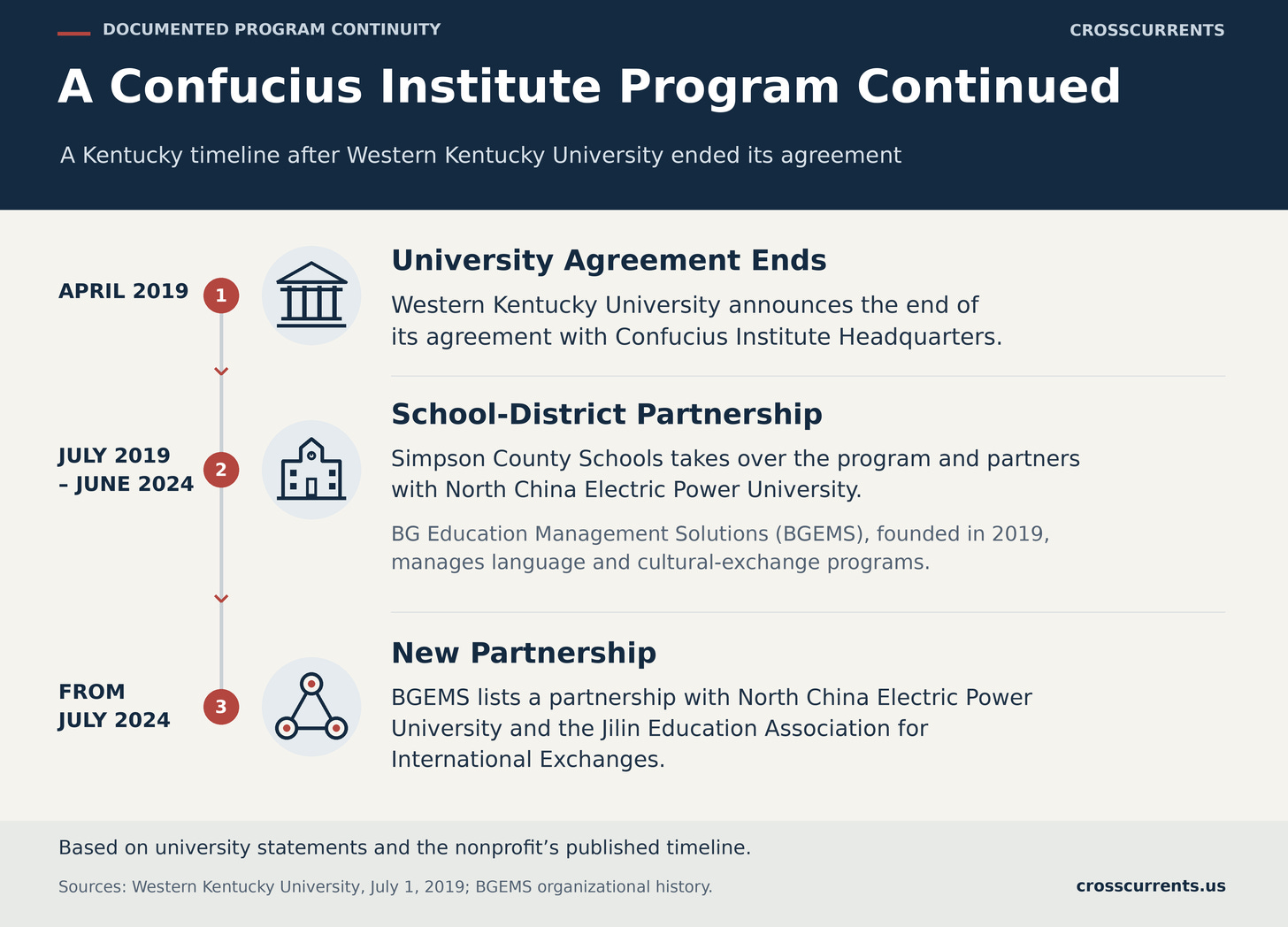
BG Education Management Solutions (BGEMS) provides another documented example. Western Kentucky University reported in July 2019 that Simpson County Schools had taken over the program after the university ended its Confucius Institute agreement. BGEMS’s timeline describes a 2019 partnership between North China Electric Power University and the Simpson County Board of Education.
According to the nonprofit, the partnership with Simpson County ended in June 2024 and was followed by a partnership involving North China Electric Power University, the Jilin Education Association for International Exchanges, and BG Education Management Solutions.
These records establish continuity in personnel, programming, and Chinese institutional relationships. The Pentagon’s published releases do not identify either nonprofit as part of the announced dismantling campaign.
The department says it will continue updating its restricted list and assessing universities that retain problematic relationships. For American education, the documented transfers of programming leave an additional question: how far measures focused on university hosts reach programs that have moved into independent nonprofits and K–12 schools.