


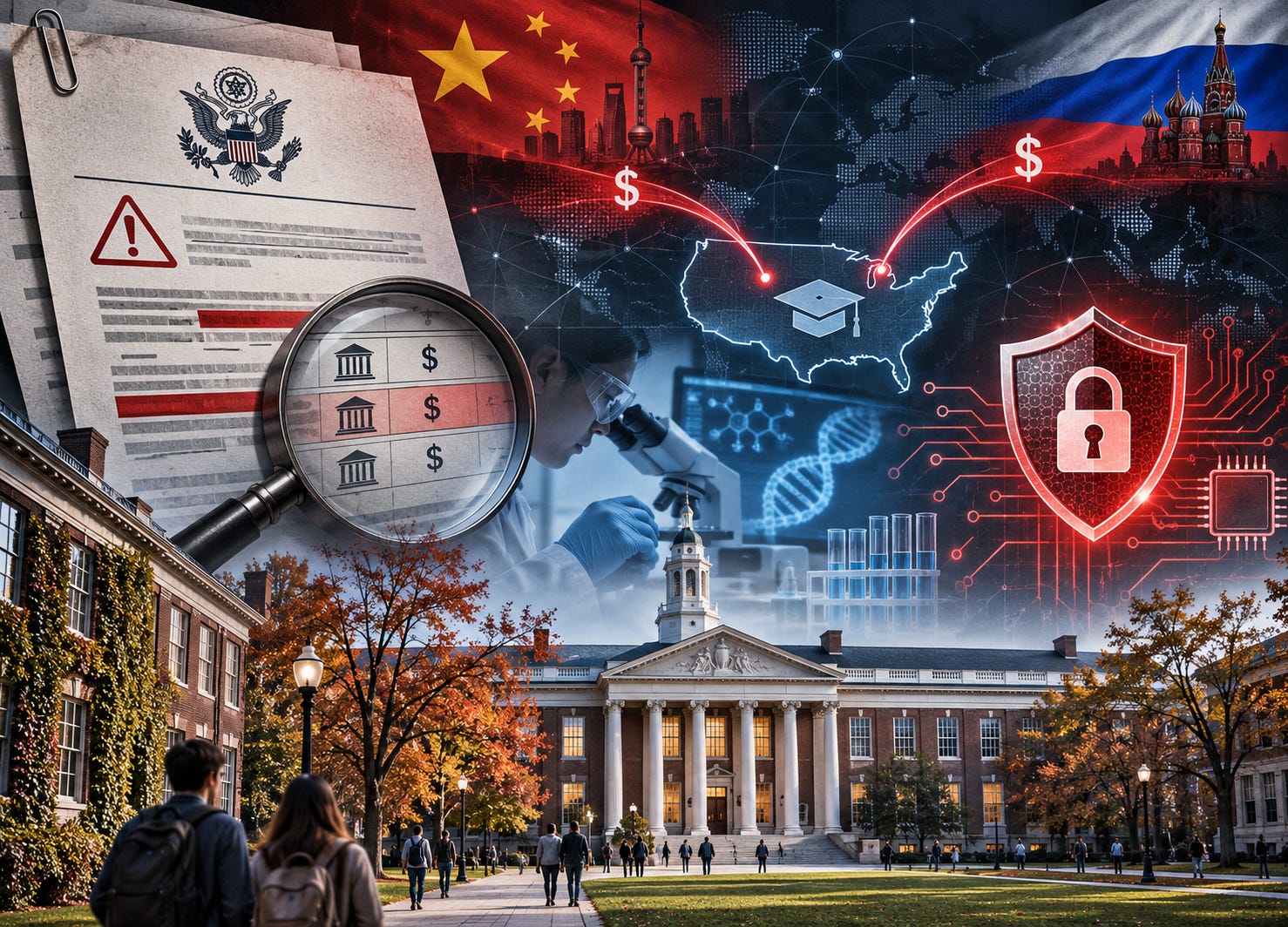
The U.S. Departments of State and Education have warned American universities that nearly $67.4 million in recently reported foreign financial transactions involved entities appearing on federal watchlists, as Washington intensifies scrutiny of international research partnerships and foreign funding at taxpayer-supported institutions.
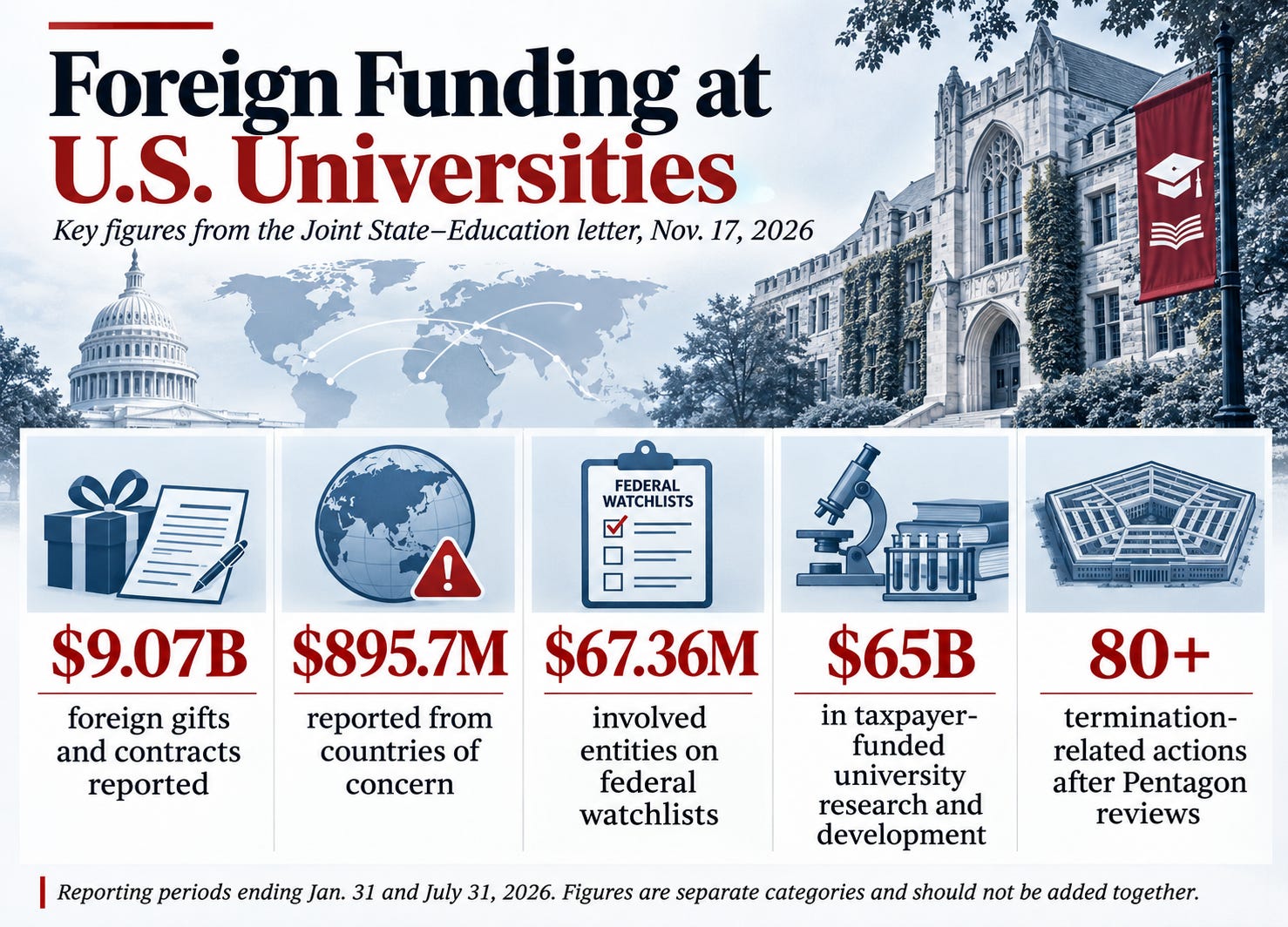
In a November 17 letter addressed to university presidents and governing boards, the agencies disclosed that American colleges and universities reported more than $9.07 billion in foreign gifts and contracts across the reporting periods ending January 31 and July 31, 2026. These figures reflect transactions disclosed during the two reporting cycles, not necessarily money received during 2026 alone.
Of that amount, approximately $895.7 million was reported from federally designated countries of concern, including China, Russia and North Korea. Another $67.36 million involved foreign counterparties appearing on at least one of ten U.S. government watchlists.
The warning comes amid an expanding federal campaign to identify potentially dangerous academic partnerships. The Pentagon reported in October that reviews of 30 American universities had produced more than 80 actions involving the termination of foreign institutional relationships.
The letter, signed by State Department Under Secretary Sarah B. Rogers and Education Department Under Secretary Nicholas Kent, urges university executives to conduct internal or independent audits of their foreign financial relationships, including affiliations involving entities and individuals flagged by federal authorities.
Billions in Foreign Funding, Millions Linked to Watchlists
The federal government says American universities receive approximately $65 billion in taxpayer-funded research and development support, placing their international collaborations under increasing national-security scrutiny.
Under Section 117 of the Higher Education Act, institutions must report foreign gifts and contracts totaling at least $250,000 from a particular source within a calendar year.
The latest letter identifies ten government lists used to screen foreign counterparties. They include the Commerce Department’s Entity List, the Pentagon’s lists of Chinese military companies and foreign research institutions, Treasury sanctions lists, and the Justice Department’s Foreign Agents Registration Act registry.
These lists carry different legal implications. Some impose sanctions or export restrictions, while others identify research-security concerns or record legally registered foreign agents.
The letter does not individually identify the universities or counterparties responsible for the newly reported $67.36 million. However, previously released federal records provide examples of substantial financial relationships involving American universities and organizations subsequently identified, or currently appearing, on government lists.
Chinese Military-Linked Institutions Financed American Universities
A July CBS News investigation identified $7.8 million in reported payments involving research institutes affiliated with the Aviation Engine Corporation of China (AECC), a major Chinese aerospace manufacturer supplying engines for military aircraft.
According to the disclosures, Northwestern University received more than $3 million from AECC research institutes between 2017 and 2021. The University of California, Irvine, reported nearly $4 million in contracts between 2018 and 2020, while the University of Connecticut reported approximately $800,000 in contracts spanning 2018 and 2021.
AECC appears on federal restrictions lists because of its involvement in China’s military-industrial sector. The historical transactions do not, by themselves, establish that the universities violated U.S. law.
Other disclosures identified a $22.6 million contract involving Bryant University and the Beijing Institute of Technology, a Chinese institution appearing on federal watchlists. Bryant’s arrangement supported a jointly operated academic program in China.
Meanwhile, CBS reported more than $25 million in historical contracts involving UC Berkeley and watch listed
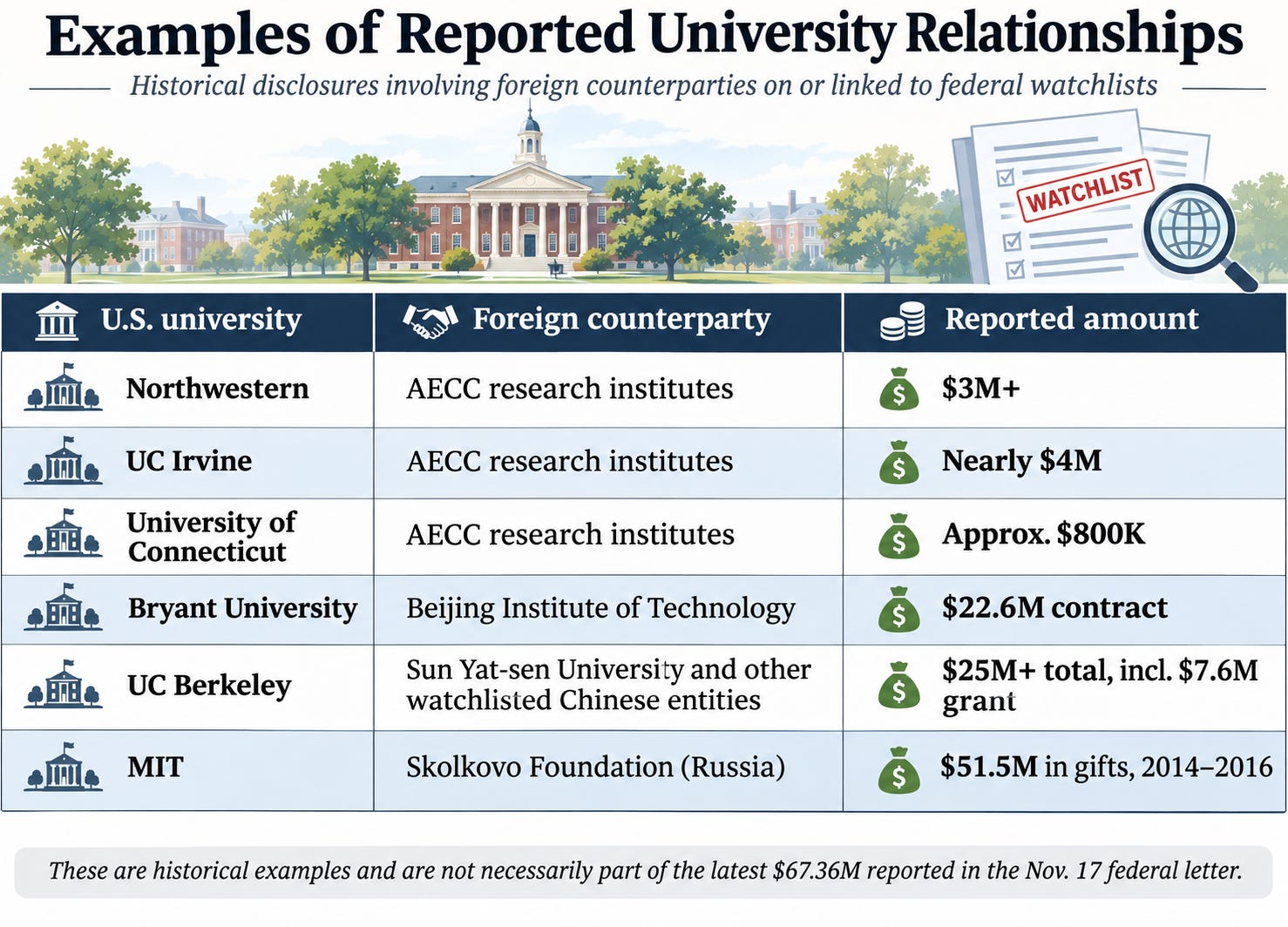
Chinese entities. Among the university’s disclosed financial relationships was what CBS described as a $7.6 million grant from Sun Yat-sen University, which appears on the Pentagon’s research-security list.
These transactions predate the latest federal warning and cannot be assumed to form part of the newly reported $67.36 million.
Fudan University and China’s Overseas Media Network
Among the institutions singled out in the November 17 letter is Fudan University, one of China’s leading universities and a central institution in a recently uncovered Chinese political-media network.
The Pentagon’s July 23 update to its Section 1286 research-security list identified 130 academic and research institutions in China, Russia and Iran. Newly named institutions included Fudan, Shanghai Jiao Tong University, Shandong University, Xidian University, Hangzhou Dianzi University and the Chinese Academy of Sciences.
Fudan also featured in a November 15 Crosscurrents investigation into The China Academy, an English-language political-media platform featuring American academics and U.S.-sanctioned Russian ideologue Aleksandr Dugin.
That investigation documented how Fudan’s China Institute supplied an intellectual foundation for the platform, while a Shanghai production company collaborated with the institute to distribute English-language political programming internationally.
The platform has featured University of Chicago professor John Mearsheimer, Columbia economist Jeffrey Sachs and other American contributors. Dugin, sanctioned by the United States in 2015, previously held a visiting academic role at Fudan.
Fudan’s inclusion on the Pentagon list has already affected American academic relationships. According to an October Washington Post investigation, Oklahoma State University decided to terminate two academic agreements with Fudan, while the University of North Carolina at Chapel Hill ended a study-abroad program.
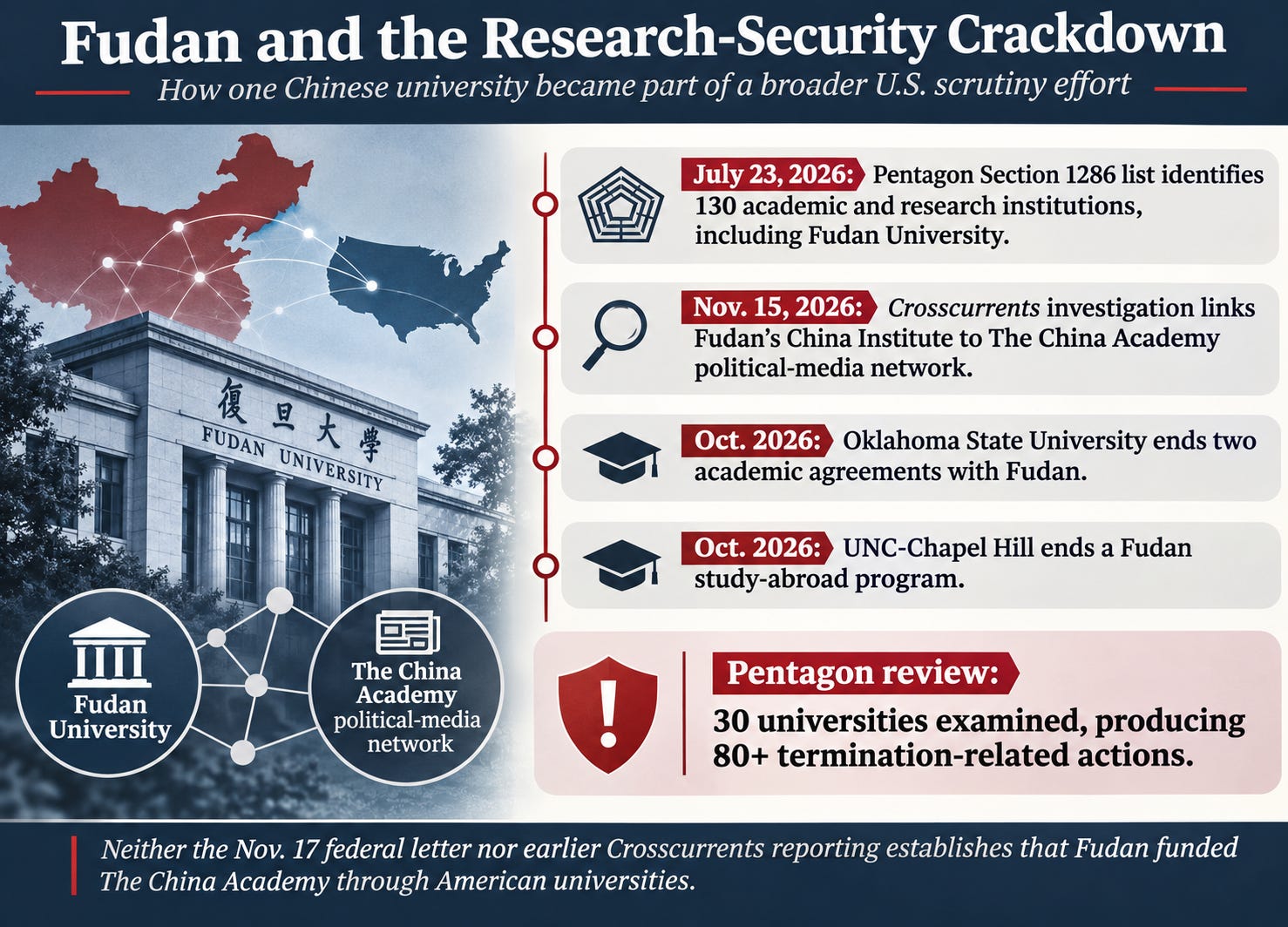
Both institutions said the programs did not involve sensitive or restricted American research. Neither the federal letter nor Crosscurrents’ earlier investigation establishes that Fudan funded The China Academy through American universities.
Pentagon Audits Trigger More Than 80 Termination Actions
The November warning follows a separate federal initiative targeting existing academic collaborations. On August 10, the Pentagon directed 30 American institutions to examine their research, financial and academic relationships with foreign entities of concern.
In an October 19 announcement, the department said all 30 institutions had addressed identified relationships involving entities on the Section 1286 list, resulting in more than 80 termination-related actions.
The actions included both the ending of relationships with listed institutions and precautionary terminations involving organizations not specifically named on the list.
The Pentagon commended seven universities for taking additional measures, including Penn State, Oklahoma State, UNC-Chapel Hill, the University of South Carolina, the University of Southern California, the University of Texas at Austin and Virginia Tech.
Some universities disputed the security implications of their partnerships, arguing that certain collaborations involved student exchanges or academic programs rather than controlled research or military technology.
Nevertheless, the Pentagon warned that institutions maintaining problematic research relationships could jeopardize their eligibility for federal research funding.
Universities Win Court Order Blocking Donor Disclosure
The government’s research-security campaign has also encountered legal resistance.
On November 13, four days before the latest federal warning, U.S. District Judge Tanya Chutkan granted a preliminary injunction sought by the Association of American Universities, blocking the Education Department’s planned publication of covered foreign donor identities.
The association, representing more than 70 research universities, argued that the government had reversed years of assurances that identifying information submitted under Section 117 would remain confidential.
The judge found that the association was likely to succeed on significant aspects of its challenge, including arguments concerning the department’s change in policy and the potential consequences for donor privacy.
The ruling does not eliminate universities’ obligations to report foreign funding to the government. It also leaves intact the department’s earlier publication of 92 foreign entities appearing on federal lists, whose transactions were linked to specific American institutions.
The injunction nevertheless restricts the government’s effort to make additional foreign counterparties publicly identifiable.
For American universities, the immediate implications extend beyond financial disclosure. The November 17 letter urges administrators to investigate counterparties’ affiliates, review individual research relationships and maintain continuing oversight of international collaborations.
With the Pentagon already reporting dozens of terminated institutional relationships, federal scrutiny is moving from identifying foreign financial connections toward determining which universities can maintain them without placing taxpayer-funded research at risk.